Fall of the Western Regions
Tibetan forces capture the Four Garrisons of Anxi, prompting Emperor Gaozong to launch a counter-offensive.
Tang Dynasty (唐朝) · HISTORICAL EVENT
大非川之战
The Battle of Dafei River (大非川之战) was a pivotal strategic confrontation fought between the Tang Empire and the Tibetan Empire from April to August 670 on the northeastern rim of the Tibetan Plateau at Dafeichuan (modern Gonghe County, Qinghai). Following the Tibetan annexation of the loyal Tang vassal state of Tuyuhun and the fall of the Four Garrisons of Anxi, Emperor Gaozong of Tang appointed the renowned general Xue Rengui to lead a field army of over…
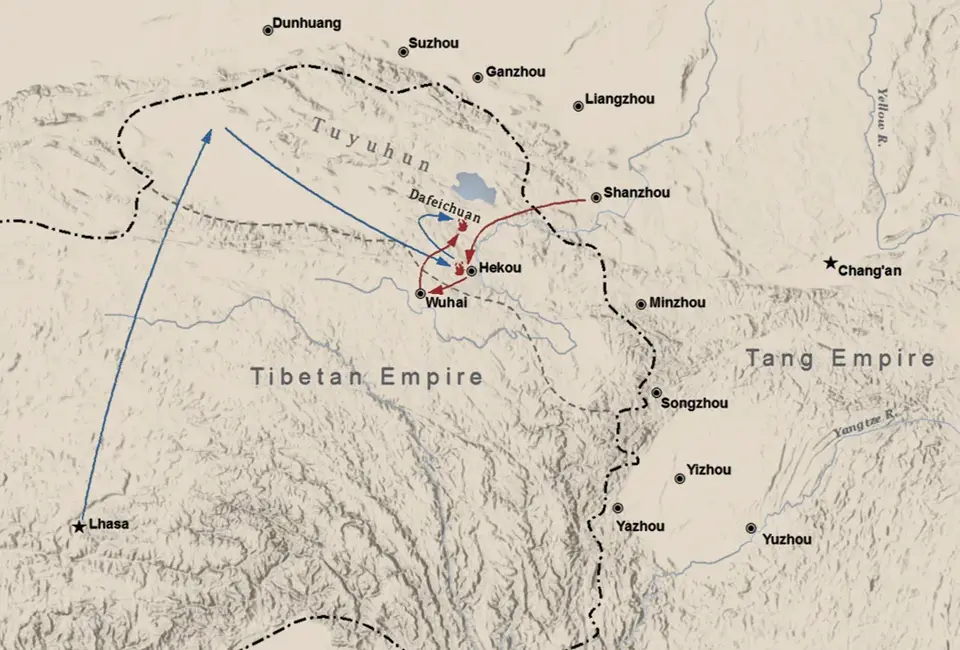
The Battle of Dafei River (大非川之战) was a pivotal strategic confrontation fought between the Tang Empire and the Tibetan Empire from April to August 670 on the northeastern rim of the Tibetan Plateau at Dafeichuan (modern Gonghe County, Qinghai). Following the Tibetan annexation of the loyal Tang vassal state of Tuyuhun and the fall of the Four Garrisons of Anxi, Emperor Gaozong of Tang appointed the renowned general Xue Rengui to lead a field army of over 50,000 veterans to restore the exiled Tuyuhun king and strike into the Tibetan heartland. Operating on high-altitude terrain exceeding 4,000 meters, Xue Rengui executed a swift cavalry strike that secured an initial victory at Hekou. However, his arrogant vice commander, Guo Daifeng, flagrantly violated orders by abandoning the fortified mountain base at Mount Dafei, leading to the complete destruction of the 20,000-strong logistical baggage train by Tibetan prime minister Gar Trinring Tsendro (Lun Qinling). Deprived of supplies, the main Tang army was surrounded at Dafeichuan by over 400,000 Tibetan troops. Suffering overwhelming casualties, Xue Rengui was forced to conclude a humiliating truce to extract his surviving forces. The catastrophic defeat terminated Tang expansion onto the plateau, shifting the empire into long-term defensive containment against Tibet.
Tibetan forces capture the Four Garrisons of Anxi, prompting Emperor Gaozong to launch a counter-offensive.
Xue Rengui is appointed Commander of the Luosuo Circuit Army, with Guo Daifeng and Ashina Daozhen as deputies.
The expedition reaches Dafeichuan; Xue Rengui orders Guo Daifeng to guard the baggage at Mount Dafei while he leads the vanguard.
Xue Rengui's vanguard routes Tibetan defenders at Hekou, capturing livestock and securing the fortress of Lake Wuhai.
Guo Daifeng abandons his post; Lun Qinling ambushes and wipes out the 20,000-man baggage train, capturing all Tang supplies.
Severed from logistical supplies, Xue Rengui abandons Lake Wuhai and conducts an arduous fighting retreat to Dafeichuan.
Lun Qinling masses 400,000 troops to encircle the Tang camp, crushing the defenders in a massive assault.
Xue Rengui concludes an emergency treaty with Lun Qinling, extracting the surviving remnant across the mountains.
Emperor Gaozong strips Xue Rengui, Guo Daifeng, and Ashina Daozhen of all noble titles, demoting them to commoners.
During the reigns of Emperor Gaozong, the Tibetan Empire (Tubo) underwent explosive territorial expansion under the leadership of King Songtsen Gampo and his formidable prime minister Gar Tongtsen Yulsung (Lu Dongzan) and his son Gar Trinring Tsendro (Lun Qinling). Situated around Lake Qinghai, the Tuyuhun kingdom had long served as a vital buffer state and steadfast vassal of the Tang court, cemented by the marriage of Princess Honghua to King Nuohebo.
In 663, Lun Qinling launched a massive offensive against Tuyuhun, capturing its royal capital at Fusicheng and eradicating the 350-year-old state. King Nuohebo fled with thousands of loyalists to take refuge in Tang Liangzhou. The annexation of Tuyuhun gave Tibet complete mastery over the rich pastures of the Qinghai basin, positioning Tibetan forces along the direct invasion approaches to the Hexi Corridor.
Tibet exploited its Qinghai foothold to strike north across the Kunlun Mountains into the Tarim Basin. In April 670, Lun Qinling led a coordinated assault that seized eighteen administrative prefectures and allied with Khotan to storm the strategic fortress of Bohuan in Kucha. The Four Garrisons of Anxi—Kucha, Karasahr, Kashgar, and Khotan—disintegrated, severing China's commercial and diplomatic conduits along the Silk Road.
Confronted with the loss of Central Asia and Tibetan armies probing the borders of Longyou, the Tang central government recognized an existential threat to its northwestern frontier. Emperor Gaozong resolved to mount an audacious counter-stroke: deploying a strike army directly across the Qinghai Plateau toward Lhasa (Luosuo) to force the Tibetans to abandon Central Asia and recall their invasion forces.
In April 670, Emperor Gaozong appointed veteran commander Xue Rengui as General Commander of the Luosuo Circuit Expedition, with Ashina Daozhen and Guo Daifeng as vice commanders. The expeditionary force numbered over 50,000 elite troops, including veteran Guanzhong cavalry and auxiliary nomadic riders.
In May, the army traversed the Sun and Moon Mountain to establish a forward base at Dafeichuan. Recognizing that carrying massive baggage trains across rugged terrain over 4,000 meters high would paralyze maneuverability and invite ambushes, Xue Rengui formulated a classic divide-and-strike strategy. He ordered Guo Daifeng to entrench twenty thousand troops at Mount Dafei to guard the entire supply reserve behind deep trenches, while Xue Rengui and Ashina Daozhen led the main strike cavalry westward in an unencumbered rapid dash.
In June, Xue Rengui's flying column encountered the Tibetan vanguard at Hekou near modern Maduo. Striking with surprise and tactical fury, Tang shock cavalry routed the enemy, killing thousands and capturing over ten thousand cattle and sheep. Following the tactical breakthrough, Xue Rengui pressed forward and occupied the fortress of Lake Wuhai.
From Lake Wuhai, Xue Rengui dispatched couriers back to Mount Dafei, instructing Guo Daifeng to advance cautiously according to the pre-arranged timetable. Xue Rengui's operational plan was sound: by securing a fortified advanced position while maintaining his logistical depot behind mountain redoubts, the Tang army could methodically wear down Tibetan defenses.
However, Xue Rengui's operational strategy was undone by Guo Daifeng's arrogant insubordination. Guo Daifeng was the son of prominent Tang founding general Guo Xiaoke and considered his aristocratic pedigree far superior to Xue Rengui's peasant origins. Deeply resentful of serving under a commoner commander, Guo Daifeng refused to remain stationary at Mount Dafei.
The moment Xue Rengui's main column advanced, Guo Daifeng abandoned his fortified redoubts and marched his entire 20,000-man baggage column slowly across the open plains toward Lake Wuhai. His troops advanced without scouting screens or defensive discipline, with supply carts strung out across tens of li. Lun Qinling, who had been shadowing the Tang movements, immediately detected the tactical breach. Concentrating over 200,000 Tibetan cavalry, Lun Qinling descended from the mountain passes in an overwhelming ambush. Guo Daifeng's disordered troops were slaughtered, and the entirety of the Tang army's grain, weapons, and medical provisions fell into Tibetan hands.
At Lake Wuhai, Xue Rengui received the devastating news that his supply line had been annihilated. Stranded on the plateau without rations or reserves, Xue Rengui had no choice but to abandon Lake Wuhai and conduct a fighting retreat toward Dafeichuan. Marching through freezing winds without food, the exhausted Tang troops established an emergency defensive camp on the barren plains.
In August, Lun Qinling mobilized over 400,000 Tibetan and allied troops to surround the Tang camp at Dafeichuan. Deploying their numerical superiority, Tibetan horsemen unleashed coordinated charges against the starving defenders. Tang infantry fought obstinately behind wagon barricades until their arrows were exhausted and spears shattered. By twilight, the Tang perimeter collapsed under relentless cavalry pressure, with over half the expeditionary army killed on the field.
Facing total annihilation, Xue Rengui and Ashina Daozhen rallied a stubborn rearguard and opened negotiations with Lun Qinling. Recognizing that destroying the desperate Tang survivors would extract heavy Tibetan casualties and that his strategic objectives had been achieved, Lun Qinling agreed to a ceasefire. Xue Rengui concluded a truce and led his demoralized survivors back across the border.
When news of the catastrophe reached Chang'an, Emperor Gaozong was profoundly shaken. Xue Rengui, Guo Daifeng, and Ashina Daozhen were arrested and transported to the capital in chains. Although initially sentenced to execution for military failure, their past martial achievements spared their lives; all three were stripped of official ranks and reduced to commoners.
The defeat at Dafeichuan was the most devastating tactical reverse suffered by the Tang Empire since its founding. The core field army of over 50,000 veteran soldiers was effectively destroyed on the Qinghai Plateau, depleting imperial military reserves in Guanzhong and Longyou.
The disgrace ruined the reputation of Xue Rengui, one of the most celebrated generals of the dynasty. Although Xue Rengui was later recalled to frontier service during the reign of Empress Wu Zetian, the trauma of Dafeichuan permanently tarnished his career and underscored the perils of divided military command.
Strategically, the battle irrevocably altered the balance of power between the Tang and Tibetan empires. Tibet absorbed the entire Tuyuhun territory, transforming the Qinghai Plateau into an unassailable bastion overlooking the Hexi Corridor and Longyou. This geographical advantage enabled Tibetan armies to threaten Chang'an and launch deep raids into Sichuan and Gansu for over a century.
The disaster compelled the Tang court to abandon offensive campaigns aimed at subjugating the Tibetan Plateau. The dynasty constructed heavily garrisoned border fortresses, establishing military commands like the Jishi Garrison to conduct static defense. Dafeichuan marked the transition from early Tang continental expansion to a grinding war of attrition that defined Sino-Tibetan relations throughout the High Tang era.
In the Old Book of Tang, Liu Xu reflected on Xue Rengui's career with admiration and regret, observing that Xue had achieved immortal glory in Liaodong and designed an unassailable strategy at Dafei, only to have his army ruined by Guo Daifeng's insubordination. He concluded that while the defeat was not Xue Rengui's fault, the loss of an entire imperial army was a disaster that justified his demotion.
In the Comprehensive Mirror in Aid of Governance, Sima Guang summarized the tactical failure, noting that Guo Daifeng considered himself the son of a celebrated minister and was ashamed to serve under Xue Rengui, deliberately defying military orders and losing the baggage. Sima Guang noted that even with immense courage, no commander could lead starving men against overwhelming numbers, identifying Dafeichuan as the origin of Tang border troubles in the west.
The philosopher Wang Fuzhi argued that Emperor Gaozong erred in attempting a rash, deep penetration across high-altitude wilderness. Wang noted that the Tibetans were acclimated to the freezing plateau and fought from rugged strongholds, while Tang troops traveled thousands of li into logistical vulnerability, making defeat virtually inevitable once the supply lines were severed.