Accession at Liaoyang
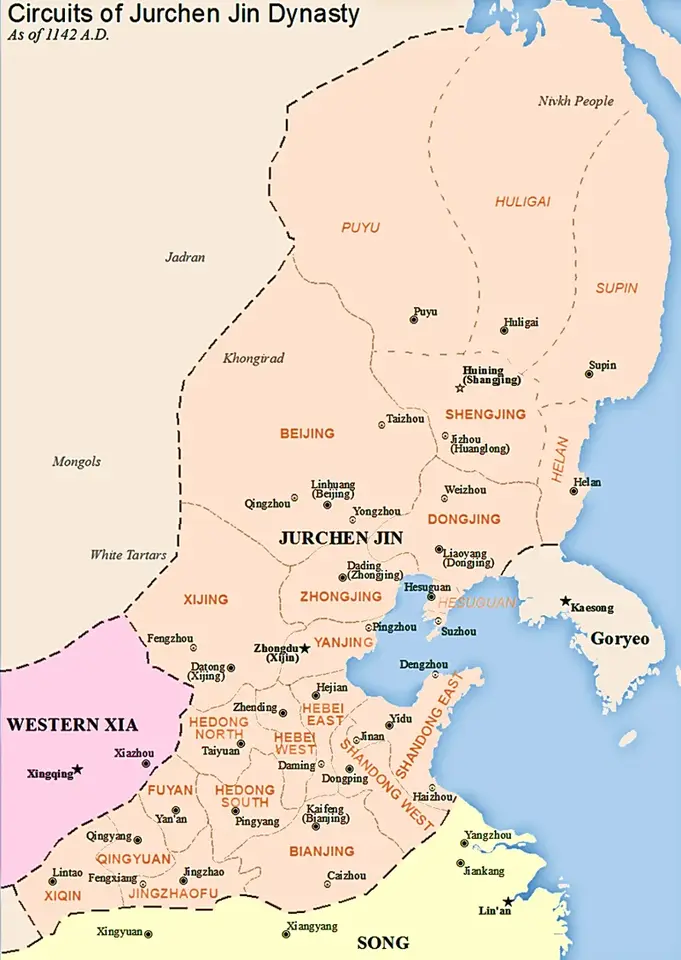
Wanyan Yong is acclaimed emperor by loyalist ministers at Liaoyang, inaugurating the Dading era.
· HISTORICAL EVENT
大定之治
The Dading-era prosperity (大定之治) denotes the golden age of peace, economic abundance, and administrative flourishing achieved during the twenty-nine-year reign of Jin Shizong (Wanyan Yong, 1161–1189) of the Jin dynasty. In 1161, amidst the domestic turmoil and Khitan rebellions caused by Prince Hailing's catastrophic invasion of the Southern Song, Wanyan Yong was acclaimed emperor by loyalist ministers at Eastern Capital Liaoyang. Ascending the throne,…
The Dading-era prosperity (大定之治) denotes the golden age of peace, economic abundance, and administrative flourishing achieved during the twenty-nine-year reign of Jin Shizong (Wanyan Yong, 1161–1189) of the Jin dynasty. In 1161, amidst the domestic turmoil and Khitan rebellions caused by Prince Hailing's catastrophic invasion of the Southern Song, Wanyan Yong was acclaimed emperor by loyalist ministers at Eastern Capital Liaoyang. Ascending the throne, Shizong terminated the southern war, crushed internal rebellions, and established the Central Capital at Daxing Prefecture, swiftly restoring dynastic stability. Throughout his reign, Jin Shizong embodied personal frugality, embraced Confucian principles of benevolent governance, purged bureaucratic corruption, and promoted competent talent regardless of lineage. Economically, he instituted comprehensive property surveys to equalize tax burdens and protected Meng'an Mouke farming households. Culturally, he inaugurated the Jurchen Jinshi examination and oversaw the translation of Confucian classics to balance Han administrative techniques with Jurchen martial traditions. Diplomatically, he concluded the Longxing Peace Accord with the Southern Song, inaugurating over four decades of regional peace. The Jin population doubled to over forty million, prompting historians to acclaim Jin Shizong as the Lesser Yao and Shun.
Wanyan Yong is acclaimed emperor by loyalist ministers at Liaoyang, inaugurating the Dading era.
Prince Hailing is assassinated at Guazhou; Shizong suppresses the Khitan uprisings and consolidates power.
The court enters Central Capital Daxing Prefecture, establishing anti-corruption edicts and promoting talent.
Imperial commissioners audit nationwide landholdings and assets, establishing fair tax assessments.
Following victory at Fuli, Shizong signs the Longxing Accord with the Southern Song, initiating forty years of peace.
The court creates the Jurchen Jinshi examination, allowing scholars to compete using the Jurchen script.
The Translation Bureau translates canonical Chinese classics—including the Book of Changes and Analects—into Jurchen.
Shizong visits the ancestral capital at Huining, staging hunting assemblies to preserve ancestral customs.
A second nationwide audit reveals hidden lands, replenishing imperial granaries to unprecedented levels.
Shizong dies after a twenty-nine-year reign; the population reaches over forty million, acclaimed as the Lesser Yao and Shun.
In the autumn of 1161, Prince Hailing (Wanyan Liang) mobilized the entire manpower and tax base of the Jin Empire to launch a reckless four-pronged invasion against the Southern Song. To finance the campaign, Hailing imposed exorbitant levies and forced labor, impoverishing northern peasantry and leaving vast tracts of fertile farmland abandoned. Seizing the opportunity created by military exhaustion, the Khitan tribes under Sa Ba and Wo'wo rose in massive rebellion, devastating the northern corridors and plunging the dynastic rear into chaos.
Following the catastrophic tactical defeat at the Battle of Caishi, Prince Hailing refused to retreat, demanding an immediate assault across the Yangtze on penalty of summary execution. Desperate soldiers and mutinous commanders led by Wanyan Yuanyi assassinated Hailing at the Guazhou imperial encampment in November 1161, causing the southern invasion army to disintegrate. The Jin dynasty faced its most perilous crisis of governance and legitimacy since its founding.
Amidst national collapse, Wanyan Yong, the grandson of dynastic founder Aguda and son of distinguished general Wanyan Zongfu, emerged as the undisputed rallying figure for the realm. Renowned for generosity, prudence, and administrative fairness, Wanyan Yong commanded immense respect across the northeastern provinces. Urged by his uncle Li Shi and senior commanders, he accepted the imperial throne at Liaoyang on October 6, 1161, inaugurating the Dading era.
Ascending the throne amidst profound exhaustion, Jin Shizong recognized that the empire required urgent respite from relentless warfare. He established a statecraft agenda centered on pacifying domestic unrest, instituting legal transparency, enforcing fiscal frugality, and concluding peace with neighboring regimes. This measured approach reversed the tyrannical excesses of the previous reign and initiated the complete rehabilitation of the Jin state.
Upon ascending the throne at Liaoyang, Jin Shizong acted swiftly to restore domestic order. He dispatched Field Marshals Heshilie Zhining and Pusan Zhongyi with northern divisions to confront the Khitan insurgents. Combining military suppression with broad amnesties, Jin forces extinguished the uprisings of Sa Ba and Wo'wo, re-establishing imperial control over the northern frontier.
Simultaneously, Shizong purged sycophants of the late Prince Hailing, reburied purged imperial clansmen with honors, and entered Central Capital Daxing Prefecture to re-establish the central government. His temperate administration and generous amnesties restored popular confidence in imperial authority, winning the loyalty of the multi-ethnic populace across northern China.
Jin Shizong maintained an austere personal lifestyle, deliberately eschewing palace luxury. He frequently remarked to his courtiers that while Emperor Wen of Han practiced pure frugality, he constantly feared excessive court expenditure. He prohibited frivolous palace construction, favored plain attire, and refused unearned stipends to imperial princes.
In bureaucratic governance, Shizong promoted talent over lineage and seniority, elevating capable junior clerks and upright scholars such as Zhang Xuansu, Li Shi, and future chancellor Tudan Yi to cabinet posts. He instituted rigorous supervisory tours and unannounced inspections, mercilessly punishing corrupt officials who accepted bribes or exploited commoners, establishing the cleanest and most orderly administration in Jin history.
Recognizing agriculture as the foundation of the empire, Jin Shizong prioritized fiscal and land reform. Beginning in 1164, he implemented nationwide property surveys, dispatching imperial commissioners to audit population registers, cultivated acreage, and livestock wealth across all circuits. Households were classified into nine wealth grades to determine proportional property taxes and corvee labor levies.
These audits abolished the illegal tax exemptions long enjoyed by noble clans and large landlords, equalizing fiscal responsibilities and significantly expanding the registered tax base. Concurrently, Shizong reformed the land allotment system for Jurchen Meng'an Mouke households, strictly prohibiting Han landlords from encroaching on military lands while preventing Jurchen nobility from leaving fields fallow. Through tax remissions during natural disasters, grain price stabilization, and irrigation projects, northern agriculture flourished, filling imperial granaries with grain.
In cultural statecraft, Jin Shizong charted an innovative path of dual institutional governance. While honoring Confucian administrative principles and regular civil examinations, he feared that prolonged immersion in urban Chinese culture would erode the martial traditions and identity of the Jurchen people. In 1173, he inaugurated the Jurchen Jinshi examination, allowing scholars to write examination essays in the Jurchen script.
In 1180, Shizong established an official Translation Bureau, commissioning scholars to translate canonical Han Confucian works into Jurchen, including the Book of Changes, Book of Documents, Analects, Mencius, Classic of Filial Piety, Spring and Autumn Annals, and Liuzi. He commanded Crown Prince Wanyan Yungong and imperial princes to master Jurchen script and maintain equestrian hunting skills. In 1184, Shizong led a grand imperial procession back to the ancestral cradle at Shangjing Huining Prefecture, staging traditional hunting assemblies to educate his successors on the hardship of dynastic foundation.
In foreign relations, Jin Shizong decisively abandoned aggressive expansionism toward the south. In 1163, when Emperor Xiaozong of Song launched the Longxing Northern Expedition, Jin generals Heshilie Zhining and Pusan Zhongyi routed the Song forces at the Battle of Fuli. Rather than pursuing a retaliatory counter-invasion across the Huai River, Shizong recognized the military stalemate and sought negotiated peace.
In December 1164, the Jin and Southern Song concluded the Longxing Peace Accord: the diplomatic relationship was renegotiated from sovereign-vassal to uncle-nephew status, the annual tribute was redefined as annual gift payments, and newly seized territories were returned. This diplomatic settlement established a stable geopolitical equilibrium along the Huai River. Border markets were reopened at Xuyi and Yingzhou, facilitating extensive commercial and cultural exchanges between north and south and securing over four decades of peace.
By the time Jin Shizong died in January 1189, the registered households of the Jin Empire had doubled from over three million at his accession to 6.78 million households, representing an official population exceeding 44.7 million citizens. This represented the demographic and economic peak of the Jin dynasty.
Through four decades of peaceful diplomacy, rigorous anti-corruption campaigns, and agrarian protectionism, Jin Shizong achieved internal harmony across Han, Jurchen, and Khitan populations. His enlightened reign established the institutional foundation for the subsequent Mingchang reign under his grandson Jin Zhangzong, earning Shizong the lasting admiration of posterity as the Lesser Yao and Shun.
The Dading-era prosperity created unprecedented demographic and agricultural achievements in northern Chinese history. Under Shizong's tenure, registered households reached 6.78 million and total citizens surpassed 44.7 million, setting the all-time demographic record for nomadic-founded regimes in northern China.
The thorough implementation of property audits eradicated fiscal irregularities, providing the court with precise tax records. Grain reserves accumulated in state granaries to tens of millions of bushels, stabilizing consumer prices across the northern circuits. Decades of peaceful commerce and tax equity transformed northern China from a war-torn battleground into an affluent, self-sustaining society.
Institutionally, the Dading era established an enduring model of dual administrative governance, successfully administering a massive sedentary Chinese populace while preserving the ethnic vitality and linguistic heritage of the ruling Jurchen minority. The establishment of the Jurchen Jinshi degree and the translation of Confucian classics provided a durable institutional bridge between steppe traditions and Confucian statecraft.
In regional geopolitics, the Longxing Peace Accord ended destructive inter-dynastic conflict along the Huai River, fostering vibrant commercial and cultural interchange between the Yellow and Yangtze river basins. Jin Shizong's personal austerity, legal restraint, and diplomatic moderation placed him alongside Han Emperor Wen and Tang Emperor Taizong as a premier embodiment of Confucian sage-rulership.
In the History of Jin, chief compiler Tuotuo extolled Shizong's governance, recording that he practiced frugality, respected ancestral virtues, rewarded merit, and gave rest to the common people. Tuotuo observed that court ministers guarded their responsibilities while households prospered and punishments remained lenient, concluding that even the golden reigns of the Zhou and Han dynasties could not exceed the accomplishments of the Lesser Yao and Shun.
In his Continued Comprehensive Mirror in Aid of Governance, Qing historian Bi Yuan reflected that Jin Shizong was naturally frugal and cherished the livelihoods of his people, abstaining from costly foreign conquests. Bi evaluated the forty years of peace with the Song as the true wellspring of Jin dynastic flourishing.
In his Notes on the Twenty-Two Histories, Zhao Yi observed that Jin Shizong restored moral order from the ashes of Prince Hailing's tyranny, governing the realm with benevolence and justice. Zhao concluded that through property audits and the creation of the Jurchen examination, the Jin Empire achieved its ultimate peak of wealth and military power during the thirty years of Dading.