Flight from Guanzhong
Warlords Li Jue and Guo Si wage war in Chang'an; Emperor Xian flees eastward under the escort of Yang Feng and Dong Cheng.
Eastern Han Dynasty (东汉) · HISTORICAL EVENT
挟天子以令诸侯
Holding the Son of Heaven to Control the Vassals (挟天子以令诸侯, historically framed by Cao Cao as "revering the Son of Heaven to subdue insurgents" and termed by rivals as "holding the sovereign hostage to coerce regional lords") was a landmark political consolidation achieved from July to September 196 CE (the 1st year of Jian'an). Taking advantage of Emperor Xian's desperate return to the scorched ruins of Luoyang, Cao Cao personally marched an elite army…
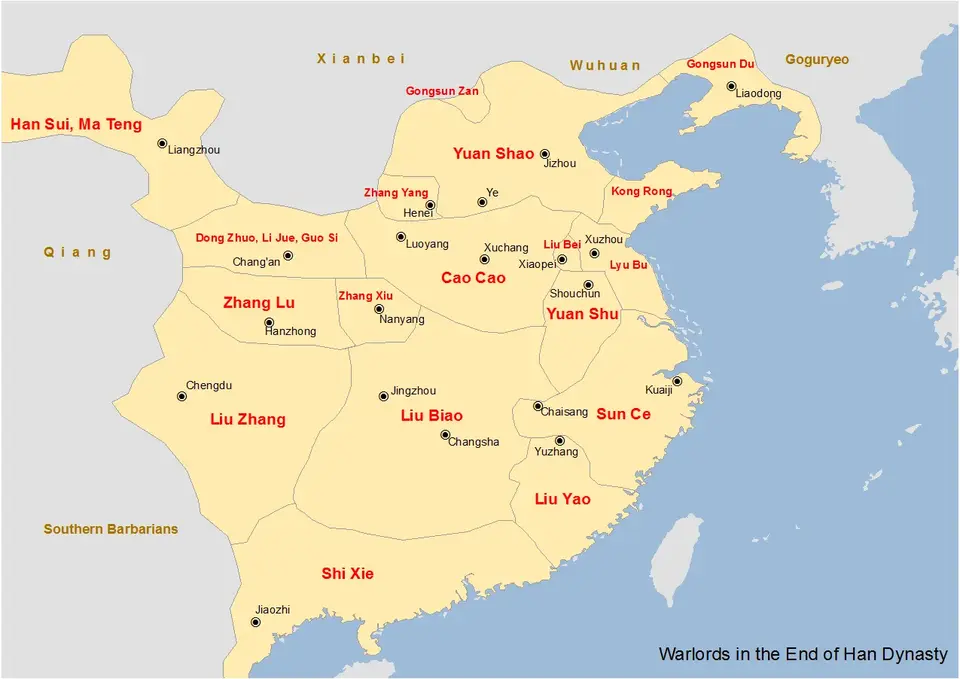
Holding the Son of Heaven to Control the Vassals (挟天子以令诸侯, historically framed by Cao Cao as "revering the Son of Heaven to subdue insurgents" and termed by rivals as "holding the sovereign hostage to coerce regional lords") was a landmark political consolidation achieved from July to September 196 CE (the 1st year of Jian'an). Taking advantage of Emperor Xian's desperate return to the scorched ruins of Luoyang, Cao Cao personally marched an elite army into the ancient capital, escorting the imperial court to his strategic base at Xu County and assuming supreme control over the central government. In the chaotic aftermath of Dong Zhuo's tyranny, rival generals Li Jue and Guo Si devastated the western metropolis of Chang'an through protracted urban warfare. Escorted by loyalist commanders Yang Feng and Dong Cheng, the teenage Emperor Xian fled back to Luoyang in the summer of 196 CE. Finding the former capital completely leveled, with high ministers foraging for wild weeds to survive, most warlords regarded the sovereign as an expensive logistical liability. Acting upon the strategic vision of chief adviser Xun Yu, who advocated "revering the sovereign to satisfy public expectations," Cao Cao decisively occupied Luoyang. Implementing Dong Zhao's covert plan to outmaneuver rival court factions, Cao Cao transferred the court to Xu County (designated as Xudu, the capital of Xu). This historic stroke elevated Cao Cao from a regional governor to the de facto ruler of the empire, permanently reshaping the geopolitical balance of the Three Kingdoms era.
Warlords Li Jue and Guo Si wage war in Chang'an; Emperor Xian flees eastward under the escort of Yang Feng and Dong Cheng.
Emperor Xian arrives at the charred ruins of Luoyang; civil ministers subsist on wild roots as warlords hesitate to intervene.
Xun Yu advises Cao Cao that "revering the sovereign to satisfy public expectations" represents the ultimate strategic imperative.
Cao Cao marches his disciplined army into Luoyang, presenting supplies to the court, and is appointed Overseer of the Secretariat.
Dong Zhao proposes transferring the court to Xu County and writes a deceptive letter to pacify general Yang Feng.
The imperial column departs Luoyang for Xu; Cao Cao's forces defeat Yang Feng's pursuit army and seize Liang County.
Emperor Xian arrives at Xu County, renaming it Xudu; the court declares a general amnesty and establishes the Jian'an era.
Yuan Shao refuses the post of Grand Commandant; Cao Cao yields the office of Grand General to Yuan Shao, assuming Minister of Works.
Cao Cao issues imperial edicts confirming honors on Liu Bei and Sun Ce while condemning Yuan Shu's usurpation.
Cao Cao establishes agricultural colonies (Tuntian) around Xudu; master strategists such as Guo Jia enter imperial service.
Following the assassination of Chancellor Dong Zhuo in 192 CE, his former lieutenants Li Jue, Guo Si, and Fan Chou mobilized the Liangzhou frontier army to storm Chang'an, killing senior minister Wang Yun and seizing custody of the young Emperor Xian (Liu Xie) and his civil ministers. Over subsequent years, Li Jue and Guo Si turned against each other, waging incessant street battles across the imperial capital. Guanzhong was reduced to utter ruin, marked by widespread famine, cannibalism, and abandoned corpses, stripping the Eastern Han monarchy of its sacred imperial dignity.
In late 195 CE, exploiting brief truces between the warring generals, Emperor Xian escaped eastward under the protection of general Yang Feng, Imperial Uncle Dong Cheng, and allied White Wave bandit leaders. Pursued relentlessly by Li Jue's cavalry, the royal caravan suffered catastrophic casualties along the Yellow River, losing imperial seals, archives, and court ladies, with the sovereign and his consorts frequently forced to subsist on raw roots.
In July 196 CE, after more than a year of perilous flight, Emperor Xian arrived at the ancient eastern capital of Luoyang. However, the magnificent metropolis had been burned to ashes during Dong Zhuo's forced relocation six years earlier. Streets were choked with thorns and brambles, and palace pavilions had ceased to exist. High-ranking ministers slept among crumbling brickwork, and dozens of imperial clerks died of starvation in the ruins. Furthermore, rival military commanders Yang Feng and Han Xian engaged in armed intimidation within the camp, rendering the imperial court completely defenseless.
Confronted with the emperor's plight at Luoyang, regional warlords reacted with starkly divergent calculations. In Ji Province, the formidable warlord Yuan Shao was urged by his chief strategist Ju Shou to "welcome the imperial carriage to the eastern capital to manifest filial devotion." However, rival advisers Guo Tu and Chunyu Qiong vehemently opposed the plan, arguing that harboring the emperor would restrict Yuan Shao's personal authority through royal protocol and compulsory petitions. Indecisive and proud, Yuan Shao abandoned the idea. Meanwhile, Yuan Shu harbored imperial ambitions of his own in Huainan, and Liu Biao remained content to govern Jing Province passively.
In contrast, Cao Cao, then Governor of Yan Province, displayed acute geopolitical foresight. Having monitored the emperor's movements, Cao Cao convened his council upon hearing of the arrival in Luoyang. Chief strategist Xun Yu presented a masterstroke of grand strategy: "To revere the sovereign in order to satisfy the expectations of the populace is a measure of supreme virtue; to uphold impartial righteousness to subdue ambitious warlords is a strategy of supreme wisdom; to support great moral duty to attract talented heroes is a policy of supreme charisma. Though rebels may emerge across the realm, they will surely be unable to prevail against us!" Concurring with counselor Cheng Yu, Cao Cao immediately resolved to lead his military forces west.
In July 196 CE, Cao Cao dispatched General of Established Martial Might Cao Hong with vanguard light cavalry to Luoyang to establish contact with the court. However, court general Dong Cheng and rival forces blocked the mountain passes, preventing Cao Hong's entry. Imperial Gentleman Dong Zhao intervened, persuading commander Yang Feng that allying with Cao Cao would provide essential grain and supplies.
On August 18, 196 CE, Cao Cao personally led his central army into Luoyang in immaculate formation, maintaining strict military discipline and forbidding any plundering. Arriving before Emperor Xian, Cao Cao presented immense quantities of grain, fine silks, and imperial utensils, resolving the existential famine afflicting the court.
Deeply moved by Cao Cao's loyalty, Emperor Xian issued imperial decrees appointing him Colonel-Director of Retainers, granted him the imperial axe of command (jieyue), and elevated him to Overseer of the Imperial Secretariat (Lu Shangshu Shi). The office of Colonel-Director conferred police and garrison powers over the capital region, while Overseeing the Secretariat placed executive control over the imperial cabinet squarely in Cao Cao's hands. Cao Cao thus became the legitimate civil and military supreme authority of the Eastern Han state.
Stationed amidst the ruins of Luoyang, Cao Cao recognized that the city was strategically unviable. Surrounding districts had been depopulated, forcing all grain supplies to be transported across hundreds of miles from Yan Province. Furthermore, military chieftains Yang Feng, Han Xian, and Zhang Yang maintained independent commands around the city, creating persistent security hazards. In addition, the northern frontier remained exposed to sudden cavalry strikes across the Yellow River by Yuan Shao.
Consulting with strategist Dong Zhao, Cao Cao reviewed his options. Dong Zhao advised: "Luoyang lies in ruins and lacks food; it cannot be held for long. Xu County sits in the heart of Yu Province, possessing fertile soil, abundant crops, and direct communications to your power base. If you escort the sovereign to Xu, you can escape the interference of rival generals and issue decrees across the realm with uncontested imperial authority."
To prevent military intervention by Yang Feng, who commanded significant forces at nearby Liang County, Dong Zhao drafted a conciliatory letter in Cao Cao's name, claiming that due to local scarcity, the court intended to move temporarily to Luyang to secure provisions, offering lavish grain gifts to Yang Feng's camp. Deceived by the letter, Yang Feng raised no objections.
On August 28, 196 CE, having finalized preparations, Cao Cao escorted Emperor Xian, the imperial consorts, and civil officials out of Luoyang under heavy guard. Bypassing Liang County, the imperial column moved rapidly southeast toward Xu County.
Realizing that Cao Cao had deceived him and was marching directly toward his home territory, Yang Feng allied with White Wave chieftain Han Xian to pursue the imperial column with elite cavalry. Anticipating this counter-move, Cao Cao placed ambush detachments under general Cao Ren, repelling the pursuit. Cao Cao then launched an immediate counter-offensive against Liang County, storming Yang Feng's headquarters and forcing Yang Feng and Han Xian to flee south to join Yuan Shu in Huainan.
On September 26, 196 CE, Emperor Xian's procession arrived safely at Xu County. Cao Cao rapidly mobilized tens of thousands of craftsmen and laborers to construct imperial palaces, ancestral shrines, and bureaucratic offices, redesignating the city as Xudu (the Capital of Xu). The emperor proclaimed a general imperial amnesty, inaugurating the Jian'an reign era and marking the beginning of the historic Jian'an era.
Upon arrival at Xudu, Emperor Xian appointed Cao Cao Grand General and enfeoffed him as Marquis of Wuping. When rival warlord Yuan Shao learned that Cao Cao held higher administrative rank than his own post of Grand Commandant, he refused the appointment in humiliation. Displaying political dexterity, Cao Cao petitioned the throne to yield the title of Grand General to Yuan Shao, accepting for himself the post of Minister of Works (Sikong) while retaining the vital concurrent office of Overseer of the Imperial Secretariat.
At Xudu, Cao Cao overhauled the court bureaucracy. Placing his most trusted strategist Xun Yu in charge of the Imperial Secretariat (Shangshutai), Cao Cao ensured that all imperial decrees, administrative appointments, and military orders were drafted and vetted by his own inner circle. Concurrently, Cao Cao recruited prestigious Confucian scholars, such as Kong Rong and Wang Lang, to maintain the dignity of the imperial court. While Emperor Xian retained his titular throne and received ceremonial court audiences, executive, military, and financial power was fully centralized within Cao Cao's administration.
The relocation of the imperial capital to Xudu fundamentally transformed the strategic landscape of late Han China. Realizing his strategic mistake, Yuan Shao demanded that Cao Cao transfer the emperor northward to Juancheng near the Ji Province border, a demand that Cao Cao flatly rejected.
Operating through the legal authority of the imperial seals, Cao Cao issued decrees that destabilized his rivals: appointing Liu Bei as General of Established Zhen and Marquis of Yicheng, and ennobling Sun Ce as Commandant of Cavalry and heir to the Marquis of Wucheng, thereby securing key regional alliances. Simultaneously, when Yuan Shu proclaimed himself emperor at Shouchun, Cao Cao issued an imperial decree condemning him as a traitor, mobilizing a multi-faction coalition to isolate him.
Furthermore, holding the Son of Heaven provided an unprecedented magnetic draw for intellectual and military talent. Premier strategists and statesmen from across China—including Guo Jia, Liu Ye, Man Chong, and Du Xi—flocked to Xudu to enter imperial service under Cao Cao. Backed by the legal authority of the throne, Cao Cao instituted large-scale military and civilian agricultural colonies (Tuntian), creating a powerful economic and logistical apparatus that enabled him to crush Yuan Shao at the Battle of Guandu and unify northern China.
The maneuver of "holding the Son of Heaven to control the vassals" concluded in an absolute political victory for Cao Cao. Through decisive military execution, Cao Cao rescued the starving imperial household from the rubble of Luoyang and established a secure, well-provisioned administrative center at Xudu. While preserving the formal ceremonies, rituals, and imperial regalia of the Han court, Cao Cao placed all executive, military, and judicial authority under his own command. This historic transformation elevated Cao Cao from a vulnerable provincial warlord into the legitimate head of the imperial government.
This strategic consolidation fundamentally shaped the trajectory of the late Han and Three Kingdoms eras. First, it provided Cao Cao with indisputable moral, legal, and political supremacy, enabling him to brand all regional military campaigns as righteous imperial pacification missions, placing rivals such as Yuan Shao, Yuan Shu, and Lu Bu in the position of unlawful rebels. Second, possession of the imperial court enabled Cao Cao to attract premier administrative and military talent across China, including the influential Yingchuan scholar-gentry and brilliant strategists like Guo Jia, Jia Xu, and Zhong Yao. Third, maintaining Emperor Xian at Xudu preserved the titular continuity of the Eastern Han Dynasty for another twenty-four years until 220 CE, when Cao Pi accepted Emperor Xian's abdication to found the Cao Wei Dynasty, completing a peaceful transition between dynasties.