Huaihuang Garrison Mutiny
Starving garrison troops murder commander Yu Jing after being denied emergency grain, initiating the frontier revolt
Northern Wei Dynasty (北魏) · HISTORICAL EVENT
六镇之乱
The Rebellion of the Six Garrisons was a catastrophic socio-military uprising and dynastic dissolution civil war that convulsed the Northern Wei Dynasty from 523 (Zhengguang 4) to 530 (Yong'an 3). In early Northern Wei times, six military garrisons—Woye, Huaishuo, Wuchuan, Fuming, Rouxuan, and Huaihuang—were erected along the Great Wall to guard the capital Pingcheng against the steppe nomadic Rouran Khaganate. Staffed by noble Xianbei clansmen, garrison…
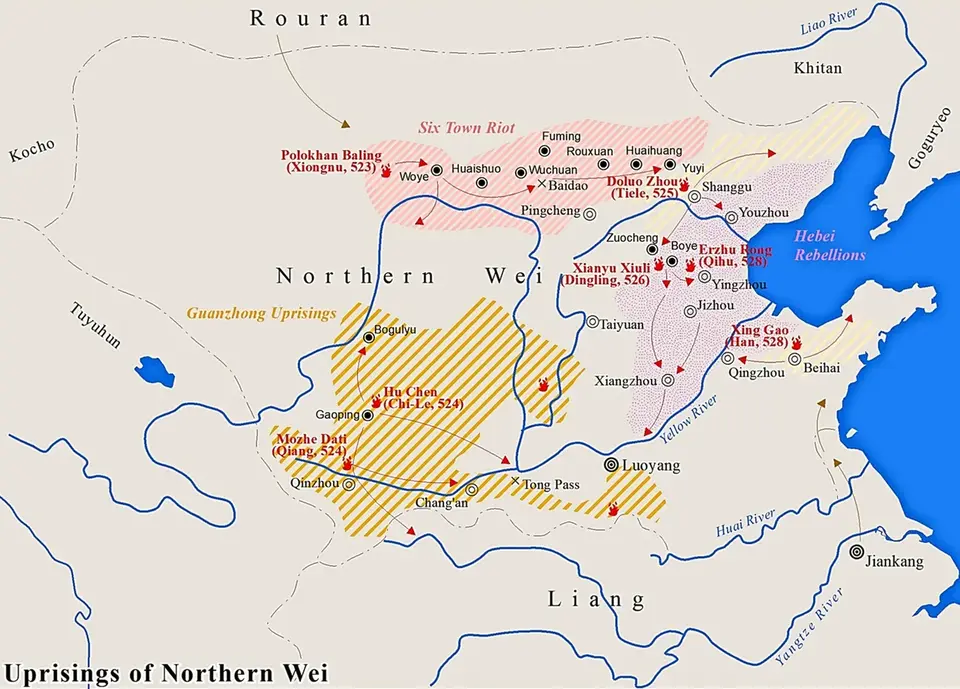
The Rebellion of the Six Garrisons was a catastrophic socio-military uprising and dynastic dissolution civil war that convulsed the Northern Wei Dynasty from 523 (Zhengguang 4) to 530 (Yong'an 3). In early Northern Wei times, six military garrisons—Woye, Huaishuo, Wuchuan, Fuming, Rouxuan, and Huaihuang—were erected along the Great Wall to guard the capital Pingcheng against the steppe nomadic Rouran Khaganate. Staffed by noble Xianbei clansmen, garrison service was prestigious and exempt from corvée. However, after Emperor Xiaowen transferred the capital southward to Luoyang and instituted wholesale Sinicization, the frontier outposts lost imperial favour. Garrison troops were reduced to degraded hereditary military serfs barred from imperial office and brutally exploited by corrupt commanders. In 523, severe famine struck the north; when the Huaihuang commander refused food relief, starving troops killed him, and Poliuhan Baling launched a general uprising at Woye. Although imperial forces, allied Rouran cavalry, and warlord Erzhu Rong eventually crushed the insurrection, the upheaval completely destroyed Northern Wei central authority, triggered the Heyin Massacre, and created the military blocs of Gao Huan (Eastern Wei/Northern Qi) and Yuwen Tai (Western Wei/Northern Zhou).
Starving garrison troops murder commander Yu Jing after being denied emergency grain, initiating the frontier revolt
Ethnic Xiongnu soldier Poliuhan Baling executes the garrison commander and adopts the era title "Zhenwang"
Weikegu overruns both key garrisons; commander Yang Jun is killed and the Haba family is captured
Cui Xian's advance force is wiped out in Baidao gorge; Commander-in-Chief Li Chong retreats into Yunzhong
Khagan Anaqui's cavalry crushes rebel forces; 200,000 captive garrison personnel are relocated to Hebei
Relocated garrison soldiers under Du Luozhou revolt at Shanggu, reigniting rebellion across Hebei
Xianyu Xiuli revolts at Zuorencheng; Ge Rong assumes command following internal strife and defeats imperial armies
Ge Rong executes Du Luozhou, unifies over one million troops as Emperor of Qi, and besieges Yecheng
Erzhu Rong takes Luoyang, massacres over 2,000 court ministers, and drowns Empress Dowager Hu in the Yellow River
Erzhu Rong's 7,000 elite cavalry ambush Ge Rong's forces at Fukou, capturing Ge Rong and ending the Hebei insurrection
Erzhu Tianguang and Haba Yue capture Moqi Chounu at Pingtong, bringing the rebellion to a close
Following the founding of the Northern Wei by Emperor Daowu (Tuoba Gui) and the establishment of its capital at Pingcheng (modern Datong, Shanxi), the nomadic Rouran Khaganate north of the Gobi Desert frequently conducted devastating raids southward. To construct an impenetrable frontier defense network, the Northern Wei founded a tier of heavily fortified military garrisons along the Yin Mountains and the Great Wall. As verified by Qing scholar Shen Yao in Explanations of the Six Garrisons, these outposts comprised, from west to east: Woye (modern Front Banner of Urad, Inner Mongolia), Huaishuo (modern Guyang, Inner Mongolia), Wuchuan (modern Wuchuan, Inner Mongolia), Fuming (modern Siziwang Banner, Inner Mongolia), Rouxuan (modern Xinghe, Inner Mongolia), and Huaihuang (modern Zhangbei, Hebei).
In early and mid-Northern Wei, these frontier garrisons were critical to dynastic survival. The court assigned imperial princes and renowned generals as commanders and garrisoned them with fierce warriors chosen from Xianbei Tuoba aristocracy and elite clans. Garrison families enjoyed substantial political prestige, complete exemption from taxes and corvée, and direct career progression into the central civil and military bureaucracy in Pingcheng. Contemporary records in the Book of Wei celebrate that military elites universally coveted garrison appointments, honoring garrison warriors as the core sinews and heart of the state.
In 493 (Taihe 17), Emperor Xiaowen enacted comprehensive Sinicization reforms and relocated the dynastic capital south to Luoyang in the Central Plains. Consequently, strategic priorities shifted from northern steppe defense toward pacifying the Huai River basin and campaigning against the Southern Qi. The northern frontier fell into geopolitical neglect. In Luoyang, Emperor Xiaowen promulgated a rigid aristocratic register ranking clans according to Han standards; while Xianbei nobles who followed the emperor south gained high offices and aristocratic splendour, the clans remaining at the northern garrisons were excluded from the elite register.
Furthermore, the garrisons were converted into penal colonies for domestic exiles and criminals. Elite frontier guardsmen were lumped together with common convicts, and their civil status was degraded into hereditary, stigmatized military households (fuhu). Opportunities for administrative advancement were severed; even seasoned warriors could rise no higher than low-ranking garrison officers. Meanwhile, their kinsmen in Luoyang dominated imperial ministerial posts. This sudden deprivation of honor, wealth, and status generated intense, smoldering resentment among northern soldiers.
In the late Northern Wei period, the Luoyang court descended into decadent indulgence. Emperor Xiaoming ascended the throne as a young boy, leaving imperial governance to his mother Empress Dowager Hu. Imperial relative Yuan Cha and eunuch Liu Teng staged a palace coup, confining the Empress Dowager to Xuan Guang Hall and exercising tyrannical despotic power. The central government engaged in blatant sale of public offices, resulting in widespread corruption among provincial magistrates. Garrison commanders dispatched to the north treated frontier postings as opportunities for extortion, embezzling military grain, exploiting troops as personal slaves, and escalating class tensions.
Simultaneously, the northern steppe experienced consecutive winters of catastrophic blizzards and extreme drought. When Rouran leader Anaqui fled south following internal tribal strife, Yuan Cha depleted state coffers to finance Anaqui's restoration and resettled his tribes directly adjacent to the northern garrisons. In 523, catastrophic spring famines devastated the northern borders. While starvation consumed the garrisons, commanders hoarded granaries and executed pleading petitioners, igniting the fuse of open armed insurrection.
Following Emperor Xiaoming's accession, Empress Dowager Hu dominated court proceedings, promoting her brother-in-law Yuan Cha to Senior General of the Palace Guard. In July 520 (Zhengguang 1), Yuan Cha partnered with chief eunuch Liu Teng to orchestrate the Xuan Guang Hall coup, imprisoning Empress Dowager Hu within the northern palace. Yuan Cha and Liu Teng usurped imperial power, deciding state affairs in private quarters. High ministers were required to attend Liu Teng's private residence each morning to curry favor before reporting to central ministries.
Under Yuan Cha's regime, corruption permeated the empire. Yuan Cha's father, Prince of Jingzhao Yuan Ji, openly received immense bribes for bureaucratic appointments, installing incompetent, rapacious figures across provincial commands. Yuan Cha and Liu Teng monopolized transport routes and natural resources, directing their greed toward the northern frontier. They controlled cross-border frontier trade and extorted hundreds of thousands of cash units annually from garrison troops, reducing border households to destitution.
In the winter of 520, dynastic succession disputes divided the Rouran Khaganate. Prince Shifa defeated the newly enthroned Khagan Anaqui, forcing Anaqui to flee south to Northern Wei territory. Yuan Cha accepted a massive bribe of one hundred pounds of gold from Anaqui and overruled ministerial opposition, mobilizing fifteen thousand troops under Huaishuo commander Yang Jun to escort Anaqui back to the steppe and establishing pasturelands north of the garrisons.
However, this policy brought catastrophe. In 523, extreme blizzards and drought struck the northern steppe. Confronting severe famine, Anaqui violated his pact with the Wei and launched a major raid across the northern frontier. Imperial envoy Yuan Fu was captured by Anaqui, who plundered over two thousand civilians and hundreds of thousands of cattle, horses, and sheep from the garrisons. Already facing subsistence failure, the frontier populations found their livelihoods completely shattered.
In March 523 (Zhengguang 4), the Huaihuang garrison suffered the brunt of Rouran depredations, resulting in widespread famine. Starving soldiers petitioned Commander Yu Jing for emergency grain distributions. Yu Jing, a proud noble from Luoyang, violently rejected their pleas and subjected petitioner delegates to public beatings. Driven to fury, garrison troops led by Gao Yuanrong stormed the commander's headquarters, executed Yu Jing, and distributed the granaries, initiating the garrison mutiny.
News of the Huaihuang mutiny sparked widespread unrest across the Yin Mountains. In March 524 (Zhengguang 5), Poliuhan Baling, an ethnic Xiongnu soldier at Woye garrison, seized the moment to organize discontented Xianbei and multiethnic troops. They executed the garrison commander, declared the rebellion, and adopted the reign title "Zhenwang" (True King). Distributing grain reserves to local populations, Poliuhan Baling's forces quickly captured Woye and swept eastward toward Shuofang and Wuyuan, attracting more than one hundred thousand recruits.
Inspired by Poliuhan Baling's uprising, Weikegu, a native of Baidao in Huaishuo garrison, assembled multiethnic local troops in rebellion, cooperating strategically with Woye forces. Weikegu besieged Huaishuo to the west and advanced southward toward Wuchuan garrison. The northern border defense system collapsed completely.
Huaishuo commander Yang Jun recruited local Xianbei martial elites. Haba Duba and his three sons—Haba Yun, Haba Sheng, and Haba Yue—were noted for exceptional military prowess. Yang Jun appointed Haba Duba as regimental commander and his three sons as army commanders to defend garrison outposts. However, the rebel tide proved overwhelming.
In March 524, the Luoyang court appointed Prince of Linhuai Yuan Yu as Commander-in-Chief of Northern Expeditions, basing his army at Yunzhong. Facing an imminent siege, Yang Jun dispatched Haba Sheng to break through enemy lines and seek reinforcements. Haba Sheng led a dozen daredevil horsemen through rebel lines under cover of darkness; when enemy cavalry pursued, Haba Sheng turned and bellowed his battlefield sobriquet: "I am Haba Pohu!" Intimidated by his renown, the pursuers halted.
Reaching Yunzhong, Haba Sheng urged Yuan Yu: "Huaishuo is surrounded and will fall within days. If Huaishuo falls, Wuchuan will collapse, multiplying rebel momentum a hundredfold. Even strategists like Zhang Liang and Chen Ping could not salvage the disaster!" Yuan Yu agreed to advance. Haba Sheng broke back into Huaishuo to deliver the news, but upon reconnoitering Wuchuan, he found Wuchuan had already fallen. Rushing back to Huaishuo, Haba Sheng discovered Huaishuo's defenses had also shattered; Yang Jun fell in battle, and the Haba family was captured by Weikegu.
In Gaoping garrison, Helian En rebelled, proclaiming Chiele chieftain Hu Chen as King of Gaoping to support Poliuhan Baling. In May 524, Prince of Linhuai Yuan Yu confronted Poliuhan Baling's main army at Wuyuan. The imperial court's ceremonial troops were quickly outmaneuvered and shattered by experienced rebel cavalry, leading to Yuan Yu's dismissal. General Li Shuren suffered a similar crushing defeat at Baidao.
Panic-stricken, the Luoyang court dispatched veteran commander Li Chong as Commander-in-Chief alongside Vice Commanders Cui Xian and Prince of Guangyang Yuan Shen. In July, the imperial army reached Baidao. Arrogant and dismissive of Li Chong's cautious strategy, Cui Xian led his advance cavalry recklessly into the treacherous Baidao gorge.
Poliuhan Baling anticipated Cui Xian's blunder and laid an ambush across the narrow defile. As imperial forces entered the gorge, rebel troops unleashed boulders and launched simultaneous flanking assaults. Cui Xian's advance army was annihilated, and Cui escaped alone on horseback. Poliuhan Baling then assaulted Li Chong's main encampment, forcing Li Chong to abandon heavy baggage and retreat into Yunzhong to maintain a desperate defensive stalemate.
Having exhausted military options in the Central Plains, Yuan Cha and the court took the desperate measure of offering substantial subsidies to the Rouran Khaganate, imploring Khagan Anaqui to attack the rebels from the rear. Eager for plunder and territorial gain, Anaqui personally led one hundred thousand nomadic horsemen across the Gobi Desert toward Woye.
The Rouran cavalry conducted brutal operations against the rebel forces. In February 525 (Zhengguang 6), Northern Wei general Yuan Chen advanced from Pingcheng to form a pincer movement with Rouran forces. Although Poliuhan Baling initially repulsed Yuan Chen at Wuyuan, Yuan Chen adopted psychological warfare and bribery, inducing rebel general Mieliehe to defect with thirty thousand troops. When Poliuhan Baling moved to intercept Mieliehe, Yuan Chen sprang an ambush at Baidao. Poliuhan Baling was decisively defeated and fled north across the desert with several thousand remnants, disappearing from history.
Imperial and Rouran armies pacified the six garrisons, capturing over two hundred thousand soldiers, civilians, and dependents. Emperor Xiaoming promulgated a general amnesty and changed the era name to Xiaochang. In a fateful miscalculation, the court forcibly relocated these two hundred thousand captive garrison personnel to the southern Hebei commanderies of Yingzhou, Jizhou, and Dingzhou. Rather than stabilizing the frontier, this decision transferred seasoned, resentful frontier combatants into the heartland of the empire at a moment when Hebei was suffering severe floods and famine.
The relocated garrison populations endured heavy labor demands and discrimination from Hebei gentry and local officials, with food rations routinely withheld. In August 525 (Xiaochang 1), former Rouxuan soldier Du Luozhou launched an uprising at Shanggu (modern Yanqing, Beijing), declaring himself "Zhenwang." Garrison troops across Hebei rose in rebellion, swelling Du Luozhou's ranks to tens of thousands. Du defeated imperial commander Li Ju outside Jicheng before falling back to Shanggu.
In January 526 (Xiaochang 2), former Huaishuo officer Xianyu Xiuli initiated an insurrection at Zuorencheng (modern Tang County, Hebei), adopting the era title "Luxing" and marching on Zhongshan. In February, Western Gaoche leader Hulyu Luoyang rebelled west of the Sanggan River, while in April Xianyu Ahu revolted in Shuozhou. Xianyu Xiuli crushed an imperial relief army under Changsun Zhi and Yuan Chen at Zhongshan, rendering central Hebei entirely outside imperial control.
In August 526, internal conflict broke out in Xianyu Xiuli's camp; after Yuan Hongye assassinated Xianyu, Ge Rong executed Yuan Hongye and assumed supreme command. Ge Rong proved to be an adept military tactician. In September, he ambushed and annihilated the imperial army at Bainiu Luo (modern Shenzhou, Hebei), executing Commander Yuan Rong, and shortly thereafter killed veteran general Yuan Chen at Boling.
Ge Rong proclaimed himself Emperor of the Great Qi, adopting the era title Guang'an. In early 528, Ge Rong assassinated Du Luozhou and consolidated their combined armies, amassing a force reputed at one million men. Sweeping across seven northern provinces—Yan, You, Ji, Ding, Ying, Yin, and Cang—Ge Rong captured royal provincial governors Yang Jin and Yuan Ning, executed hundreds of prominent Zhaojun gentry, and laid siege to the strategic metropolis of Yecheng, directly threatening Luoyang.
Concurrently, extensive rebellions erupted across the Guanlong and northwestern frontier. In June 524, Moqi Dati rebelled in Qinzhou, killing governor Li Yan. His son Moqi Niansheng assumed leadership, declaring himself Emperor with the reign title "Tiantong." Moqi Niansheng overran Qin, Nanqin, Qi, and Yuan provinces, annihilating a major imperial expeditionary force led by Xiao Baoyin and Cui Yanbo at Shuiluocheng.
Simultaneously, Moqi Chounu, a Xiongnu Xiutu tribal leader from Woye garrison, launched an uprising in Yuanzhou. Following the deaths of allied leaders and Xiao Baoyin's subsequent defection from the court, Moqi Chounu absorbed these forces and proclaimed himself Emperor with the reign title "Shenshou" in July 528. Dominating the northwestern borderlands, Moqi Chounu established an independent administrative regime that pinned down imperial defenses in the west.
With the imperial field armies decimated, tribal chieftain Erzhu Rong of Xiurongchuan (modern Shuozhou, Shanxi) emerged as the dominant military power. Commanding tens of thousands of elite Qihu tribal cavalry, Erzhu Rong recruited displaced martial talent from the fallen northern garrisons, incorporating future dynastic founders including Gao Huan, Yuwen Tai, Haba Sheng, Haba Yue, and Hou Jing into his private military retinue.
In February 528, court tensions reached a bloody climax when Empress Dowager Hu poisoned the nineteen-year-old Emperor Xiaoming to preserve her regency, installing toddler puppet Yuan Zhao. Using the emperor's death as a pretext, Erzhu Rong marched his cavalry south from Jinyang toward Luoyang under the banner of avenging the monarch.
On April 13, 528, Erzhu Rong enthroned Yuan Ziyou (Emperor Xiaozhuang) at Heqiao, summoning the entire civil and military officialdom to Heyin on the northern outskirts of Luoyang under the pretext of an imperial oath. Surrounding the assembly with cavalry, Erzhu Rong denounced the court for corruption and ordered a general slaughter. Over two thousand imperial princes, ministers, and high officials were massacred, while Empress Dowager Hu and the young puppet emperor were thrown into the Yellow River and drowned. The Heyin Massacre destroyed the traditional Luoyang aristocracy, reducing imperial authority to a puppet of Erzhu Rong's military dictatorship.
Erzhu Rong then turned to eliminate Ge Rong's siege of Yecheng. In August 528, Erzhu Rong led seven thousand elite cavalry through the Taihang Mountains, emerging rapidly at Fukou behind Ge Rong's main lines.
Overconfident in his numerical superiority, Ge Rong dispersed his massive army over dozens of miles to encircle the attackers. Exploiting this fatal tactical dispersal, Erzhu Rong concealed his main forces behind wooded hills, equipping each horseman with batons and short swords and ordering them to bypass common soldiers to strike directly at Ge Rong's command post while raising blinding clouds of dust. Huaishuo defector Gao Huan shouted appeals in Xianbei to induce former garrison troops to surrender. Erzhu Rong's lightning charge broke Ge Rong's center, causing general panic. Ge Rong was captured alive on the battlefield and transported to Luoyang for execution, resulting in the surrender of over two hundred thousand rebel troops.
Ge Rong's subordinate Han Lou held Jicheng until 529 before being crushed by Hou Yuan. In the western theater, Erzhu Rong appointed his cousin Erzhu Tianguang in January 530 to lead an expedition into Guanlong alongside Haba Yue and Yuwen Tai. Feigning military exhaustion to encourage Moqi Chounu's troops to disperse for agricultural labor, Erzhu Tianguang launched a surprise cavalry strike at Pingtong in Anding, capturing Moqi Chounu and executing him in Luoyang. By mid-530, the seven-year Rebellion of the Six Garrisons was officially extinguished.
Though the seven-year rebellion was extinguished through brute military force, it permanently dismantled the institutional foundations of the Northern Wei Dynasty. The civil bureaucracy and aristocratic gentry established following the relocation to Luoyang were obliterated during the Heyin Massacre, reducing imperial legitimacy to a hollow facade manipulated by competing warlords.
In 530, Emperor Xiaozhuang assassinated Erzhu Rong inside the palace, provoking a retaliatory siege of Luoyang by the Erzhu clan. Exploiting the turmoil, Gao Huan mobilized twenty thousand disgruntled northern garrison troops in Hebei, annihilated the Erzhu family at the Battle of Hanling Mountain, and seized control of the central government. Meanwhile, Yuwen Tai secured undisputed control over Guanlong following Haba Yue's assassination. In 534, Emperor Xiaowu fled Luoyang to seek asylum with Yuwen Tai in Chang'an. In response, Gao Huan enthroned Emperor Xiaojing in Yecheng, formalizing the permanent partition of Northern Wei into the Eastern Wei and Western Wei.
The most transformative legacy of the Rebellion of the Six Garrisons was the fundamental realignment of China's ruling elite and geopolitical landscape. The dispersal of frontier soldiers across Hebei and Guanlong gave rise to two paramount military factions: the Hebei Xianbei martial bloc led by Gao Huan (Eastern Wei and Northern Qi) and the Guanlong Military Aristocracy led by Yuwen Tai (Western Wei and Northern Zhou).
Originating predominantly from Wuchuan garrison, the Guanlong group formulated the revolutionary Fubing militia system and promoted ethnic fusion between Han gentry and Xianbei warriors. Both Yang Jian (Emperor Wen of Sui) and Li Yuan (Emperor Gaozu of Tang) descended directly from Wuchuan garrison officers who served under Yuwen Tai. Consequently, the rebellion of degraded northern border troops not only destroyed the Northern Wei, but shattered the decaying Southern-style aristocracy, injecting a rugged martial ethos into northern society that culminated in the reunification of China under the Sui and Tang empires.