The Tumu Crisis
Emperor Yingzong is captured at Tumu Station; the imperial army is annihilated.
Ming Dynasty (明朝) · HISTORICAL EVENT
北京保卫战
The Defense of Beijing (北京保卫战) was an existential military campaign fought in autumn 1449, in which Ming forces under the visionary leadership of Minister of War Yu Qian successfully defended the imperial capital against invading Oirat Mongol armies commanded by Grand Preceptor Esen. Two months earlier, the catastrophic Tumu Crisis had wiped out the imperial field army of five hundred thousand men, resulting in the humiliating capture of Emperor Yingzong.…
The Defense of Beijing (北京保卫战) was an existential military campaign fought in autumn 1449, in which Ming forces under the visionary leadership of Minister of War Yu Qian successfully defended the imperial capital against invading Oirat Mongol armies commanded by Grand Preceptor Esen. Two months earlier, the catastrophic Tumu Crisis had wiped out the imperial field army of five hundred thousand men, resulting in the humiliating capture of Emperor Yingzong. Confronted with a terrified court contemplating abandoning Beijing to flee south to Nanjing, Yu Qian vehemently denounced flight, declaring that anyone advocating retreat deserved decapitation. To neutralize Esen's attempt to use the captured emperor as an instrument of extortion, Yu Qian orchestrated the enthronement of the emperor's younger brother, Zhu Qiyu, as Emperor Jingtai, demoting Yingzong to retired sovereign. Yu Qian was promoted to Minister of War, assuming dictatorial control over military defense. He summoned provincial relief garrisons from across Henan, Shandong, and the coastal grain transport corps, stockpiled millions of bushels of grain from Tongzhou, manufactured tens of thousands of firearms, and reorganized the metropolitan army into ten integrated battle corps. When Esen breached the Zijing Pass and surrounded the capital, Yu Qian ordered the city gates locked and led two hundred and twenty thousand troops outside the walls to fight to the death. In savage street and gate skirmishes at Deshengmen, Xizhimen, and Zhangyimen, Ming artillery and citizen militias shattered the Oirat cavalry, killing Esen's top commanders. Depleted and threatened by approaching relief armies, Esen burned his camps and retreated across the northern passes, securing a magnificent victory for the Ming dynasty.
Emperor Yingzong is captured at Tumu Station; the imperial army is annihilated.
Yu Qian denounces proposals to relocate to Nanjing, urging total commitment to defending Beijing.
Ministers bludgeon eunuch henchman Ma Shun to death; Yu Qian shields the prince and stabilizes the court.
Zhu Qiyu is enthroned as Emperor Jingtai, neutralizing Esen's hostage diplomacy.
Yu Qian summons provincial armies, secures grain from Tongzhou, and creates the ten Tuanying divisions.
Oirat armies bypass border fortresses and capture Zijing Pass; defender Sun Xiang perishes.
Yu Qian deploys 220,000 troops outside the nine city gates and orders the gates barred behind them.
Ming artillery ambushes the Oirat vanguard; commanders Boluo and Maonahai are killed.
Esen burns his camps and flees toward Zijing Pass; Ming forces launch a relentless pursuit.
Depleted by defeat, Esen sues for peace and repatriates Yingzong without condition.
Following the capture of Dadu by Ming founding forces, the Mongol court retreated to the northern steppe. Across the Hongwu and Yongle reigns, Ming military expeditions fragmented the steppe nomads into eastern Tatars and western Oirats. A regular tribute-trade framework was established, allowing nomadic tribes to exchange horses, hides, and livestock for Chinese silk, iron cooking pots, grain, and manufactured goods.
During the Xuande and Zhengtong eras, the Oirat leader Toghan consolidated power, unifying steppe tribes and placing puppet khan Toghtoa Bukha upon the throne while reserving supreme executive command as Grand Preceptor. Upon Toghan's death, his ambitious son Esen succeeded him. Esen expanded across Central Asia, conquering Hami and Shazhou, subduing Uriankhai and Jurchen tribes, and establishing unchallenged hegemony from the Greater Khingan Mountains to Lake Balkhash, creating a formidable threat along the Great Wall frontier.
The Ming-Mongol tribute trade operated on an asymmetric economic logic: nomad chieftains viewed tribute missions as lucrative profit opportunities, as the imperial court followed a lavish patronage policy of distributing gifts far exceeding the value of tributary items. Consequently, Oirat missions swelled from several hundred envoys to several thousand, accompanied by extensive fraudulent name padding.
In February 1449, Esen dispatched an embassy of over two thousand men to Beijing while claiming rations and gifts for three thousand. The all-powerful director of ceremonial, eunuch Wang Zhen, curtailed rewards by four-fifths after auditing the actual numbers and rejected Esen's imperial marriage petition. Enraged by this diplomatic rebuff, Esen launched a four-pronged invasion across northern frontiers in July 1449, striking Datong and Xuanfu.
When frontier garrisons at Yanghe collapsed and commanders perished, Wang Zhen, lacking any strategic understanding, persuaded the twenty-three-year-old Emperor Yingzong to lead a personal punitive expedition. Disregarding the fervent opposition of Minister of War Kuang Ye and Vice Minister Yu Qian, the emperor departed Beijing with a hastily assembled army of several hundred thousand men.
Hampered by continuous rainfall, incompetent supply logistics, and erratic commands, the imperial army was outmaneuvered and forced into retreat. On August 15, 1449, the column was encircled at Tumu Station near Huailai, lacking water for two days.
Esen unleashed a ferocious cavalry charge that destroyed the trapped imperial host. Wang Zhen was bludgeoned to death by furious imperial bodyguard Fan Zhong; over fifty senior civil and military dignitaries perished; and Emperor Yingzong was captured alive. News of the disaster struck Beijing like a thunderbolt, pitching the capital into unprecedented terror and chaos.
When word of the catastrophe arrived in Beijing on August 18, the imperial administration ground to a halt. The city contained fewer than one hundred thousand elderly and sick garrison troops, while wealthy residents and noble families packed valuables onto carts in preparation for flight. Empress Dowager Sun commanded Prince of Cheng Zhu Qiyu to oversee emergency court sessions at the Wenhua Hall.
During deliberations, imperial lecturer Xu Cheng stepped forward, citing astrological portents and shifting planetary alignments to argue that heaven's mandate had departed northern China, urging immediate relocation of the capital to Nanjing. Several fainthearted ministers voiced agreement, threatening to reproduce the southern flight of the Song dynasty.
At this existential juncture, Vice Minister of War Yu Qian stepped forth, shouting with ringing conviction that anyone counseling flight to the south should be executed. He argued that Beijing formed the bedrock of the empire, harboring ancestral shrines, dynastic tombs, and the administrative core; any retreat would shatter territorial cohesion and invite immediate continental collapse.
Yu Qian's resolute stance rallied patriots across the court. Senior ministers, including Minister of Personnel Wang Zhi and Minister of Rites Hu Ying, expressed unreserved support. Prince Zhu Qiyu formally endorsed the policy, permanently terminating defeatist debate.
Although defensive strategy was resolved, popular hatred against the late eunuch Wang Zhen remained a volatile powder keg. On August 23, during an open court audience, censors and ministers fell to their knees, petitioning Prince Zhu Qiyu to exterminate Wang Zhen's entire clan to assuage the empire.
Ma Shun, the commander of the Embroidered Uniform Guard and Wang Zhen's chief henchman, intervened arrogantly, shouting at the petitioners and ordering them to disperse. Enraged by this insolence, Supervising Secretary Wang Hong leaped upon Ma Shun, biting his cheek, while assembled ministers rushed forward, beating the commander to death with ivory tablets and bare fists on the palace stones. Two other eunuch conspirators were similarly bludgeoned.
With blood staining the palace marble, Prince Zhu Qiyu fled toward the inner chambers in terror. Sensing imminent breakdown, Yu Qian forced his way through the melee, caught the prince's sleeve, and urged him to remain seated and proclaim an immediate general pardon, declaring the executions an act of public justice. The prince complied, averting military mutiny and consolidating the patriotic coalition.
Following the Tumu Crisis, Esen regarded the captured emperor as his supreme bargaining chip, intending to parade him before border garrisons to compel unconditional surrender and extort colossal quantities of silver and silk.
Yu Qian and senior statesmen recognized that so long as the monarch remained in enemy hands, military resistance would be crippled by filial and political paralysis. Proclaiming that the state took precedence over the monarch, Yu Qian and court grandees petitioned Empress Dowager Sun to elevate Prince Zhu Qiyu to the throne.
On September 22, 1449, Zhu Qiyu ascended the throne as Emperor Jingtai, honoring the captive Yingzong as Grand Emperor Emeritus. This constitutional maneuver transformed Yingzong from an active sovereign into a titular dignitary with zero executive authority. When Esen arrived at frontier passes demanding entry under Yingzong's name, garrison commanders responded that they answered only to the reigning monarch in Beijing. The hostage was rendered politically powerless.
Elevated to Minister of War, Yu Qian directed defense preparations with extraordinary vigor. To address acute manpower shortages, he dispatched imperial couriers across the empire, summoning coastal naval detachments, provincial reserves from Henan and Shandong, and grain transport troops to Beijing, swelling the defensive garrison from one hundred thousand demoralized troops to two hundred and twenty thousand combat-ready soldiers.
To solve the food crisis, Yu Qian addressed the massive stores of grain accumulated at the Tongzhou canal depot. Countering proposals to incinerate the warehouses to prevent their capture, Yu Qian offered monetary bonuses to incoming relief regiments and civilian cart drivers to transport the grain into the walled capital, stockpiling over one million bushels in the city within days.
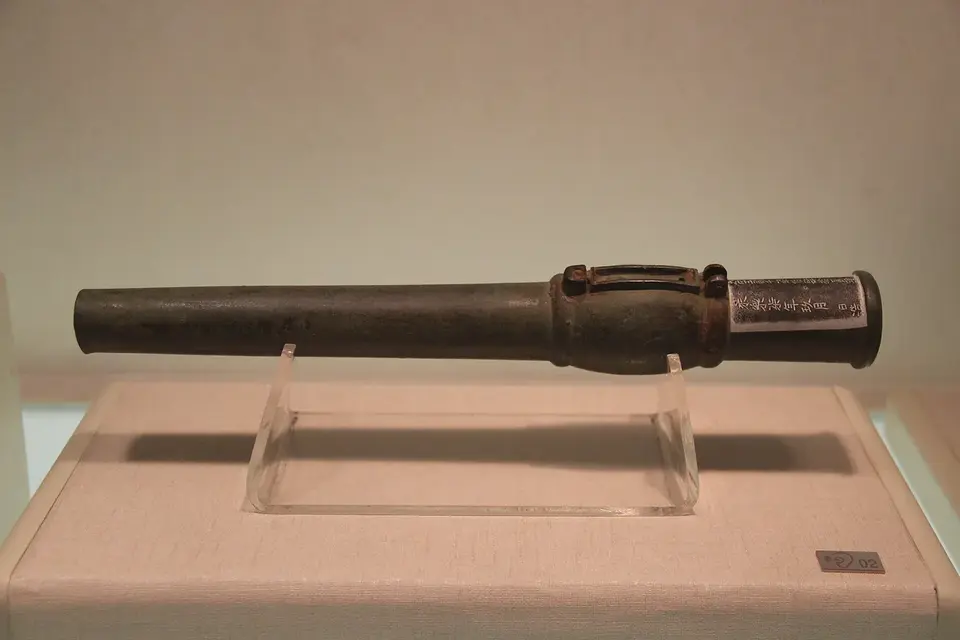
Under Yu Qian's supervision, the Ministry of Works operated day and night, producing hundreds of thousands of sets of armor, 11,000 matchlocks, 20,000 bronze handgonnes, 440,000 fire arrows, and over eight hundred heavy cannons, mobilizing thousands of coal miners and blacksmiths from the Western Hills to manufacture weapons.
In commander appointments, Yu Qian demonstrated impeccable discernment, pardoning disgraced general Shi Heng to command the capital garrison, elevating Liaodong marksman Fan Guang to vice general, and stationing tested veterans including Guo Deng at Datong, Yang Hong at Xuanfu, and Luo Tong at Juyong Pass.
Recognizing that the traditional Three Great Camps suffered from fragmented command and lack of combined-arms coordination, Yu Qian reorganized the 220,000-strong army into ten integrated battle corps known as the Tuanying. Each division combined heavy cavalry, pikemen, and Shenji gunners under unified command, allowing missile fire to suppress cavalry charges while armored infantry protected the gun lines.
Simultaneously, Yu Qian mobilized civilian laborers to dredge and deepen city moats, construct timber doors along the battlements, and bind barbed branches and stakes atop the parapets to repel arrows. Heavy cannons were installed along gate towers, while approach corridors were planted with iron caltrops and concealed horse-trapping pits, transforming Beijing into an unassailable fortress.
In late October 1449, Esen led over one hundred thousand Oirat horsemen through the frontier. Bypassing strong garrisons at Xuanfu, the Mongols breached Baiyangkou and encircled Zijing Pass on October 27, where commander Sun Xiang died defending the battlements. Capturing Laiyuan and Yizhou, Oirat columns advanced toward Beijing.
On October 29, imperial officers proposed sealing the nine gates and maintaining a passive siege defense. Yu Qian categorically rejected this advice, arguing that locking oneself inside conveyed weakness and demoralized the defenders.
Donning full battle armor, Yu Qian ordered the nine city gates thrown open and marched all two hundred and twenty thousand troops outside the walls, entrenching them in front of the gate complexes. Stone barricades were erected, and Yu Qian ordered the gates barred behind the troops.
He issued the legendary iron decree: Any general who retreats ahead of his army shall be beheaded; any soldier who retreats ahead of his general shall be executed by the rear ranks. Generals were assigned specific positions: Shi Heng and Fan Guang at Deshengmen; Tao Jin at Andingmen; Gao Li and Sun Tang at Dongzhimen; Liu An at Chaoyangmen; Liu Ju at Xizhimen; Gu Xingzu at Zhengyangmen; and Wang Tong at the southern gates. Yu Qian personally established his headquarters in the open camp outside Deshengmen, swearing to perish with the capital.
On November 1, Esen's main vanguard arrived outside Beijing, encamping near the White Pagoda Temple outside Xizhimen. Astonished to find the Ming army arrayed outside the walls rather than hiding behind battlements, Esen probed the lines before dispatching an embassy demanding gold, which Yu Qian summarily rejected.
At dawn on November 3, Esen dispatched tens of thousands of elite cavalry to strike Deshengmen, aiming to crush Ming headquarters in a single stroke. Yu Qian ordered Shi Heng to conceal shock troops within vacant roadside houses while sending light cavalry to stage a feigned retreat.
Believing the defenders were fleeing, Oirat horsemen galloped recklessly into the narrow streets leading to the gate. When the enemy vanguard packed the killing zone, Yu Qian signaled the city wall. Vice General Fan Guang directed the Shenji artillery batteries to unleash a devastating volley of grape shot, bronze bombards, and explosive rockets.
Simultaneously, concealed Ming infantry burst from surrounding compounds with poleaxes and three-eyed firearms, while Shi Heng led heavy cavalry into the enemy flanks. Esen's brother Boluo and senior commander Maonahai were struck by cannon shot and killed instantly. Thousands of Oirat riders were slaughtered, and the remnants retreated in complete disarray.
Enraged by the disaster at Deshengmen, Esen redirected his assault toward Xizhimen and Zhangyimen. That afternoon, Oirat cavalry assaulted Xizhimen, where commander Sun Tang engaged in desperate hand-to-hand combat.
Outnumbered, Sun Tang's battalions took heavy casualties and fell back toward the gate. In accordance with Yu Qian's strict orders, gatekeepers refused to open the portals. Cornered against the wall, Sun Tang shouted that there was no retreat, leading his survivors back into the fray with spears leveled.
At this critical juncture, Gao Li and Mao Fushou swept in from flanking camps, while Shi Heng wheeled his cavalry around from Deshengmen. Defenders on the walls discharged stone throwers and iron bolts, crushing the Oirat assault wave.
At Zhangyimen, commander Wu Xing was killed by an arrow, causing the Ming front line to waver. Suddenly, thousands of Beijing commoners ascended residential rooftops along the street, hurling roof tiles, bricks, and cauldrons of boiling water down upon the mounted invaders.
Citizens mobilized stretchers to evacuate wounded soldiers while strapping youths took up cleavers and clubs to hunt down isolated horsemen. Reinforced by Wang Hong and Tao Jin, Ming columns encircled and destroyed the breaching columns, driving Esen back into the western suburbs.
While Esen suffered catastrophic losses outside Beijing, his strategic flanks began to disintegrate. Esen had sent a flanking column to storm Juyong Pass, seeking to secure an escape route through the mountains.
At Juyong Pass, Director Luo Tong directed a brilliant defense. With winter temperatures plunging below freezing, Luo Tong ordered his troops to haul mountain spring water onto the outer stone ramparts and approach roads overnight.
By dawn, the mountain slopes were converted into sheer, glassy ice cliffs. Oirat horses slipped and tumbled into the abyss; siege ladders were unable to find traction on the frozen masonry. The garrison fired matchlocks from atop the ice walls, inflicting devastating casualties and forcing the attackers to abandon the pass. The vital northern retreat route remained firmly sealed.
After four days of continuous carnage, Esen realized that his army was exhausted, short of provisions, and facing encirclement by advancing relief columns under Guo Deng and Yang Hong.
On the night of November 3, under cover of darkness, Esen ordered his camps burned and began a headlong retreat toward the Zijing Pass, dragging the captive Yingzong along.
Informed of the enemy withdrawal, Yu Qian ordered an immediate general pursuit. Generals Shi Heng, Fan Guang, and Tao Jin led cavalry forces to harass the retreating enemy, ambushing Oirat rearguards at Lugou Bridge, Zhuozhou, and Liangxiang.
Ming forces pursued the invaders across hundreds of miles, slaughtering thousands of rearguard troops and liberating tens of thousands of captive civilians and livestock. By November 7, Esen's battered remnants were driven beyond the Great Wall, bringing the Defense of Beijing to a triumphant conclusion.
The Defense of Beijing concluded with the complete defeat of the Oirat Mongol confederation. Over ten thousand elite nomadic horsemen were killed, senior tribal commanders including Boluo and Maonahai were eliminated, and thousands of captured civilians were recovered. The siege of the capital was lifted, and outer passes were restored to Ming control.
The victory prevented the Ming dynasty from collapsing or fleeing south, preserving unified imperial administration over northern China. Esen's prestige was shattered, igniting internal steppe rivalries that culminated in his eventual assassination.
In military administration, the Ten Tuanying system devised by Yu Qian replaced the antiquated Three Great Camps, institutionalizing integrated combined-arms doctrine that shaped Ming military organization throughout the sixteenth century.