Sectarian Conspiracy and Mass Arrests
Liu Zhixie plans a multi-provincial uprising; official dragnets and extortions provoke the slogan "officials have forced the people to rebel."
Qing Dynasty (清朝) · HISTORICAL EVENT
川楚白莲教起义
The White Lotus Rebellion in Sichuan and Hubei was a protracted anti-Qing peasant insurrection fought between 1796 and 1804 across the rugged frontier mountainous borders of Hubei, Sichuan, Shaanxi, Henan, and Gansu. During the late Qianlong era, rapid population expansion and aggressive land concentration compelled millions of displaced migrants to seek subsistence within the primeval forests of the Qinling and Daba Mountains. The millenarian White Lotus…
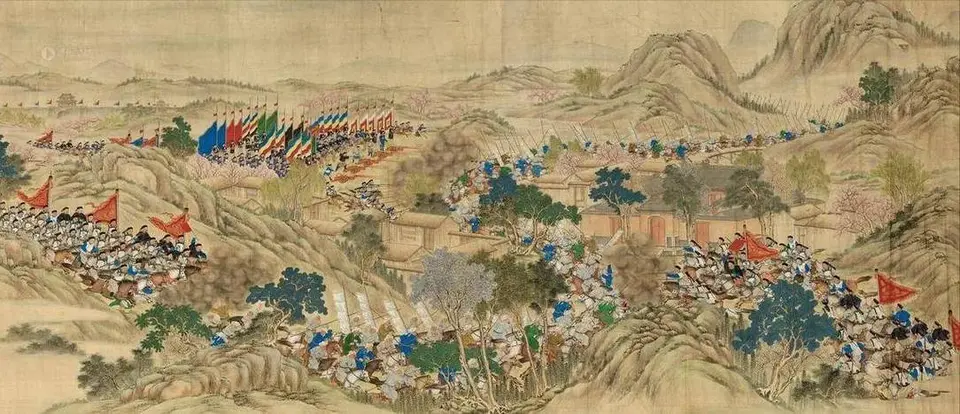
The White Lotus Rebellion in Sichuan and Hubei was a protracted anti-Qing peasant insurrection fought between 1796 and 1804 across the rugged frontier mountainous borders of Hubei, Sichuan, Shaanxi, Henan, and Gansu. During the late Qianlong era, rapid population expansion and aggressive land concentration compelled millions of displaced migrants to seek subsistence within the primeval forests of the Qinling and Daba Mountains. The millenarian White Lotus sect spread rapidly among these marginalized populations through its doctrines of mutual material assistance and the advent of the Maitreya Buddha. When predatory Qing magistrates engaged in extortion under the guise of suppressing heresy, widespread rebellion erupted. In early 1796, leaders Zhang Zhengmo, Wang Cong'er, Yao Zhifu, Xu Tiande, and Wang Sanhuai took up arms. Assembling over one hundred thousand rebels, the insurgents outmaneuvered imperial armies through mobile guerrilla warfare across several provinces. Following the death of the Qianlong Emperor in 1799, the Jiaqing Emperor purged the corrupt grandee Heshen and overhauled counter-insurgency doctrine. Imperial commanders Lebao and Eledengbao instituted a brutal strategy of clearing the countryside, concentrating peasants within fortified stone redoubts, and raising disciplined local militia battalions. Deprived of food, shelter, and popular support, the rebel bands were hunted down and extinguished by 1804. The conflict drained more than two hundred million taels from imperial coffers, shattered the martial reputation of the Eight Banners, and initiated the structural decline of the Qing empire.
Liu Zhixie plans a multi-provincial uprising; official dragnets and extortions provoke the slogan "officials have forced the people to rebel."
Zhang Zhengmo and Nie Jieren initiate armed revolt in Hubei ahead of schedule, sparking widespread resistance across the province.
Wang Cong'er and Yao Zhifu mobilize the Xiangyang congregations, adopting fluid guerrilla tactics to evade imperial armies.
Xu Tiande and Wang Sanhuai lead insurrections in Dazhou and Dongxiang, drawing widespread migrant support across Sichuan.
Xiangyang forces cross the mountains into Sichuan, linking with local rebels to form a 100,000-strong army organized under four banners.
Encircled by Qing forces in Yunxi, Hubei, Wang Cong'er and Yao Zhifu leap to their deaths from mountain precipices.
Emperor Jiaqing executes Heshen, replaces corrupt commanders, and appoints Lebao to coordinate pacification across five provinces.
Ran Tianyuan defeats Qing forces at Pengxi before being surrounded and executed at Mount Matou, pushing the rebellion into decline.
The Qing administration enforces fortified village defense, cutting off food and water supplies and confining rebels to deep mountain forests.
The last insurgent detachment under Gou Wenming is wiped out on the border, concluding the nine-year rebellion.
Throughout the High Qing period under the Kangxi, Yongzheng, and Qianlong emperors, domestic peace and agricultural expansion fueled a demographic explosion, with the imperial population surpassing three hundred million by the late eighteenth century. However, runaway land concentration alienated vast segments of the agrarian population, reducing tenant farmers to destitution. Dispossessed peasants, bankrupt laborers, and starving migrants from Henan, Anhui, Jiangxi, and Hubei migrated into the rugged borderlands where Hubei, Sichuan, and Shaanxi converged. By the mid-Qianlong period, over one million migrants had settled within the primeval forests of the Qinling and Daba mountain ranges.
Known locally as shack people, these settlers survived by clearing steep slopes to cultivate maize, burning charcoal, felling timber, and manufacturing paper, dwelling in crude brush shelters. The rapid clearance of mountain slopes exhausted topsoil, while local governance remained non-existent, leaving the region outside the reach of the traditional baojia registration system. Migrants were subjected to extortion by corrupt magistrates, predatory runners, and local bullies, creating acute social volatility across the border wilderness.
In this desperate environment, the White Lotus religion—a millenarian popular faith venerating the Unborn Venerable Mother and prophesying the advent of the Maitreya Buddha—became an appealing spiritual refuge. Sectarian branches preached mutual aid, declaring that all material goods should be shared equally and that believers in distress must be protected, enabling indigent migrants to travel across provincial lines without money. A clandestine network of sectarian congregations spread across the villages of northern Hubei and eastern Sichuan.
Following the suppression of Henan sectarian leader Liu Song in 1775, his disciple Liu Zhixie secretly proselytized across the mountainous borderlands, organizing congregations for armed resistance. In 1793, Liu Zhixie evaded arrest in Henan, prompting the imperial court to order an empire-wide dragnet. Corrupt regional officials, led by Huguang Viceroy Bi Yuan and Hubei Governor Funing, exploited the campaign to extort private wealth from ordinary households. Official runners fabricated sectarian allegations against anyone unable to pay bribes, driving thousands of families into ruin. In response, sectarian leaders rallied the populace with the slogan "officials have forced the people to rebel," agreeing to launch a simultaneous insurrection across Hubei and Sichuan on the tenth day of the third lunar month in 1796.
Faced with escalating arrests and official violence, sectarian leaders Zhang Zhengmo and Nie Jieren were forced to launch an early revolt in Yidu and Zhijiang, Hubei, on the seventh day of the first lunar month in 1796. Insurrections quickly ignited across neighboring counties. On the tenth day of the third month, the Xiangyang congregation, commanded by the young female leader Wang Cong'er and her lieutenant Yao Zhifu, rose according to the original timetable.
While isolated rebel bands attempting to hold static mountain stockades were crushed by imperial forces, Wang Cong'er and Yao Zhifu demonstrated exceptional operational agility. Recognizing that their volunteers lacked heavy siege artillery and regular combat training, Wang Cong'er adopted fluid guerrilla maneuvers, moving rapidly through mountainous passes, eluding imperial cordons, and ambushing Qing baggage trains. Marching by night and concealing their forces in dense forests, the Xiangyang host expanded into a seasoned mobile force of several tens of thousands.
In the ninth lunar month of 1796, eastern Sichuan erupted in sympathetic insurrections led by Xu Tiande in Dazhou and Wang Sanhuai in Dongxiang, drawing tens of thousands of impoverished migrants and capturing several district seats. The Qing court mobilized banner and Green Standard divisions to surround the Sichuan rebels. In early 1797, Wang Cong'er broke through the encirclement lines of Huguang Viceroy Funing, launching an expansive raid through Henan and southern Shaanxi before crossing the Daba Mountains to link up with the Sichuan insurgents at Dongxiang in the seventh month.
The combined insurgent forces exceeded one hundred thousand fighters. To overcome organizational fragmentation, the rebel chiefs convened a war council, electing Wang Cong'er as commander-in-chief of the forward army. The insurgents organized into four corps identified by yellow, white, blue, and green banners, creating titles such as chancellor, marshal, vanguard, and general. The coalition executed coordinated sweeps across northern Sichuan and southern Shaanxi, routing imperial pursuit forces under Shaan-Gan Viceroy Yimian, Huguang Viceroy Jing'an, and Sichuan Viceroy Huiling.
Faced with the spreading rebellion, the Qing high command descended into paralysis. During the final years of the Qianlong Emperor's retirement, imperial grandee Heshen dominated the government, using the military crisis to siphon enormous sums into private pockets. Senior Manchu field commanders falsified casualty counts and extorted local treasuries, while imperial soldiers committed widespread looting, alienating the populace. In the third month of 1798, while attempting to lead her mobile army from northern Sichuan back into Hubei, Wang Cong'er was encircled by Qing forces under Delengtai and Mingliang within the steep gorges of Yunxi, Hubei. After days of fierce combat, Wang Cong'er and Yao Zhifu leaped from high cliffs to their deaths rather than face capture.
On the third day of the first lunar month in 1799, the Qianlong Emperor passed away, and the Jiaqing Emperor assumed personal control of the state. Jiaqing acted swiftly, arresting and ordering the suicide of Heshen, confiscating his vast fortune, and cashiering incompetent field marshals. Emperor Jiaqing recognized that military sweeps alone could not extinguish the rebellion. He appointed Lebao as Imperial Commissioner, naming Eledengbao and Mingliang as deputy commanders to coordinate operations across five provinces under the comprehensive doctrine of combining military pacification with rural fortification.
Under the strategic counsel of magistrate Gong Jinghan and scholar Yan Ruyi, the Qing administration shifted from active field pursuits to rural lockdown. Imperial authorities mandated that all rural households dismantle isolated homesteads and relocate into concentrated hilltop villages protected by stone ramparts and deep ditches. All harvest grain, livestock, and fodder were moved into these fortified redoubts, while standing crops outside the walls were cut down or incinerated.
Concurrently, the court authorized local gentry to raise and command local militia battalions known as xiangyong, placing them under capable Han commanders including Yang Yuchun, Yang Fang, and Luo Siju. Operating from well-supplied stone forts, the militias defended the passes, denying the insurgents food, water, and recruits. Arriving before fortified, self-sufficient villages, the rebels found themselves trapped within a scorched-earth perimeter, unable to replenish provisions or replace casualties.
Despite these crushing pressures, insurgent commanders Ran Tianyuan, Xu Tiande, and Wang Sanhuai continued to strike with desperate bravery. In early 1800, Ran Tianyuan forced a crossing of the Jialing River, routing Qing forces at Pengxi and slaying brigade general Zhu Shedou. He later ambushed Eledengbao's vanguard at Jiangyou, advancing to the outskirts of Chengdu. However, surrounded by reinforcing militia and banner units, Ran Tianyuan was captured and executed at Mount Matou, while Wang Sanhuai was lured into captivity and executed in Beijing.
In late 1800, Eledengbao was elevated to Imperial Commissioner, enforcing a strategy of relentless pursuit and tactical containment. The court promulgated an imperial proclamation distinguishing between rebel ringleaders and coerced followers, pardoning commoners who abandoned the camps. Worn down by famine and continuous attacks, insurgent strength plummeted from tens of thousands to a few thousand fighters trapped within the deepest mountain forests. In the ninth lunar month of 1804, the final insurgent chieftain, Gou Wenming, was tracked down and slain on the Sichuan-Shaanxi frontier, bringing the nine-year rebellion to an end.
The White Lotus Rebellion inflicted unprecedented material and institutional damage upon the Qing dynasty. Spanning eight years and eight months across five provinces, the suppression campaign compelled the Qing throne to mobilize regular troops from sixteen provinces, resulting in the deaths of dozens of general officers and over four hundred field grade officers. The war consumed over two hundred million taels of silver—equivalent to nearly five years of imperial treasury revenues—exhausting the reserves accumulated during the Qianlong era. Crucially, the conflict shattered the reputation of the Manchu Eight Banners and Green Standard Armies, exposing their rampant cowardice, indiscipline, and operational incompetence.
The conflict marked an institutional turning point in late imperial Chinese history. To compensate for regular military collapse, the Qing court was forced to cede military and fiscal authority to regional Han elites, relying upon local gentry-led militias (xiangyong) and Han commanders such as Yang Yuchun and Yang Fang. This precedent laid the structural foundations for the rise of the Hunan and Huai Armies during the Taiping Rebellion half a century later. Although the White Lotus movement was extinguished, it permanently shattered the political authority of the High Qing, serving as the historical milestone marking the transition of the Qing dynasty from peak prosperity into irreversible structural decline.