Accession of Emperor Hui
Emperor Wu dies; his mentally incapacitated son Sima Zhong ascends the throne as Emperor Hui; Grand Tutor Yang Jun monopolizes government.
Western Jin Dynasty (西晋) · HISTORICAL EVENT
八王之乱
The War of the Eight Princes (八王之乱) was a catastrophic sixteen-year civil war of imperial succession that devastated the Western Jin Empire from 291 to 306 CE. Having overthrown the Cao Wei dynasty, Emperor Wu of Jin (Sima Yan) attributed Wei's collapse to its failure to enfeoff the imperial clan. To insulate his house, Emperor Wu granted sweeping territorial fiefs, personal armies, administrative autonomy, and provincial military commands to Sima…
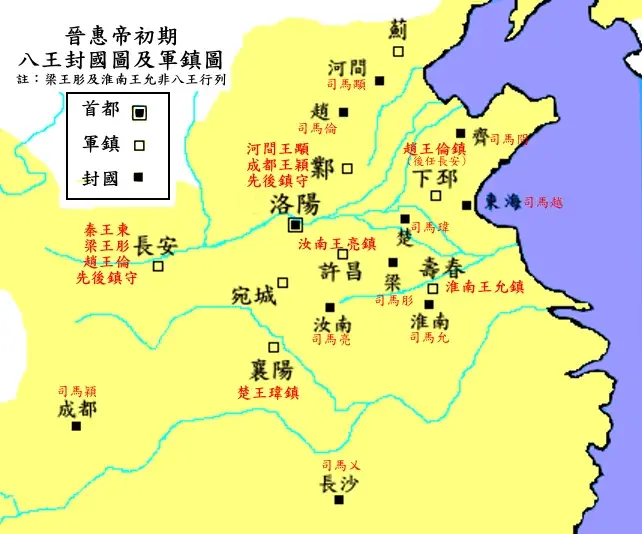
The War of the Eight Princes (八王之乱) was a catastrophic sixteen-year civil war of imperial succession that devastated the Western Jin Empire from 291 to 306 CE. Having overthrown the Cao Wei dynasty, Emperor Wu of Jin (Sima Yan) attributed Wei's collapse to its failure to enfeoff the imperial clan. To insulate his house, Emperor Wu granted sweeping territorial fiefs, personal armies, administrative autonomy, and provincial military commands to Sima imperial princes, inadvertently institutionalizing autonomous warlord kingdoms. Following Emperor Wu's demise, his mentally challenged son Emperor Hui (Sima Zhong) ascended the throne, allowing the ambitious and ruthless Empress Jia Nanfeng to seize court authority. Empress Jia launched bloody purges against consort regent Yang Jun, leveraging Prince of Runan Sima Liang and Prince of Chu Sima Wei before liquidating them in turn. When Empress Jia murdered Crown Prince Sima Yu in 300, Prince of Zhao Sima Lun staged a coup, executed the empress, and usurped the imperial throne. This blatant usurpation ignited an all-out civil war among imperial princes across China. Rival coalitions led by Prince of Qi Sima Jiong, Prince of Chengdu Sima Ying, Prince of Hejian Sima Yong, Prince of Changsha Sima Ai, and Prince of Donghai Sima Yue repeatedly besieged the capitals of Luoyang and Chang'an, recklessly enlisting northern nomadic cavalry from the Xiongnu, Xianbei, and Wuhuan. The protracted fratricide depopulated the Central Plains, slaughtered civil elites, and reduced both imperial capitals to ashes. Although Sima Yue ultimately secured hegemony, the devastation obliterated Western Jin's military resilience, directly provoking the Disaster of Yongjia and centuries of partition during the Sixteen Kingdoms era.
Emperor Wu dies; his mentally incapacitated son Sima Zhong ascends the throne as Emperor Hui; Grand Tutor Yang Jun monopolizes government.
Empress Jia Nanfeng summons Prince of Chu Sima Wei to Luoyang, killing Yang Jun and his clan and starving Empress Dowager Yang.
Empress Jia directs Sima Wei to execute regents Sima Liang and Wei Guan, then executes Sima Wei for unauthorized murder, securing absolute authority.
Empress Jia forces the intoxicated Crown Prince Sima Yu to transcribe treasonous texts, demoting him to a commoner and imprisoning him in Xuchang.
Empress Jia poisons Crown Prince Sima Yu; Prince of Zhao Sima Lun stages a palace coup, executing Empress Jia, Zhang Hua, and Pei Wei to seize power.
Sima Lun deposes Emperor Hui and declares himself emperor; Prince of Qi Sima Jiong rallies imperial princes to launch a loyalist campaign.
Sima Jiong, Sima Ying, and Sima Yong capture Luoyang, execute Sima Lun, and restore Emperor Hui to the throne.
Prince of Qi Sima Jiong abuses power; Prince of Changsha Sima Ai stages an urban assault in Luoyang, executing Sima Jiong after three days of combat.
Sima Ying and Sima Yong deploy two hundred and seventy thousand troops to besiege Luoyang; Sima Ai mounts a brilliant defense.
Prince of Donghai Sima Yue stages a midnight mutiny, delivering Sima Ai to General Zhang Fang, who burns him alive.
Sima Yue escorts Emperor Hui on an expedition against Ye; Shi Chao ambushes the imperial camp at Dangyin, wounding the emperor; Wang Jun sacks Ye with Xianbei cavalry.
General Zhang Fang plunders Luoyang and forcibly relocates Emperor Hui and Sima Ying to Chang'an under Sima Yong's control; Liu Yuan rebels in Shanxi.
Sima Yue deploys Xianbei horsemen to capture Chang'an, executes Zhang Fang, and escorts Emperor Hui back to Luoyang; Sima Ying and Sima Yong are killed.
Emperor Hui dies after eating poisoned cakes; Sima Yue enthrones Emperor Huai and takes power, setting the stage for the Disaster of Yongjia five years later.
The Western Jin dynasty was founded upon the political support of hereditary aristocratic lineages through a managed abdication from Cao Wei. Refuting Cao Wei's policy of isolating imperial kinsmen, Emperor Wu believed that only a vast network of blood-related princes could shield the imperial lineage from usurpers. In 265 CE, Emperor Wu enfeoffed twenty-seven Sima agnates as territorial princes with commandery-sized states. In 277, he enacted statutes granting princely kingdoms standing armies, ranging from fifteen hundred men for minor kingdoms to five thousand for major realms. In 289, Emperor Wu implemented the regional command system, stationing principal princes across provincial frontiers as regional military commanders. By consolidating judicial, fiscal, and operational military powers in princely hands, the court cultivated autonomous regional principalities with the military might to challenge central authority.
A profound structural crisis emerged through imperial succession. Emperor Wu's eldest son died prematurely, leaving the second son, Sima Zhong, as crown prince. Sima Zhong suffered from severe intellectual disability, notoriously inquiring why starving peasants did not eat minced meat during famines. Although Emperor Wu recognized his son's incapacity, the sovereign was seduced by the intelligence of his grandson Sima Yu and swayed by Empress Yang's advocacy, ultimately failing to disinherit Sima Zhong. Upon Emperor Wu's death in 290 CE, Sima Zhong ascended the throne as Emperor Hui. Lacking autonomous political agency, the sovereign became a helpless pawn, dissolving monarchical legitimacy and rendering the imperial throne the object of violent competition.
Following Emperor Hui's accession, Grand Tutor Yang Jun—father of Empress Dowager Yang Zhi—monopolized central administration and sidelined rival lineages. Emperor Hui's consort, Empress Jia Nanfeng, possessed fierce political ambition and deeply resented Yang Jun's hegemony. She formed clandestine ties with palace guards Meng Guan and Li Zhao, while summoning Prince of Chu Sima Wei from Jingzhou and Prince of Runan Sima Liang from Xuchang. In 291 CE, Empress Jia forged an imperial edict branding Yang Jun a traitor, surrounded his mansion with palace guards, and slaughtered thousands of Yang kinsmen while starving Empress Dowager Yang to death in Jinyong Castle. However, with the Yang clan eradicated, Empress Jia discovered that imperial princes posed an even more existential threat to her autocracy.
In the third month of 291 CE (the first year of the Yuankang era), Empress Jia mobilized elite troops under Prince of Chu Sima Wei to wipe out Grand Tutor Yang Jun inside Luoyang. Following this slaughter, the court appointed senior statesman Prince of Runan Sima Liang and veteran general Wei Guan as joint regents directing the Secretariat, while Emperor Wu's fifth son, Sima Wei, became General of the Guards commanding the metropolitan garrison. Revered for their integrity, Sima Liang and Wei Guan grew wary of Sima Wei's aggressive temperament, submitting memorials to strip his command and send him back to his Jingzhou fief. Sima Wei refused to depart.
Recognizing that Sima Liang and Wei Guan obstructed her path to supreme authority, Empress Jia enacted a treacherous stratagem. In the sixth month of 291, she issued an imperial decree in Emperor Hui's name to Sima Wei, falsely claiming that Sima Liang and Wei Guan were plotting treason and directing Sima Wei to arrest them. Sima Wei assembled his northern garrison troops and encircled Sima Liang's mansion and Wei Guan's compound. Despairing of civil war, Sima Liang surrendered without resistance and was murdered by mutinous soldiers, while Wei Guan and nine sons and grandsons were massacred.
Having eliminated the regents, Empress Jia immediately turned on Sima Wei. Fearful of his military strength and volatile ambition, she dispatched the Chamberlain for Law Enforcement at dawn to surround Sima Wei's camp, publicly proclaiming that Sima Wei had forged imperial edicts to murder the chief ministers. Abandoned by his troops, Sima Wei was captured and summarily executed in Luoyang's public marketplace at age twenty-one. Within three months, Empress Jia had eliminated Yang Jun, Sima Liang, and Sima Wei, consolidating autocratic control over the imperial court for the next nine years.
During Empress Jia's dominance, the central administration retained stability through the capable statesmanship of ministers Zhang Hua and Pei Wei. However, Empress Jia remained childless, while Emperor Hui's only son, Crown Prince Sima Yu, matured into an intelligent young man who openly despised the Jia clan. Terrified that the prince would execute her family upon accession, Empress Jia resolved to liquidate him. In the twelfth month of 299 CE, she intoxicated Prince Sima Yu and coerced him into transcribing a treasonous draft demanding the emperor's abdication, presenting the document to compel Emperor Hui to demote the prince to a commoner and imprison him in Xuchang.
The prince's deposition provoked widespread outrage. Prince of Zhao Sima Lun (ninth son of Sima Yi and granduncle of Emperor Hui), who commanded the metropolitan palace guards, conspired with advisor Sun Xiu to seize power. Sun Xiu calculated a deadly plot: he intentionally leaked rumors that loyalists planned to restore the crown prince, provoking a panicked Empress Jia into ordering her agents in Xuchang to bludgeon twenty-two-year-old Sima Yu to death with a pestle. Sima Yu's murder handed Sima Lun the pretext for rebellion. In the fourth month of 300 CE, Sima Lun mobilized palace guards to seize Empress Jia and her kinsmen, forcing her to drink poisoned wine while executing Zhang Hua and Pei Wei.
Following Empress Jia's execution, Prince of Zhao Sima Lun assumed the titles of Grand Commandant and Chancellor, monopolizing central power alongside his venal confidant Sun Xiu. Sima Lun distributed aristocratic ranks indiscriminately to cooks, guards, and slaves, generating the popular derisive proverb that sable tails were insufficient and had to be pieced out with dog tails. In the first month of 301 CE, Sima Lun deposed Emperor Hui, declared himself emperor under the reign title of Jianshi, and confined Emperor Hui in Jinyong Castle.
This usurpation shattered all legitimacy within the imperial clan. Stationed at Xuchang, Prince of Qi Sima Jiong (nephew of Emperor Wu) dispatched a nationwide manifesto rallying imperial kinsmen to defend the dynastic line. Prince of Chengdu Sima Ying at Ye and Prince of Hejian Sima Yong in the Guanzhong region immediately joined the coalition. Sima Ying led tens of thousands of northern elite troops across the Yellow River, while Sima Jiong mobilized over one hundred thousand soldiers from Yuzhou. Sima Lun deployed generals Zhang Hong and Sun Hui with royal guards to contest the river crossings.
Fierce battles erupted around Wen County and Yangdi south of the Yellow River, inflicting tens of thousands of casualties. Sima Ying's assault columns shattered Sima Lun's defensive lines; simultaneously, palace guard general Wang Yu staged an internal insurrection inside Luoyang, executed Sun Xiu, and restored Emperor Hui to the throne. Sima Lun was captured and forced to drink poisoned wine, and his lineage was exterminated. This multi-month war marked the fateful transformation of palace coups into full-scale inter-regional civil war, leaving more than one hundred thousand soldiers and civilians dead.
Following Emperor Hui's restoration, Prince of Qi Sima Jiong entered Luoyang as chief regent with the title of Grand Marshal. However, Sima Jiong quickly replicated the arrogance of his predecessors, constructing vast palatial residences, commanding hundreds of thousands of troops, and marginalizing the imperial court. Resenting Sima Jiong's monopoly, Prince of Chengdu Sima Ying and Prince of Hejian Sima Yong conspired to overthrow him. In the twelfth month of 302 CE, Sima Yong dispatched General Li Han from Guanzhong toward Luoyang, secretly directing Prince of Changsha Sima Ai, who resided in the capital, to attack Sima Jiong from within.
Prince of Changsha Sima Ai was a man of resolute courage and unswerving dynastic loyalty. Receiving the secret directive, Sima Ai mobilized over a hundred palace retainers to assault Sima Jiong's headquarters. Sima Jiong responded with tens of thousands of retainers, initiating three days and nights of savage urban warfare across Luoyang's streets and palace courtyards. Raging fires consumed imperial gatehouses and civilian quarters under torrential arrow fire. Sima Ai fought in the front ranks; inspired by his heroism, metropolitan troops and citizens rallied to his side, storming the Grand Marshal's mansion and capturing Sima Jiong, who was beheaded alongside two thousand retainers. Sima Ai assumed the regency as Grand Commandant, serving Emperor Hui with diligence, but rival princes refused to accept central authority.
Operating as regent, Prince of Changsha Sima Ai practiced frugality and upheld monarchical dignity. However, Prince of Hejian Sima Yong had anticipated that Sima Ai would be killed by Sima Jiong, intending to establish Prince of Chengdu Sima Ying as crown prince and himself as chancellor. Astounded by Sima Ai's survival, Sima Yong formed an alliance with Sima Ying to crush the capital. In the eighth month of 303 CE, Sima Ying advanced south from Ye with two hundred thousand northern troops, while Sima Yong dispatched General Zhang Fang with seventy thousand Guanzhong soldiers to strike from the west, encircling Luoyang in a pincer movement.
Sima Ai personally escorted Emperor Hui to the battlefront, coordinating defensive fortifications outside the capital and repeatedly repelling allied assaults, crushing Zhang Fang's forces at Shisanku Bridge. The siege persisted for months, completely cutting off food supplies. Grain prices skyrocketed, forcing soldiers and civilians to slaughter warhorses and exchange children for food, resulting in widespread famine. Nevertheless, inspired by Sima Ai's leadership, the defenders held fast, and the allied armies suffered tens of thousands of casualties.
However, Minister of Works Prince of Donghai Sima Yue, envious of Sima Ai's glory and terrified of defeat, staged a midnight mutiny with palace guards in the first month of 304 CE, seizing Sima Ai and imprisoning him in Jinyong Castle. To curry favor with Zhang Fang, Sima Yue delivered Sima Ai into the hands of the Guanzhong warlord. Zhang Fang tied twenty-eight-year-old Sima Ai to a wooden pyre and roasted him alive over an open fire, plunging Luoyang into tears. Sima Ai's martyrdom destroyed the last remaining hope for legitimate dynastic governance.
Following Sima Ai's death, Prince of Chengdu Sima Ying entered Luoyang, assumed the titles of Chancellor and Crown Brother, and shifted the imperial court to his stronghold at Ye. Sima Ying ruled with wanton tyranny, provoking bitter resentment throughout the Central Plains. Chafing at his subordinate position, Prince of Donghai Sima Yue staged a coup in Luoyang in July 304 CE, escorting Emperor Hui on an expedition of over one hundred thousand men to attack Ye.
Sima Yue's forces advanced to Dangyin (modern Tangyin, Henan), where Sima Ying's general Shi Chao launched a devastating surprise cavalry assault on the disorganized imperial encampment. The imperial army disintegrated; Sima Yue abandoned the emperor and fled to his Donghai fief. A shower of arrows enveloped Emperor Hui's carriage, wounding the sovereign with three arrows to the face and drenching his dragon robes in blood while courtiers fled. Only Attendant Gentleman Ji Shao (son of Ji Kang) stepped forward to shield the emperor with his body, and was hacked to death on the carriage shaft. Emperor Hui wept bitterly as Shi Chao took him prisoner to Ye.
The disaster at Dangyin prompted Bingzhou Inspector Sima Teng (Sima Yue's brother) and Youzhou Inspector Wang Jun to rebel against Sima Ying. To achieve military supremacy, Wang Jun recruited tens of thousands of Duan Xianbei and Wuhuan nomadic cavalry to march on Ye. The nomadic horsemen routed Sima Ying's army, stormed Ye, and subjected the city to brutal pillage, capturing thousands of women and reducing the northern capital to ashes. Sima Ying fled to Luoyang with Emperor Hui, only to be seized by General Zhang Fang and forcibly relocated to Chang'an, spreading the conflagration across northern China.
In Chang'an, Prince of Hejian Sima Yong and Zhang Fang dominated the captive Emperor Hui, stripping Sima Ying of his title as Crown Brother. Resenting Guanzhong's dominance, eastern aristocrats and regional garrisons rallied behind Prince of Donghai Sima Yue. In 305 CE, Sima Yue launched a major western counter-offensive from Shandong, mobilizing regional coalitions alongside Tuoba Xianbei and Wuhuan auxiliary horsemen.
In the spring of 306 CE, Sima Yue's general Qi Hong led allied cavalry to crush the Guanzhong armies, storming through Tongguan. Sima Yong executed Zhang Fang in an attempt to sue for peace, but could not halt the eastern advance. In the fifth month, Qi Hong captured Chang'an; allied non-Han cavalry plundered the city, killing over twenty thousand people. Qi Hong secured Emperor Hui and escorted him back to Luoyang alongside Sima Yue. In June, Emperor Hui re-entered Luoyang and proclaimed the Guangxi era.
Having secured total dominance, Sima Yue carried out the systematic liquidation of his rivals. Sima Ying was strangled on his flight northward, and his sons were butchered; Sima Yong was strangled inside his carriage by assassins sent by Sima Yue's brother Sima Mo while traveling to the capital under an imperial pardon. In the eleventh month of 306 CE, Emperor Hui died suddenly after consuming poisoned cakes in Luoyang, widely believed to have been poisoned by Sima Yue. Sima Yue enthroned Emperor Wu's twenty-fifth son Sima Chi as Emperor Huai, changing the reign title to Yongjia. Thus, of the principal belligerents—Sima Liang, Sima Wei, Sima Lun, Sima Jiong, Sima Ai, Sima Ying, and Sima Yong—all perished with their clans, leaving only Sima Yue in possession of supreme authority. The sixteen-year War of the Eight Princes concluded.
The conclusion of the War of the Eight Princes brought no relief, but rather cast Western Jin into existential catastrophe. Sixteen years of civil war had decimated the dynasty's military elite, drained its fiscal reserves, and dismantled frontier defense networks. In their desperate bids for the throne, the princes had invited Xiongnu, Jie, Xianbei, Di, and Qiang nomadic cavalry into the Chinese heartland, exposing the complete vulnerability of central defenses.
In 304 CE, amidst the height of princely combat, Southern Xiongnu aristocrat Liu Yuan rebelled at Lishi in Shanxi, proclaiming himself King of Han, while Ba-Di chieftain Li Xiong declared himself King of Chengdu in Sichuan, opening the era of the Sixteen Kingdoms. Only five years after the end of the civil war, in 311 CE (the fifth year of Yongjia), Liu Yuan's successor Liu Cong dispatched generals Shi Le, Liu Yao, and Huyan Yan to capture Luoyang. The invaders captured Emperor Huai, massacred over thirty thousand imperial princes and officials, plundered imperial tombs, and burned the palaces to the ground in the Disaster of Yongjia. In 316 CE, Liu Yao captured Chang'an and executed Emperor Min, extinguishing the Western Jin dynasty and plunging northern China into nearly three centuries of division and devastation.
The sixteen-year War of the Eight Princes concluded with the pyrrhic supremacy of Prince of Donghai Sima Yue. Across the protracted conflict, the core branches of the Sima imperial house were exterminated, leaving the dynasty devoid of military commanders and administrative leaders. The metropolitan regions of Luoyang and Chang'an were repeatedly sacked, burned, and depopulated, while the central treasury and imperial armies ceased to exist. Although Sima Yue poisoned Emperor Hui and enthroned Emperor Huai, imperial authority over provincial commanderies had completely vanished, leaving the empire defenseless against external invasion.
The War of the Eight Princes was the decisive cataclysm that destroyed the Western Jin dynasty and reshaped Chinese civilization. Economically and demographically, continuous campaigns depopulated the agricultural heartlands of Henan, Guanzhong, and Hebei, triggering catastrophic famines and reducing both capitals to smoking ruins. Militarily, the competing princes dismantled northern defensive garrisons while enlisting non-Han cavalry into domestic civil wars, revealing the complete military impotence of the imperial state. Seizing this opportunity, Xiongnu leader Liu Yuan established the Han-Zhao state in 304 CE, initiating the era of the Sixteen Kingdoms and the Disaster of Yongjia in 311 CE. The destruction of Western Jin compelled surviving aristocratic lineages to migrate south across the Yangtze, opening nearly three centuries of division between northern non-Han dynasties and southern regimes.