Outbreak of Rebellion
An Lushan mobilizes border forces at Fanyang and surges south toward Luoyang.
Tang Dynasty (唐朝) · HISTORICAL EVENT
天宝之乱
The An Lushan Rebellion was a monumental military rebellion and civil war that shook the Tang Dynasty between 755 and 763. Originating during the late reign of Emperor Xuanzong of Tang, regional military commissioner An Lushan mobilized massive frontier garrison forces across northern commands and launched an open insurrection against the imperial court. The catastrophic conflict ravaged both imperial capitals, devastated northern agricultural heartlands,…
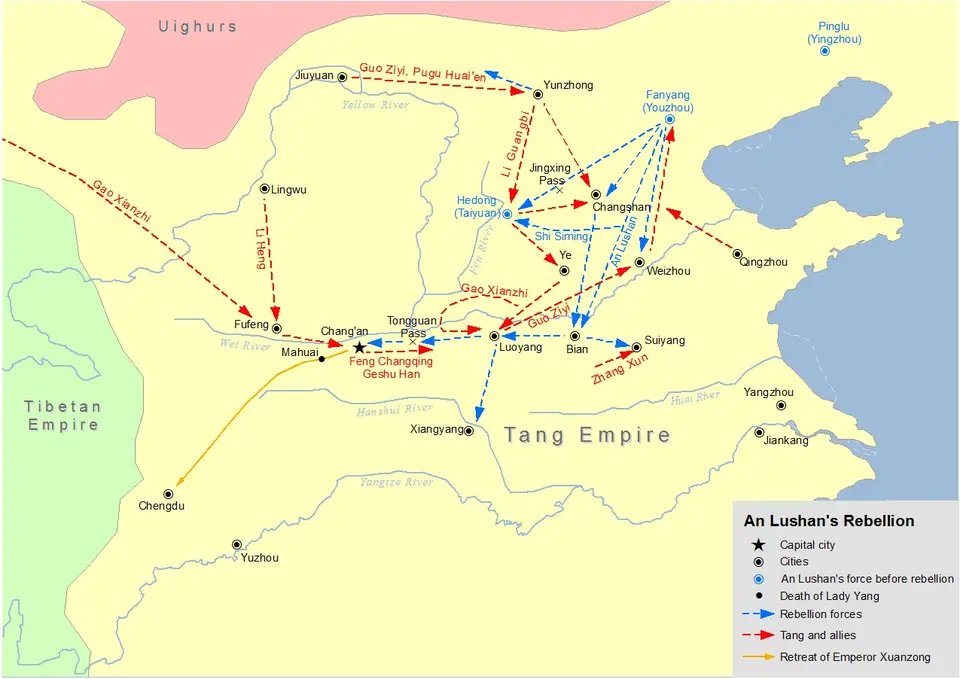
The An Lushan Rebellion was a monumental military rebellion and civil war that shook the Tang Dynasty between 755 and 763. Originating during the late reign of Emperor Xuanzong of Tang, regional military commissioner An Lushan mobilized massive frontier garrison forces across northern commands and launched an open insurrection against the imperial court. The catastrophic conflict ravaged both imperial capitals, devastated northern agricultural heartlands, and permanently terminated the High Tang golden age, reshaping the medieval Chinese institutional landscape.
An Lushan mobilizes border forces at Fanyang and surges south toward Luoyang.
Rebel forces cross the Yellow River and capture the Eastern Capital Luoyang; An Lushan proclaims the Great Yan dynasty in the following month.
Swayed by slander, Emperor Xuanzong executes loyal commanders Feng Changqing and Gao Xianzhi at Tong Pass.
Pressured by Yang Guozhong, Geshu Han leads his army out of Tong Pass and is ambushed and routed at Lingbao.
Imperial guards mutiny at Mawei Station during the flight from Chang'an, killing Yang Guozhong and forcing the death of Consort Yang.
Crown Prince Li Heng ascends the throne at Lingwu as Emperor Suzong, organizing the counter-offensive.
Yan forces capture Luoyang and Chang'an; Xuanzong flees; Suzong ascends throne at Lingwu.
An Lushan assassinated; Guo Ziyi and Uyghur cavalry retake Chang'an and Luoyang.
Shi Siming usurps Yan leadership, breaks the Siege of Yecheng, and recaptures Luoyang.
Shi Chaoyi commits suicide following crushing military defeats, ending the eight-year rebellion.
The seeds of the catastrophe were sown during the reign of Emperor Xuanzong of Tang. To counter external border threats from the Tibetan Empire and nomadic confederations, the imperial court established powerful regional military commissions known as frontier commands along the peripheral marches. These commissioners commanded massive standing armies and exercised extensive financial and administrative control over frontier regions.
Meanwhile, the imperial capital suffered from severe political decay and administrative paralysis. Xuanzong increasingly indulged in luxury and delegated sovereign governance to chancellor Yang Guozhong, whose bitter rivalry with An Lushan deepened mutual distrust. An Lushan, who simultaneously commanded three crucial frontier commands in modern Hebei, Liaoning, and Shanxi, accumulated enormous logistical reserves and elite non-Han cavalry units, preparing secretly for an armed showdown with the central government.
In December 755, An Lushan formally launched his insurrection from Fanyang under the pretext of overthrowing the corrupt chancellor Yang Guozhong. Leading over one hundred and fifty thousand elite veteran troops, the rebel forces swept southward across the Yellow River with astonishing speed. Tang local garrisons in the interior, unaccustomed to prolonged combat, collapsed rapidly before the fierce onslaught.
In early 756, An Lushan seized the eastern capital of Luoyang and proclaimed himself emperor of the Great Yan dynasty. Confronted with the imminent threat to the Tongpass defense corridor, Emperor Xuanzong executed loyal defensive generals Geshu Han's cautious strategy by forcing an ill-advised offensive into open plains. The Tang army was routed, the strategic mountain pass fell, and the rebel army marched directly toward Chang'an.
Emperor Xuanzong fled southwest into Sichuan. During the chaotic retreat at Mawei Courier Station, mutinous imperial guards lynched chancellor Yang Guozhong and compelled the emperor to order the suicide of Consort Yang Guifei. Meanwhile, Crown Prince Li Heng parted company and headed north to Lingwu, where he assumed the imperial throne as Emperor Suzong. Suzong consolidated loyal northwestern frontier forces and enlisted allied cavalry from the Uyghur Khaganate to counter the rebellion.
Internal power struggles soon tore through the rebel leadership. In 757, An Lushan was assassinated by his own son An Qingxu. Capitalizing on this turmoil, supreme Tang commanders Guo Ziyi and Li Guangbi coordinated joint counteroffensives, successfully liberating both Chang'an and Luoyang later that year. However, rebel general Shi Siming rallied remnant forces in northern Hebei, murdered An Qingxu, and reignited the rebellion with savage ferocity.
The protracted war continued until Shi Siming was in turn murdered by his son Shi Chaoyi in 761. Weakened by endemic fratricide and pressed relentlessly by combined Tang and Uyghur armies, the Yan forces collapsed. In early 763, Shi Chaoyi was hunted down and committed suicide, bringing eight devastating years of total warfare to a formal conclusion.
The An Lushan rebellion marked the definitive dividing line between High Tang prosperity and Middle Tang retrenchment. The conflict annihilated vast populations, obliterated northern agricultural infrastructure, and drastically eroded central tax revenues, forcing the imperial court to abandon the equal-field land distribution system and transition toward two-tax monetary collections.
Furthermore, the imperial settlement relied heavily on appeasing surrendered rebel generals by confirming their hereditary governorships across Hebei and Henan. This policy entrenched semi-autonomous military commissions that resisted central administrative oversight, creating perpetual fiscal and military decentralization that plagued the remainder of the Tang Dynasty.
Traditional and contemporary historians regard the rebellion as one of the most destructive catastrophes in Chinese imperial history. Sima Guang in the Comprehensive Mirror for Aid in Governance observed that the disaster permanently crippled imperial authority, reducing prosperous civilian regions to ghost towns. The conflict demonstrated the fatal peril of concentrating professional offensive legions on peripheral frontiers while leaving the imperial core institutionally demilitarized.