Foundation of Northern Wei
Tuoba Gui convenes northern tribes at Niuchuan, establishing Northern Wei and converting nomadic warriors into settled farmers.
Northern Zhou Dynasty (北周) · HISTORICAL EVENT
北朝
The Northern Dynasties designates the collective sequence of five northern regimes—Northern Wei, Eastern Wei, Western Wei, Northern Qi, and Northern Zhou—that confronted the Southern Dynasties between 386 and 581 (from the 1st year of Dengguo to the 1st year of Kaihuang). Following the Disaster of Yongjia, northern China fractured into the chaotic Sixteen Kingdoms. In 386, Xianbei leader Tuoba Gui founded Northern Wei, and in 439 (the 5th year of Taiyan),…
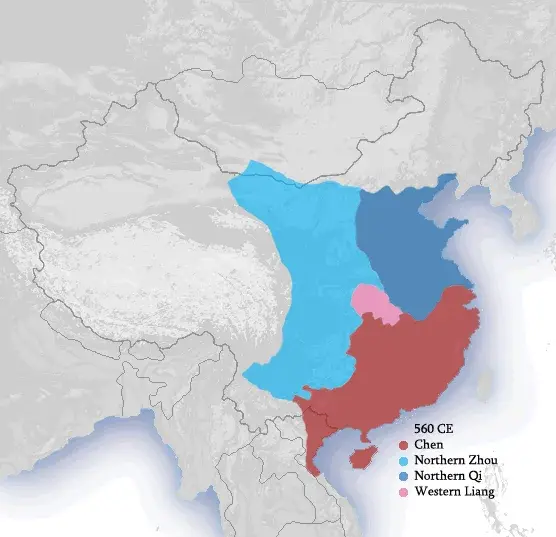
The Northern Dynasties designates the collective sequence of five northern regimes—Northern Wei, Eastern Wei, Western Wei, Northern Qi, and Northern Zhou—that confronted the Southern Dynasties between 386 and 581 (from the 1st year of Dengguo to the 1st year of Kaihuang). Following the Disaster of Yongjia, northern China fractured into the chaotic Sixteen Kingdoms. In 386, Xianbei leader Tuoba Gui founded Northern Wei, and in 439 (the 5th year of Taiyan), Emperor Taiwu (Tuoba Tao) conquered Northern Liang to unify the Yellow River basin, initiating the era of Northern and Southern Dynasties. Emperor Xiaowen instituted the Equal-Field System and relocated the capital to Luoyang, executing radical Sinicization policies that prohibited nomadic clothing, mandated the Chinese language, and changed Xianbei surnames, profoundly accelerating ethnic integration. In the late Northern Wei, the Rebellion of the Six Garrisons fragmented the realm into Eastern Wei and Western Wei, which evolved into Northern Qi and Northern Zhou. Western Wei and Northern Zhou forged the Fubing militia system and consolidated the Guanlong military-aristocratic bloc. In 577, Emperor Wu of Northern Zhou annexed Northern Qi to reunify the north. In 581, Yang Jian usurped the Northern Zhou throne to found the Sui dynasty, conquering the Chen dynasty in 589 to end three centuries of fragmentation. The Northern Dynasties created the institutional models of equal land allocation and militia recruitment that powered the golden age of the Sui and Tang dynasties.
Tuoba Gui convenes northern tribes at Niuchuan, establishing Northern Wei and converting nomadic warriors into settled farmers.
Tuoba Gui moves the capital to Pingcheng and assumes the imperial title, establishing legal and administrative institutions.
Tuoba Tao conquers Northern Liang to end the Sixteen Kingdoms, initiating the Northern and Southern Dynasties partition.
Empress Dowager Feng institutes equal land allocations and the Three Chiefs System, laying the foundation for medieval land administration.
Emperor Xiaowen moves the imperial court to Luoyang, mandating Chinese speech, Han dress, and intermarriage while changing the royal surname to Yuan.
Frontier garrisons along the northern borderlands revolt against marginalization, leading to the collapse of the Northern Wei defensive system.
Erzhu Rong massacres thousands of imperial courtiers along the Yellow River, subordinating the imperial court to military commanders.
Emperor Xiaowu flees to Chang'an under Yuwen Tai, while Gao Huan establishes Eastern Wei at Ye, formalizing the east-west divide.
Gao Yang forces the abdication of the Eastern Wei emperor to found Northern Qi at Ye, mounting cavalry expeditions against steppe nomads.
Yuwen Hu deposes the Western Wei sovereign, establishing Northern Zhou at Chang'an and organizing the Fubing militia.
Emperor Wu leads the campaigns that capture Ye and extinguish Northern Qi, reunifying northern China under Northern Zhou.
Yang Jian usurps the Northern Zhou throne to establish the Sui dynasty, conquering the Chen dynasty in 589 to reunify China.
Following the War of the Eight Princes and the Disaster of Yongjia in the early fourth century, nomadic confederations—the Xiongnu, Jie, Xianbei, Di, and Qiang—vied for supremacy across northern China. From Han-Zhao, Later Zhao, Former Yan, and Former Qin to Later Yan and Later Qin, the Yellow River valley experienced a century of rapid dynastic transitions, ethnic strife, and widespread social devastation. High-ranking aristocratic clans fled south across the Yangtze, leaving the north fractured into fortified rural estates, uncultivated farmlands, and destroyed irrigation canals.
Although Former Qin sovereign Fu Jian briefly unified northern China under the guidance of Wang Meng, his catastrophic defeat at the Battle of Fei River in 383 shattered his empire. Northern China fractured once again into regional militarist domains: Murong Xianbei established Later Yan and Western Yan, Qiang warlord Yao Chang founded Later Qin, and regimes like Western Qin and Later Liang emerged across the northwest.
Amidst this protracted fragmentation, the Tuoba clan of the Xianbei people—originating from Gaxian Cave in the Greater Khingan Mountains—gradually expanded across the Daibei plateau. During the late Western Jin, Tuoba Yilu was invested as Prince of Dai for military assistance against the Jie, establishing the state of Dai. Although Former Qin temporarily subjugated Dai, Tuoba chieftains retained military cohesion across the Inner Mongolian grasslands.
In early 386 (the 1st year of Dengguo), young chieftain Tuoba Gui convened an assembly of tribes at Niuchuan, reviving the state of Dai and changing the dynastic name to Wei, known to history as Northern Wei. Tuoba Gui implemented the pivotal policy of disbanding tribal lineages and settling nomads as sedentary agriculturalists, dismantling ancient blood-based clan units and converting nomadic pastoralists into registered taxpaying subjects. Moving his administrative center southward toward the agricultural frontier, Tuoba Gui transferred the capital to Pingcheng (modern Datong, Shanxi) in 398, assumed the title of emperor, and codified bureaucratic ranks and legal codes, laying the foundation for imperial expansion across the Central Plains.
Based in Pingcheng, Northern Wei expanded southward against Later Yan and Later Qin. Tuoba Gui smashed Later Yan armies at the Battle of Canhebei, securing the fertile plains of Hebei, while Emperor Mingyuan annexed strategic fortresses including Hulao and Luoyang from the southern Liu Song dynasty.
Northern unification was completed by the third monarch, Emperor Taiwu (Tuoba Tao). A brilliant cavalry general, Tuoba Tao conducted an expedition against the Hu Xia state in 427, capturing its fortress capital of Tongwan City through a feigned retreat. In 429, he launched an expedition across the Gobi Desert, routing the Rouran Khaganate and forcing the submission of three hundred thousand Gaoche tents, eliminating nomadic threats to his rear.
Tuoba Tao then turned his armies against regional rivals: in 436 (the 2nd year of Taiyan), he extinguished Northern Yan, annexing Liaodong; and in 439 (the 5th year of Taiyan), he besieged Guzang, compelling Northern Liang ruler Juqu Mujian to surrender. The fall of Northern Liang in 439 terminated the Sixteen Kingdoms period and reunified the Yellow River basin after 135 years of fragmentation. Confronting the southern Liu Song dynasty across the Huai River and the Qinling Mountains, China formally entered the Northern and Southern Dynasties era. In 450, Tuoba Tao launched a massive counter-offensive against Liu Song's Yuanjia Northern Expedition, driving his cavalry south to the northern banks of the Yangtze at Mount Guabu, securing strategic military dominance for the northern state.
Having unified the north, Northern Wei confronted acute internal contradictions: a Xianbei military aristocracy attempting to govern millions of Han sedentary farmers. Early nomadic nobles engaged in rampant extortion, while rural Han magnates concealed vast tenant populations from imperial tax registries. Beginning in 465, Empress Dowager Feng (an educated woman of Han ancestry) assumed the regency for over two decades, inaugurating sweeping administrative reforms.
Empress Dowager Feng instituted the Regular Salary System, providing quarterly stipends of silk and grain to civil officials while imposing capital punishment on any magistrate embezzling more than one bolt of silk. She established the Three Chiefs System (organizing five households into a neighborhood, five neighborhoods into a village, and five villages into an association) to register concealed populations, dismantling the tax-shielding private estates of powerful clans. In 485 (the 9th year of Taihe), she promulgated the historic Equal-Field System, allocating uncultivated and state-owned arable land to peasants based on household headcounts. This revived agricultural production and provided the legal template for the land and tax systems of the subsequent Sui and Tang dynasties.
Following Empress Dowager Feng's death in 490, Emperor Xiaowen (Tuoba Hong) assumed personal rule. Convinced that remaining in Pingcheng would keep the dynasty isolated from classical civilization, Xiaowen moved the imperial capital to Luoyang in 494 under the pretext of launching a southern military campaign.
In Luoyang, Emperor Xiaowen enacted comprehensive Sinicization: he banned traditional Xianbei clothing in favor of Han court robes; prohibited the use of the Xianbei language in court deliberations among officials under thirty years of age; changed the royal surname from Tuoba to Yuan, commanding other Xianbei nobles to adopt Chinese single-character surnames (such as Baba to Changsun, and Daxi to Xi); ranked Xianbei and Han lineages within a unified aristocratic register; and vigorously promoted intermarriage between imperial Xianbei lineages and premier northern Han clans (the Cui, Lu, Li, and Zheng). Xiaowen's reforms broke down ethnic barriers and advanced social integration, but alienated the conservative Xianbei garrison forces stationed along the northern frontiers, setting the stage for future rebellions.
While the Xianbei nobility in Luoyang assimilated into Han aristocratic luxury, the veteran troops defending the Six Frontier Garrisons (Woye, Huaishuo, Wuchuan, Fuming, Rouxuan, and Huaihuang) along the Inner Mongolian perimeter were marginalized. Formerly celebrated as the core defenders of the dynasty, the frontier soldiers were reduced to hereditary military penal status, denied promotions and suffering from food shortages.
In 523 (the 4th year of Zhengguang), the garrison at Huaihuang executed their commander following an outbreak of famine, sparking the Rebellion of the Six Garrisons across northern China. Led by Poluhan Baling and regional chieftains, hundreds of thousands of frontier soldiers rose in revolt, dismantling the empire's northern defensive network. Incapable of quelling the rebellion, the imperial court enlisted Rouran nomadic auxiliaries, sparking subsequent insurrections across Hebei under Ge Rong.
Amidst this chaos, Erzhu Rong—chieftain of the Qihu tribe—consolidated power at Jinyang (modern Taiyuan). In 528 (the 1st year of Jianyi), following the poisoning of Emperor Xiaoming by Empress Dowager Hu, Erzhu Rong marched his cavalry into Luoyang, installing Yuan Ziyou as Emperor Xiaozhuang. At Heyin along the Yellow River, Erzhu Rong gathered over two thousand civil and military courtiers and massacred them, an atrocity known as the Heyin Massacre.
The Heyin Massacre dismantled the administrative structure and moral authority of the Luoyang court. Emperor Xiaozhuang assassinated Erzhu Rong, only for the Erzhu clan to be crushed in turn by veteran commander Gao Huan. In 534 (the 3rd year of Yongxi), Emperor Xiaowu fled west to Chang'an to seek sanctuary with general Yuwen Tai; Gao Huan subsequently installed Yuan Shanjian as Emperor Xiaojing in Ye, while Yuwen Tai poisoned Xiaowu and placed Yuan Baoju on the throne in Chang'an as Emperor Wen. Northern Wei formally fractured into Eastern Wei and Western Wei.
At the onset of the partition, the balance of power favored Eastern Wei. Governed by Gao Huan from Ye, Eastern Wei possessed the fertile agricultural plains of Hebei, Shandong, and Henan, alongside hundreds of thousands of veteran soldiers from the Six Garrisons. Conversely, Western Wei under Yuwen Tai controlled the impoverished, drought-prone loess plateau of Shaanxi and Gansu, facing threats from neighboring nomads and the Southern Dynasties.
Between 537 and 547, Gao Huan and Yuwen Tai waged five major field campaigns: at the Battles of Xiaoguan and Shayuan in 537, Yuwen Tai deployed disciplined shock tactics to defeat Eastern Wei armies numbering over two hundred thousand. Although Eastern Wei retaliated at the Battle of Mangshan, the campaigns produced an enduring strategic stalemate along the Yellow River and Hangu Pass.
Confronting critical manpower shortages, Yuwen Tai enacted institutional innovations guided by legalist administrator Su Chuo. He promulgated the Six Edicts to curb corruption and created the Fubing militia system. Breaking nomadic monopolies on military service, Yuwen Tai enrolled wealthy Han agriculturalists and local magnates into a standing military hierarchy commanded by the Eight Pillar Generals, Twelve Senior Generals, and Twenty-Four Divisional Commanders.
Furthermore, Yuwen Tai granted honorary Xianbei surnames to prominent Han commanders (such as Li Hu and Yang Zhong), forging a cohesive military-aristocratic coalition bound by shared martial codes, intermarriage, and state service: the Guanlong Group. The Fubing militia were granted land allotments and tax exemptions, creating a self-sustaining agrarian army that transformed Western Wei into a formidable military state.
With dynastic power consolidated by the regent families, formal usurpation followed. In May 550 (the 8th year of Wuding), Gao Huan's second son Gao Yang deposed the puppet emperor of Eastern Wei, founding Northern Qi at Ye as Emperor Wenxuan.
During its initial years, Northern Qi possessed formidable military strength; Gao Yang personally led his Six Garrisons cavalry to defeat the Rouran, Khitans, and Turks, constructing defensive walls across the northern frontier. However, later Northern Qi sovereigns degenerated into erratic despotism and family bloodshed; rulers Gao Zhan and Gao Wei indulged in extravagance and executed premier commanders such as Hulü Guang and Gao Changgong (Prince of Lanling), undermining the state's military readiness.
In the west, Yuwen Tai conquered the Sichuan basin and sacked Jiangling from the southern Liang dynasty, expanding Western Wei territory into the upper Yangtze. Following Yuwen Tai's death in 556, his nephew Yuwen Hu served as regent. In February 557, Yuwen Hu forced the Western Wei emperor to abdicate in favor of Yuwen Tai's son Yuwen Jue, establishing Northern Zhou at Chang'an.
After Yuwen Hu assassinated two successive young sovereigns, Emperor Wu (Yuwen Yong) eliminated the regent in 572 to assume personal rule. Emperor Wu enforced administrative frugality, proscribed Buddhism and Daoism to return millions of monastic dependents to the tax rolls and agricultural fields, and freed agricultural slaves, refining the Fubing militia into an elite army.
By the 570s, Northern Zhou's institutional vitality surpassed the decadent court of Northern Qi. Between 575 and 577 (from the 4th to the 6th year of Jiande), Emperor Wu led a succession of campaigns against Northern Qi, capturing the fortress of Jinzhou and storming the capital at Ye.
In early 577, Northern Qi was annexed, reunifying northern China under Northern Zhou authority. Emperor Wu extended equal land allotments and tax relief across the conquered eastern territories, integrating the northern Han gentry into his administration. Planning an expedition against the Göktürks, Emperor Wu fell ill and died at the age of thirty-six.
Following the brief reign of the erratic Emperor Xuan, power fell to Grand Councilor Yang Jian, Duke of Sui and a prominent member of the Guanlong aristocracy. Yang Jian crushed rebellions led by northern loyalists Yuchi Jiong and Sima Xiaonan, clearing all rival claimants from the court.
In March 581 (the 1st year of Dading), Yang Jian accepted the abdication of Emperor Jing, establishing the Sui dynasty at Chang'an as Emperor Wen. In 589, Sui armies under Prince Yang Guang crossed the Yangtze River, captured Jiankang, and deposed the last ruler of the Chen dynasty. This ended 270 years of division since the Disaster of Yongjia and concluded 150 years of confrontation between the Northern and Southern Dynasties, restoring unified bureaucratic rule across China.
The two-century rule of the Northern Dynasties dismantled the rigid ethnic animosities that had plagued China since the late Han and Western Jin dynasties.
Through the integration of the Xianbei clans into Chinese administrative structures and the adoption of martial traditions by northern Han magnates within the Guanlong coalition, the nomadic and sedentary populations fused into a new cultural synthesis. This dynamic society infused fresh vitality into the classical Han civilization, shaping the cosmopolitan culture of the Sui and Tang empires.
The Northern Dynasties functioned as the primary laboratory for pre-modern Chinese institutional development. Confronting vast abandoned lands following prolonged conflicts, the northern regimes developed the Equal-Field System, Three Chiefs System, and Tripartite Tax System, harmonizing state landownership with independent family farming.
In the military sphere, Yuwen Tai's Fubing system integrated military service with agrarian production, providing a self-sustaining army of elite cavalry and heavy infantry. These frameworks were inherited by the Sui and early Tang dynasties, serving as the administrative engine behind their imperial expansion and prosperity.
The Guanlong Group forged in Western Wei and Northern Zhou represented the decisive political legacy of the Northern Dynasties. Uniting Xianbei commanders and northern Han gentry into an elite coalition, this faction monopolized supreme civil and military authority across successive generations.
From Northern Zhou's annexation of Northern Qi to Yang Jian's founding of the Sui and Li Yuan's establishment of the Tang, the founding imperial lineages of both dynasties emerged directly from this northern military aristocracy. By synthesizing the military power of the north with the administrative traditions of the south, the Northern Dynasties laid the foundations for the unified Sui and Tang world empires.