Wiman Joseon (卫满朝鲜; 195–108 BCE), also historically designated as Wei-clan Joseon (卫氏朝鲜), was a regional regime established in the northwestern Korean Peninsula during the early Western Han dynasty by Wiman, a military commander originating from the Chinese state of Yan, enduring for three generations across eighty-seven years. In the twelfth year of Emperor Gaozu of Han, King Lu Wan of Yan rebelled and fled into exile among the Xiongnu. Wiman gathered over one thousand followers, tied…
109 BCE–108 BCECapital · Wangxian City (王险城; also written as Wanggeom City / 王俭城; present-day Pyongyang, Democratic People's Republic of Korea / 今朝鲜平壤市)
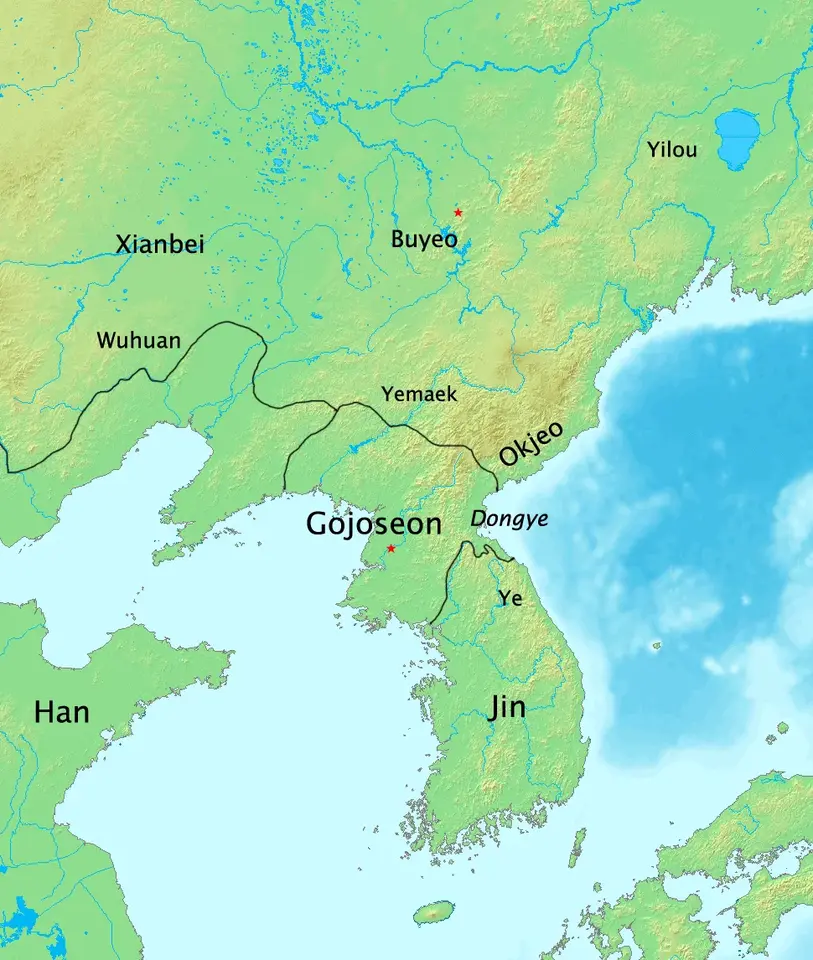
Historical territory map of Wiman Joseon (108 BCE)Image creditsHistoriographer at English Wikipedia · CC BY-SA 3.0Image source
ERA OVERVIEW
Wiman Joseon (卫满朝鲜; 195–108 BCE), also historically designated as Wei-clan Joseon (卫氏朝鲜), was a regional regime established in the northwestern Korean Peninsula during the early Western Han dynasty by Wiman, a military commander originating from the Chinese state of Yan, enduring for three generations across eighty-seven years. In the twelfth year of Emperor Gaozu of Han, King Lu Wan of Yan rebelled and fled into exile among the Xiongnu. Wiman gathered over one thousand followers, tied their hair into local topknots, adopted barbarian dress, and crossed the Yalu River eastward to submit to King Jun, the last monarch of Gija Joseon. Entrusted with defending the western borderland, Wiman established a local base, systematically recruited Han Chinese refugees from Yan and Qi, and rapidly expanded his political and military strength. In 194 BCE, Wiman launched a surprise offensive against the capital of Wangxian City, deposing King Jun and establishing Wiman Joseon, while King Jun fled south by sea to the Mahan confederacy.
Following his accession, Wiman concluded a formal border agreement with the Grand Administrator of Liaodong, entering the Han imperial framework as an external vassal charged with guarding the northern marches in exchange for Han military supplies, iron implements, and trade privileges. Utilizing Han imperial backing, Wiman expanded his territory across thousands of square li, subjugating adjacent tribal polities such as Zhenfan and Lintun. By the reign of his grandson Wei Ugeo, the regime had grown wealthy and militarily assertive, harboring fugitive Chinese populations and forcibly severing tributary communications between neighboring polities—such as Zhenfan, Okjeo, and the southern Jin State—and the Western Han imperial court. In 109 BCE, the assassination of a Joseon escort commander by Han envoy She He ignited an armed conflict. Emperor Wu of Han mobilized a fifty-thousand-strong force, dispatching Left General Xun Zhi via Liaodong by land and Tower Ship General Yang Pu across the Bohai Sea by water. Following a year-long siege of Wangxian City, internal factionalism erupted, leading dissenting ministers to assassinate Wei Ugeo and surrender. In 108 BCE, Wangxian City fell, and the Han empire established the Four Commanderies of Han (Lelang, Xuantu, Zhenfan, and Lintun), terminating the existence of Wiman Joseon.
Time span109 BCE–108 BCE
CapitalWangxian City (王险城; also written as Wanggeom City / 王俭城; present-day Pyongyang, Democratic People's Republic of Korea / 今朝鲜平壤市)
ERA TIMELINE
Wiman's Eastward Crossing
Following the collapse of Lu Wan's insurrection in Yan, officer Wiman led over one thousand followers eastward across the Yalu River with indigenous hair styles and attire, taking refuge under King Jun of Gija Joseon and receiving an investiture over the western marches.
Usurpation of Wangxian City
Exploiting false alarms of an imminent Han invasion, Wiman mobilized his refugee army under pretext of protecting the capital, executed a surprise assault against Wangxian City, ousted King Jun, and assumed royal power.
Enfeoffment as External Vassal
Wiman reached a treaty agreement with the Grand Administrator of Liaodong, swearing allegiance as an external vassal of Western Han to guard the borderlands in return for imperial trade subsidies and advanced iron weaponry.
Succession of the Second Monarch
Following the death of Wiman, his son ascended the throne as the second ruler, adhering to external tributary protocol with Han while consolidating territorial control over Zhenfan and Lintun.
Enthronement of Wei Ugeo
Wiman's grandson Wei Ugeo assumed power; bolstered by economic prosperity and thousands of Han fugitives, he adopted an aggressive posture and gradually terminated regular tributary audiences in Chang'an.
Defection of Chieftain Nanlv
Resenting heavy taxation and autocratic rule under Wei Ugeo, Huemo tribal leader Nanlv led two hundred and eighty thousand subjects to submit to Western Han, prompting the temporary creation of Canghai Commandery.
The She He Incident
Han imperial envoy She He reprimanded Wei Ugeo for blocking tribute routes; upon returning across the border river, She He murdered the Joseon escort officer, prompting Wei Ugeo to execute a retaliatory raid that killed She He.
Coordinated Imperial Expedition
Emperor Wu launched a punitive campaign of fifty thousand troops, sending Yang Pu with a naval armada across the Bohai Sea and Xun Zhi with infantry and cavalry overland across Liaodong to encircle Wangxian City.
Fall of Wangxian City
Protracted siege operations created deep divisions within Joseon leadership; Chancellor of Niqi Can and other ministers assassinated Wei Ugeo, paving the way for the capitulation of the capital.
Creation of the Four Commanderies
Emperor Wu dismantled the territorial structure of Wiman Joseon, organizing the lands into Lelang, Xuantu, Zhenfan, and Lintun commanderies under direct Han civil administration.
Relationship graph
FULL ENTRY
Historical Evolution
Eastward Migration of Yan Emigrants and Dynastic Usurpation
During the zenith of the Warring States period, General Qin Kai of the state of Yan campaigned extensively into the northeast, pushing back Donghu and Joseon tribes, erecting the Liaodong Great Wall, and stationing garrisons to incorporate Zhenfan and Joseon into the Yan sphere. Following the Qin conquest of Yan, these regions were categorized as outer borderlands of Liaodong Commandery without deep civil administration. During the dynastic transition between Qin and Han, catastrophic civil warfare devastated the Central Plains, leaving northern frontier outposts poorly defended. In the twelfth year of Emperor Gaozu of Han, King Lu Wan of Yan revolted against the throne; upon his military defeat, Lu Wan fled northward into exile among the Xiongnu. Wiman, a senior officer in the Yan military establishment, recognized that northern China offered no sanctuary and marshaled his lineage along with more than one thousand seasoned followers to withdraw beyond the Liaodong frontier.
To facilitate integration with the local population and evade surveillance by Han patrols, Wiman and his retinue adopted local customs, braiding their hair into topknots and dressing in regional barbarian attire before crossing the Yalu River eastward into Gija Joseon. King Jun, the reigning sovereign of Gija Joseon, welcomed Wiman, conferring upon him the rank of academician, presenting ritual jade tallies, and granting him jurisdiction over a western territory encompassing one hundred square li to defend against potential Han incursions. Wiman utilized this base to harbor continuous streams of emigrants from Yan and Qi fleeing instability in China, quietly amassing agricultural stores and stockpiling weapons to expand his independent military strength. In 194 BCE, deeming his preparations complete, Wiman dispatched deceitful warnings to King Jun claiming that immense Han imperial legions were crossing the frontier and requesting permission to lead his army into the capital to guard the palace. King Jun granted the request; Wiman immediately led his veteran refugee army in a rapid strike against Wangxian City (modern Pyongyang). King Jun was routed, taking ship by sea to flee southward to the Mahan region where he proclaimed himself King of Han, leaving Wiman to seize the throne, retain the dynastic title Joseon, and inaugurate Wiman Joseon.
Alliance as an External Vassal and Territorial Expansion
Upon seizing supreme authority, Wiman confronted intense hostility from indigenous peninsula tribes as well as potential military retaliation from the expanding Western Han empire. At that juncture, the Han court was governed under Empress Dowager Lv and Emperor Hui, prioritizing economic rehabilitation and the recovery of agricultural productivity through policies of non-intervention, leaving little appetite for costly frontier expeditions. The Grand Administrator of Liaodong received imperial authorization to negotiate with Wiman, concluding a pragmatic diplomatic accord. The treaty stipulated that Wiman would serve as an external vassal of Western Han, acting as a northern shield against nomadic raiders and guaranteeing that regional barbarian tribes would not violate Han frontiers; furthermore, Wiman was forbidden from obstructing tributary missions sent by surrounding tribal chieftains to the imperial court or hindering transit commerce between regional traders and Han markets. In return, the Western Han government formally recognized Wiman's sovereign jurisdiction over northern Korea, providing continuous subsidies of military armaments, horses, grain, and wrought iron.
Bolstered by imperial legitimacy and advanced material aid, Wiman launched comprehensive military campaigns against adjacent territories. Leveraging superior Chinese infantry formations and iron weapons, Wiman subdued neighboring tribal polities, forcing Zhenfan and Lintun to acknowledge his supremacy. Within a few decades, Wiman Joseon extended its administrative and tributary reach across thousands of square li, controlling territories stretching from the Yalu River basin down to the northern banks of the Taedong and Han rivers. Following Wiman's passing, his son inherited the royal seat, continuing the policy of outward deference toward Han while fostering domestic agriculture, preserving frontier tranquility across several peaceful decades.
Interdiction of Tributary Missions and the She He Incident
By the ascension of Emperor Wu of Han, the imperial dynasty had amassed enormous wealth and embarked on sustained strategic offensives against the Xiongnu, Southern Yue, and Southwestern Barbarians. During this era, Wiman's grandson Wei Ugeo succeeded to the throne in Wangxian City. Having enjoyed generations of uninterrupted stability, the regime possessed a thriving population and robust military arsenals. Overconfident in his geographic insularity, Wei Ugeo ceased presenting regular tribute to Chang'an, systematically gave refuge to Chinese criminals and military deserters to augment his ranks, and established fortified checkpoints along overland and maritime trade arteries to prohibit neighboring polities such as Zhenfan, Okjeo, and the southern Jin State from presenting tribute to the Han court, aiming to construct a regional hegemony in Northeast Asia.
In 128 BCE, deeply alienated by Wei Ugeo's exorbitant requisitions and despotic rule, Chieftain Nanlv of Huemo rebelled with two hundred and eighty thousand followers, marching west to surrender to Liaodong Commandery; Emperor Wu responded by establishing Canghai Commandery over their territory, exposing severe structural vulnerabilities within Wiman Joseon. In 109 BCE, Emperor Wu dispatched envoy She He to Wangxian City to deliver an imperial reprimand demanding the reopening of tribute routes and full submission. Wei Ugeo obstinately rejected the edict. Upon reaching the border crossing at the Pei River, She He, fearing imperial punishment for a failed mission, treacherously ambushed and murdered the Joseon vice-commander assigned to escort him, subsequently fleeing across the border and falsely reporting the death of an enemy general. Emperor Wu condoned the act and promoted She He to Eastern Commandant of Liaodong. That winter, an enraged Wei Ugeo sent elite cavalry across the frontier, storming the commandant's headquarters and executing She He, which severed diplomatic relations and prompted Emperor Wu to order an all-out invasion.
The Coordinated Han Campaign and the Fall of Wangxian City
In the autumn of 109 BCE, Emperor Wu mobilized fifty thousand veteran troops in a dual-pronged land-sea pincer movement. Tower Ship General Yang Pu embarked from Qi with seven thousand naval marines, traversing the Bohai Sea to make landfall at Liekou near the mouth of the Taedong River; concurrently, Left General Xun Zhi led several tens of thousands of infantry and cavalry out of Liaodong, crossing the Yalu River to strike from the north. However, strategic coordination failed completely. Yang Pu arrived at Liekou prematurely and, eager to monopolize military honors, launched an isolated assault against Wangxian City before the land armies could assemble. Wei Ugeo recognized the tactical vulnerability, sallied forth with his main host, and routed Yang Pu's detachment, sending the survivors fleeing into the mountains while Yang Pu remained in hiding for days before regrouping his remnants. Simultaneously, Xun Zhi encountered resolute resistance along the Chongchon River, leaving both wings stalled.
Emperor Wu dispatched imperial commissioner Wei Shan to negotiate a peaceful resolution. Faced with crushing strategic pressure, Wei Ugeo agreed to surrender, dispatching the Crown Prince with ten thousand armed riders alongside grain and horses to Chang'an. At the border river, however, Xun Zhi and Wei Shan demanded that the Joseon escort lay down all arms; suspecting an imperial trap, the Crown Prince aborted the mission and retreated to the capital, terminating negotiations. Emperor Wu executed Wei Shan for incompetence and commanded Xun Zhi and Yang Pu to press the siege of Wangxian City. Protracted operational friction between the two generals paralyzed command until imperial envoy Gongsun Sui arrived, who placed Yang Pu under arrest on Xun Zhi's biased accusations and unified command under Xun Zhi. Xun Zhi unleashed relentless siege warfare, using trebuchets and assault lines to batter the fortress. By the summer of 108 BCE, severe starvation gripped the garrison, sparking factional discord. Dissenting chancellors, including Chancellor of Joseon Luren, Chancellor Han Yin, and Chancellor of Niqi Can, concluded that resistance was futile; Chancellor of Niqi Can dispatched assassins to murder Wei Ugeo, subsequently leading thousands out to surrender. Loyal minister Chengji continued resisting until Xun Zhi persuaded Wei Ugeo's son Wei Zhangjiang and Luren's son Lu Zui to kill Chengji and surrender the fortress. Emperor Wu dissolved the regime, establishing the Four Commanderies of Han over its territories and terminating Wiman Joseon.
Politics and Institutions
Tributary External Vassal Status and Imperial Hierarchy
Wiman Joseon occupied a dual constitutional position: from the perspective of the Western Han court, it operated as an external border vassal, whereas within the Korean Peninsula, it functioned as an autonomous monarchical state possessing absolute sovereign authority. During the early Han era, the imperial government favored frontier stabilization through indirect rule, investing Wiman with imperial tallies and seals to preserve order over frontier populations without interfering in local administration. In exchange, Wiman Joseon recognized the ritual supremacy of the Han calendar and sovereign, utilizing imperial sanction to legitimize its regional hegemony while shielding the Central Plains from northeastern border disruptions.
Bureaucratic Administration and the Chancellor-General System
Wiman Joseon replaced archaic kinship councils with centralized bureaucratic governance adapted from Warring States and Han institutional models. Supreme authority was vested in the hereditary monarch. Beneath the throne, executive functions were distributed to civil chancellors (xiang), such as the Chancellor of Joseon and Chancellor of Niqi, who managed taxation, internal law, and diplomatic communications, offices predominantly staffed by distinguished Chinese emigrants. Military authority was delegated to designated generals (jiangjun) commanding regular army formations and capital defense brigades. Additionally, the regime conferred vice-king (piwang) titles upon royal princes and prominent frontier tribal chiefs, establishing a functioning civil-military administrative equilibrium.
Commandery-Style Household Registration and Tribal Pacification
In local governance, Wiman Joseon implemented a stratified administrative system. Across the metropolitan core surrounding Wangxian City and the fertile agricultural basins of the Taedong River, the state enforced direct civil administration modeled after Chinese commanderies, maintaining household registers, collecting agricultural taxes, and levying corvee labor with the assistance of literate Han emigrants. Conversely, peripheral tribal territories—including Zhenfan, Lintun, and Okjeo—were supervised through indirect military vassalage. Local tribal headmen retained indigenous customary leadership while submitting regular tribute in regional commodities and mobilizing auxiliary warriors during external conflicts.
Military and Foreign Relations
Military Mobilization and Elevated Fortress Defenses
The military architecture of Wiman Joseon relied on a standing elite core supplemented by universal mobilization during wartime. Over one thousand original Yan armored warriors formed the nucleus of royal palace guards and tactical commanders. During external threats, registered farming populations across the plains were levied as heavy spearmen, while allied Huemo and tribal auxiliaries contributed light cavalry and archers, generating an operational field army of several tens of thousands. Wangxian City possessed formidable natural defenses along the Taedong River, featuring high rammed-earth ramparts, deep moats, and extensive logistical granaries built according to Warring States architectural techniques, enabling the garrison to withstand a massive imperial siege for nearly an entire year.
Frontier Diplomacy and the Role of External Vassal
During its formative period, Wiman Joseon pursued a prudent external policy grounded in realistic assessments of Han military capabilities. Wiman maintained regular tributary missions to Liaodong, patrolled frontier corridors, and repatriated cross-border raiders, ensuring sustained border tranquility. In return, the regime enjoyed decades of uninterrupted commercial prosperity, deploying its recognized external vassal authority to subjugate smaller regional chiefdoms without risking imperial intervention.
Tributary Blockade and Strategic Linkage with Southern Campaigns
Under Wei Ugeo, diplomatic policy shifted toward aggressive regional unilateralism, erecting fortified outposts to cut off maritime and overland transit routes between neighboring tribes—such as Mahan and the southern Jin State—and the Han court. At that historical juncture, Emperor Wu had recently completed the conquest of Southern Yue and pacified the Southwestern Barbarians. Wei Ugeo's attempt to disrupt the tributary world order directly violated imperial grand strategy. Upon pacifying the southern maritime frontiers, Emperor Wu rapidly redeployed military resources toward the northeast, illustrating a direct strategic continuum linking the campaigns against Southern Yue with the subjugation of Gojoseon.
Economy and Commerce
Diffusion of Iron Metallurgy and Ox-Plow Agriculture
The establishment of Wiman Joseon marked a profound technological transition across the Korean Peninsula, replacing late bronze and polished stone implements with advanced iron metallurgy. Wiman's followers introduced bloomeries and cast iron casting techniques, establishing state-operated metallurgical workshops in Wangxian City that mass-produced iron plowshares, hoes, pickaxes, and swords. The widespread adoption of iron agricultural implements combined with Chinese ox-plow cultivation revolutionized agriculture in the Taedong and Chaeryong river basins, facilitating deep soil tillage, irrigation management, and substantial increases in grain yields, providing the logistical foundations for dynastic expansion.
Transit Trade Monopoly across the Liaodong Peninsula
Commanding the geographical nexus between northern China, southern Manchuria, and the Korean Peninsula, Wiman Joseon operated as an indispensable commercial hub. The regime controlled maritime routes running from the mouth of the Taedong River to the Shandong Peninsula, imposing heavy transit tariffs on goods flowing between the Han empire and southern peninsular communities. By monopolizing the exchange of Chinese silks, lacquerware, and iron tools for regional commodities such as pearls, furs, timber, and sea salt, Wangxian City accumulated immense wealth, providing Wei Ugeo with the financial means to challenge imperial authority.
Resettlement of Displaced Persons and Handicraft Manufacturing
Throughout the Qin-Han transition, waves of displaced Chinese refugees migrated into the Korean Peninsula. Wiman accommodated these populations by distributing arable lands, organizing them into tax-paying farming settlements, and recruiting skilled artisans into urban manufacturing bureaus. Consequently, state workshops attained extraordinary sophistication in bronze casting, ceramics, fine lacquer crafting, and textile production. Excavations of Han-style bronze mirrors, chariot fittings, and lacquer vessels from this period demonstrate a material standard fully comparable to contemporary commanderies across northern China.
Culture and Society
Dissemination of Huaxia Civilization and Canonical Institutions
Wiman Joseon functioned as a vital conduit for the northward expansion of Huaxia civilization. Archaic Chinese served as the administrative language of the royal court, and official proclamations, judicial registers, and diplomatic correspondence were transcribed using Chinese characters. Central Plains ritual norms, statutory legal concepts, and moral philosophies gradually supplanted indigenous shamanistic practices across the ruling elite. Aristocratic society adopted Han-style robes and headgear, while state sacrificial ceremonies mirrored Zhou and Han cosmological rituals, accelerating the transition of the northern peninsula into a literate, institutionalized society.
Ethnocultural Integration and Social Stratification
Society in Wiman Joseon was organized into three distinct tiers. The pinnacle comprised the royal Wei house and distinguished Han emigrant families who monopolized premier ministerial and military offices. The secondary tier consisted of indigenous Huemo and Zhenfan chieftains who allied with the monarchy through intermarriage and regional titles. The broad base included registered peasant households, artisans, and servile domestic laborers. The state maintained internal cohesion by combining Chinese administrative statutes with respect for indigenous tribal conventions, fostering deep ethnocultural synthesis.
Historical Foundations of the Lelang Civilization
The eighty-seven years of Wiman Joseon rule constituted the formative period for what archaeologists designate as Lelang Culture. Excavations across the earthen fortress sites and wooden-chamber tombs of the Lelang district in Pyongyang have unearthed vast quantities of iron armaments, bronze mirrors, and ceremonial vessels identical in form and motif to Han artifacts from Hebei and Shandong. The administrative infrastructure, agricultural techniques, and urban networks established under Wiman Joseon directly provided the institutional and cultural bedrock upon which the Han empire established the Four Commanderies, sustaining Chinese commandery administration in the region for more than four centuries.
Key Figures
Wiman: Founding monarch of Wiman Joseon. Originally a military officer in the Warring States and Han state of Yan, he led over a thousand followers eastward across the Yalu River after Lu Wan's rebellion, usurped the throne of Gija Joseon, established Wangxian City as capital, and allied with Western Han as an external vassal to pioneer the first documented dynasty in Korean history.
Wei Ugeo: Last monarch of Wiman Joseon and grandson of Wiman. Governing a powerful and prosperous realm, he harbored Han fugitives, severed tributary access for neighboring tribes, and ordered the killing of envoy She He, provoking Emperor Wu's coordinated land-sea invasion that culminated in his assassination during the siege of Wangxian City.
King Jun: Last monarch of Gija Joseon. He granted refuge and a western border fief to Wiman, who subsequently turned against him in a surprise offensive. King Jun evacuated his court by sea to the southern Mahan region, proclaiming himself King of Han and facilitating the southward diffusion of northern civilization.
She He: Western Han diplomatic envoy. In 109 BCE, he journeyed to Wangxian City to order Wei Ugeo to submit; upon failing his mission, he murdered his Joseon escort commander at the border river to fabricate military merit, inciting the retaliatory raid in which he was killed, which ignited the Han-Joseon War.
Xun Zhi: Western Han Left General. He led the overland army out of Liaodong across the Yalu River, weathered fierce initial resistance, secured sole operational command over the combined expeditionary forces, and directed the siege that ultimately subdued Wangxian City, though he was later imprisoned for quarreling over military merit.
Yang Pu: Western Han Tower Ship General. Renowned for earlier victories against Southern Yue, he commanded seven thousand naval troops crossing the Bohai Sea to strike Liekou. Suffering an early tactical reversal before Wangxian City, he regrouped his forces and contributed to the encirclement before being stripped of command by imperial commissioner Gongsun Sui.
Niqi Xiangcan: Senior executive minister of Wiman Joseon. Confronting a hopeless siege by Han forces, he conspired with Chancellor of Joseon Luren and Chancellor Han Yin, dispatching assassins to kill the recalcitrant King Wei Ugeo before surrendering the capital, subsequently receiving enfeoffment from Emperor Wu as Marquis of Huanqing.
Emperors and Rulers
The reign of Wiman Joseon spanned eighty-seven years across three generations:
Temple / Posthumous Title
Personal Name
Reign Period
Key Governance Policies and Historical Role
None
Wiman
194 BCE – ca. 161 BCE
Founding sovereign; migrated east, seized royal power, negotiated external vassal status with Western Han, and expanded realm across thousands of li
None
Unnamed Ruler
ca. 161 BCE – ca. 129 BCE
Second monarch; son of Wiman; consolidated borders, maintained tributary diplomacy with Han, and integrated Zhenfan and Lintun
None
Wei Ugeo
ca. 129 BCE – 108 BCE
Last monarch; grandson of Wiman; blocked tributary routes, harbored Chinese runaways, executed Han envoy, and perished in the siege of Wangxian City
Senior Ministers and Military Commanders
Chancellor of Joseon Luren: Head of civil administration; recognized the strategic inevitability of defeat and led an early surrender to Han, receiving enfeoffment as Marquis of Dijie.
Chancellor Han Yin: High-ranking executive minister; assisted Chancellor Luren in directing state policy and defected to the Han military, subsequently created Marquis of Diju.
Chancellor of Niqi Can: Strategic military chancellor; took decisive action by arranging the assassination of Wei Ugeo to end the siege, later enfeoffed as Marquis of Huanqing.
General Wang Jia: Commander of the royal army; surrendered to Left General Xun Zhi during the siege, receiving creation as Marquis of Pingzhou.
Minister Chengji: Steadfast loyalist; continued stubborn defense of Wangxian City after the death of Wei Ugeo until assassinated in a plot organized by Prince Wei Zhangjiang and Lu Zui.
Major Events
195 BCE (Han Gaozu 12th year) | Wiman's Eastward Crossing | Following the suppression of Lu Wan's uprising, officer Wiman led over one thousand followers eastward across the Yalu River to seek asylum under King Jun of Gija Joseon.
194 BCE (Han Huidi 1st year) | Usurpation of the Throne | Wiman deployed false alarms of imperial invasion to march into Wangxian City, overthrown King Jun, and established Wiman Joseon.
192 BCE (Han Huidi 3rd year) | Vassalage Agreement | Wiman concluded an accord with the Grand Administrator of Liaodong to act as an external vassal guarding frontier borders in exchange for imperial subsidies.
128 BCE (Han Wudi Yuanshuo 1st year) | Submission of Huemo | Chieftain Nanlv of Huemo rebelled against Wei Ugeo and defected to Han with two hundred and eighty thousand people, leading to the temporary establishment of Canghai Commandery.
109 BCE (Han Wudi Yuanfeng 2nd year) | The She He Incident | Han envoy She He murdered a Joseon escort officer on his return journey; Wei Ugeo dispatched troops to execute She He, precipitating imperial invasion.
109 BCE (Han Wudi Yuanfeng 2nd year) | Dual-Pronged Invasion | Emperor Wu launched a coordinated expedition, dispatching Yang Pu across the Bohai Sea and Xun Zhi across Liaodong to invest Wangxian City.
108 BCE (Han Wudi Yuanfeng 3rd year) | Fall of the Capital | Severe siege warfare fractured the Joseon court; Chancellor of Niqi Can had Wei Ugeo assassinated, Chengji was killed, and Wangxian City capitulated.
108 BCE (Han Wudi Yuanfeng 3rd year) | Creation of the Four Commanderies | Emperor Wu organized the conquered realm into Lelang, Xuantu, Zhenfan, and Lintun commanderies, incorporating northern Korea into the Han imperial system.
Historical Assessment and Legacy
Assessments by Traditional Historians
In the Records of the Grand Historian (Shiji, "Biographies of Joseon"), Western Han historian Sima Qian offered a sober appraisal of the rise and fall of Wiman Joseon: "Wiman took advantage of military momentum and the turbulence within the Central Plains to expand into foreign frontiers, serving as an external vassal guarding the borders to benefit his state. Yet by the time of his grandson Ugeo, failing to discern the balance of power, he obstructed imperial edicts and cut off tributary access for neighboring tribes, ultimately bringing about his own death and the dissolution of his state."
Ban Gu, writing in the Book of Han (Hanshu), lauded Emperor Wu's frontier expansion, emphasizing that the subjugation of Joseon and the establishment of the Four Commanderies extended Central Plains administrative civilization across the eastern seas, transforming peripheral customs and consolidating the frontiers of the unified empire.
Historical Significance and Foundation of Lelang Civilization
As the earliest regional state in Northeast Asia supported by clear contemporary epigraphic and textual records, Wiman Joseon served as an essential historical bridge between Central Plains civilization and the Korean Peninsula. It brought an end to late bronze-age cultural isolation across northern Korea, introducing advanced iron metallurgy, intensive ox-plow agriculture, and bureaucratic institutions.
The subsequent establishment of the Four Commanderies, centered upon Lelang Commandery in Pyongyang, perpetuated direct Han administrative governance for over four hundred years. Countless Chinese officials, scholars, merchants, and craftsmen settled in the region, fostering the renowned Lelang culture, which radiated Han cultural norms across the entire Korean Peninsula and into the Japanese archipelago, leaving an indelible imprint on the historical development of East Asian civilization.