Appointment of Gao Jichang
Later Liang founder Zhu Wen appointed Gao Jichang as Military Commissioner of Jingnan to rebuild depopulated Jiangling.
924 CE–963 CE
南平(荆南)
Nanping (924–963 AD), historically known as Jingnan (荆南) or Northern Chu (北楚), was a regional regime founded by Gao Jixing at Jiangling during the Five Dynasties and Ten Kingdoms period. Following the devastation of Jiangling at the end of the Tang dynasty, Emperor Taizu Zhu Wen of Later Liang appointed Gao Jichang as Military Commissioner of Jingnan. Gao resettled displaced refugees, erected formidable brick ramparts, and established the Nanping kingdom upon receiving the royal investiture as…
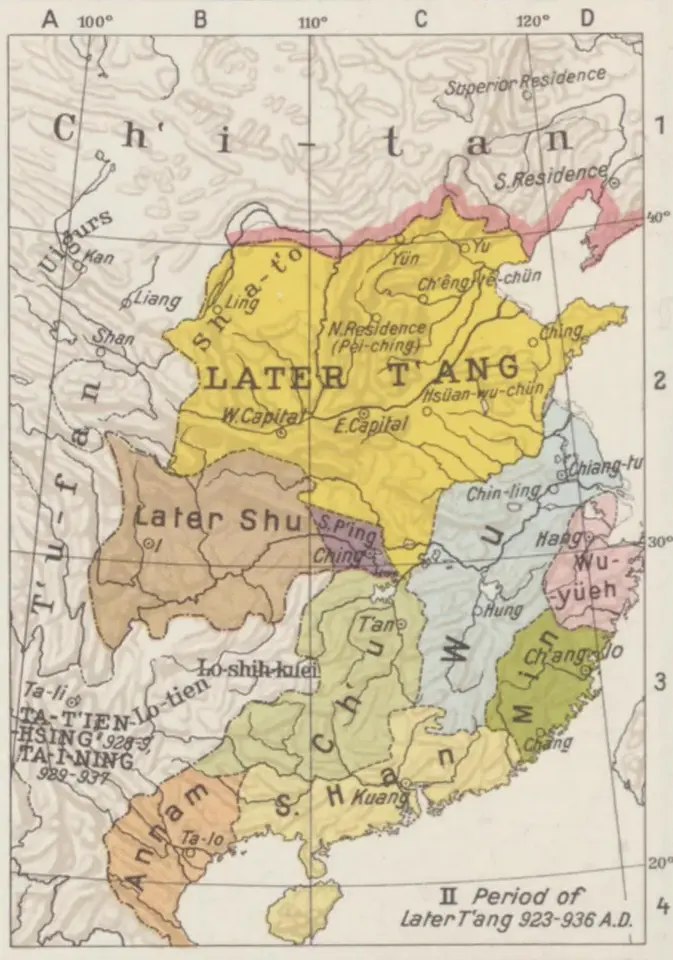
Nanping (924–963 AD), historically known as Jingnan (荆南) or Northern Chu (北楚), was a regional regime founded by Gao Jixing at Jiangling during the Five Dynasties and Ten Kingdoms period. Following the devastation of Jiangling at the end of the Tang dynasty, Emperor Taizu Zhu Wen of Later Liang appointed Gao Jichang as Military Commissioner of Jingnan. Gao resettled displaced refugees, erected formidable brick ramparts, and established the Nanping kingdom upon receiving the royal investiture as Prince of Nanping in 924 AD. Nanping administered merely three prefectures—Jing, Gui, and Xia—straddling the strategic bottleneck of the Yangtze River. Facing formidable neighboring powers, successive Gao monarchs pursued a policy of multilateral vassalage and regional pacification while adroitly intercepting passing tribute embassies and merchant caravans to replenish state coffers, earning the satirical sobriquet Gao the Rascal (Gao Laizi). Nanping constructed the hundred-and-thirty-li Gaoshi Dike and developed Jiangling into an international transit hub for Abbasid maritime imports and domestic tea trade. In 963 AD, Song Emperor Taizu seized Jiangling through a classic transit stratagem, and the final sovereign Gao Jichong surrendered the realm, peacefully concluding forty years of dynastic rule across five monarchs.
Later Liang founder Zhu Wen appointed Gao Jichang as Military Commissioner of Jingnan to rebuild depopulated Jiangling.
Gao Jichang constructed brick ramparts, outer enceintes, and watchtowers around Jiangling.
Gao Jichang changed his name to Gao Jixing, attended court in Luoyang, and fled by night after sensing political peril.
Emperor Zhuangzong of Later Tang formally created Gao Jixing Prince of Nanping, establishing the kingdom.
Gao Jixing seized Kuizhou, fought Later Tang, and submitted to Yang Wu for military backing.
Gao Jixing died; his son Gao Conghui normalized relations with Later Tang, adopting multilateral tributary diplomacy.
Gao Conghui died; his son Gao Baorong succeeded, observing strict vassal etiquette toward Later Han and Later Zhou.
Gao Baorong flooded seven li north of Jinan City to build the Beihai Reservoir and maintained the Gaoshi Dike.
Zhao Kuangyin founded Northern Song; Gao Baorong sent tribute thrice before dying, succeeded by Gao Baoxu.
Gao Baoxu died; Gao Baorong's eldest son Gao Jichong took office as Song planned southern campaigns.
Song used transit excuse to capture Jiangling; Gao Jichong surrendered registers of three prefectures to Song.
During the Tianyou era at the end of the Tang dynasty, the Jianghan Plain was reduced to a brutal battleground for rival warlords. Successive military commissioners Cheng Rui and Zhao Kuangning collapsed amid protracted factional warfare, resulting in the dismemberment of the eight prefectures historically administered by Jingnan. Ravaged by continuous warfare and arson, towns were leveled into ash heaps, leaving only the desolate fortress of Jiangling with mere dozens of surviving households amidst wild weeds. In 907 AD, Emperor Taizu Zhu Wen of Later Liang established his dynasty in the Central Plains. Seeking to sever the strategic land and water communication between Yang Wu in Huai'nan and Former Shu in Sichuan, Zhu Wen appointed his trusted cavalry officer Gao Jichang as Acting Military Commissioner of Jingnan, inaugurating the Gao family's four-decade governance over the middle Yangtze.
A native of Xiashi in Shan Prefecture, Gao Jichang had been adopted in his youth into the household of wealthy merchant Li Rang and subsequently entered Zhu Wen's inner circle, distinguishing himself in military campaigns against warlords Li Maozhen and Wang Shifan. Upon arriving in depopulated Jiangling, Gao faced complete ruin and immediately instituted benevolent policies of economic rehabilitation. He engaged prominent scholars Liang Zhen and Sikong Xun as confidential civil advisors while placing seasoned commanders Ni Kefu and Bao Tang in charge of military administration, actively gathering starving refugees from forested mountains, distributing seed grain, and remitting onerous taxes. Externally, Gao partnered with Prince Ma Yin of Chu to crush predatory incursions by warlord Lei Yangong from Langzhou. To secure against future raids, Gao conscripted over ten thousand laborers to construct outer ramparts around Jiangling, pioneering the extensive use of fired bricks over earthen walls to transform a ruined bastion into a secure and thriving urban sanctuary.
As Jiangling's fortifications were perfected and displaced populations returned to stable farming, Gao Jichang's ambitions for autonomous regional dominance expanded. Following the death of Emperor Taizu of Later Liang, bitter imperial succession feuds erupted at Kaifeng, precipitating dynastic decline. Recognizing the weakening authority of the Later Liang court, Gao practiced external outward obedience while executing clandestine measures to consolidate his power. He diverted imperial tax revenues into his private treasury, recruited demobilized Liang soldiers and armed vagrants, and seized control of neighboring Gui and Xia prefectures to solidify a territorial domain spanning Jing, Gui, and Xia. Furthermore, Gao commissioned the construction of five hundred large warships, renovated weapons arsenals, and severed tributary remittances to the capital while opening diplomatic channels with Yang Wu and Former Shu. Powerless to restrain Gao's growing defiance, the imperial court could only placate him by conferring the title Prince of Bohai in 913 AD.
In 923 AD, Prince Li Cunxu of Jin annihilated the Later Liang and established the Later Tang dynasty, adopting the era name Tongguang. Having previously served as a senior officer under the fallen Liang, Gao understood the immense hazards posed by dynastic transition. To demonstrate goodwill and personally assess the strength of the new regime, he observed imperial naming taboos by changing his personal name to Gao Jixing and traveled to Luoyang for an imperial audience despite strong warnings from his chief counselor Liang Zhen. In Luoyang, Gao urged Emperor Zhuangzong to dispatch an army against the decadent kingdom of Former Shu, an initiative the emperor welcomed. However, Gao observed firsthand that the court was thoroughly compromised by theatrical actors, eunuchs, and undisciplined extravagance, concluding that Later Tang would soon suffer internal turmoil. Although Zhuangzong initially permitted Gao to depart, he soon regretted the decision and sent secret orders to detain him; sensing imminent peril at Xiangyang, Gao forced open the city gates by night and fled back to Jiangling.
Following his narrow escape to Jiangling, Gao Jixing redoubled his determination to maintain regional autonomy. Seeking to stabilize his southwestern perimeter and prevent Jiangling from entering an alliance with Shu, Emperor Zhuangzong issued an imperial edict in March 924 AD formally creating Gao Jixing Prince of Nanping, thereby marking the official foundation of the Nanping kingdom. In autumn 925 AD, Later Tang launched a massive campaign that crushed Former Shu. As captured Shu treasures, gold, pearls, and precious silks were transported down the Yangtze River toward Luoyang, Gao Jixing deployed riverine flotillas to intercept and confiscate the imperial convoys along the Three Gorges. Emboldened by this wealth, Gao petitioned Emperor Mingzong for jurisdictional control over the five prefectures of Kui, Zhong, Wan, Gui, and Xia, demanding the authority to appoint prefects directly from his own clan, a demand that deeply alarmed the court at Luoyang.
Emperor Mingzong of Later Tang rejected Gao Jixing's territorial demands and appointed an imperial prefect to Kuizhou. Enraged by the refusal, Gao deployed river troops to seize Kuizhou by force, expelling imperial officials and launching naval skirmishes against Fuzhou. This open defiance provoked imperial retaliation; in 927 AD, Emperor Mingzong stripped Gao of his offices and mobilized a joint punitive coalition under Liu Xun and Ma Yin of Chu to besiege Jiangling. With imperial forces closing in by land and water, Gao demonstrated consummate diplomatic agility by dispatching urgent envoys to the southern state of Yang Wu, declaring himself a vassal and securing vital naval support from Huai'nan. Plagued by summer humidity and confronted with Jiangling's formidable defenses, the Later Tang coalition withdrew. In gratitude, Yang Wu invested Gao Jixing as Prince of Qin, successfully preserving the Nanping kingdom from extinction.
In January 929 AD, Gao Jixing passed away in Jiangling at the age of seventy-one, posthumously honored as Prince Wuxin. His eldest son Gao Conghui assumed the military commissionership and took control of state affairs. Evaluating the geopolitical realities, Gao Conghui concluded that Yang Wu was too distant across eastern waterways to provide reliable protection, whereas the northern military power of Later Tang was contiguous and overwhelmingly superior. Recognizing that permanent estrangement from the Central Plains was unsustainable, Gao Conghui requested Prince Ma Yin of Chu to mediate reconciliation, submitting humble petitions of apology to Emperor Mingzong along with three thousand ounces of silver as indemnification. Welcoming a peaceful resolution, Emperor Mingzong granted full pardons, reinstating Gao Conghui as Military Commissioner of Jingnan and Chancellor, thereby restoring diplomatic harmony with the Central Plains.
Gao Conghui institutionalized a foundational diplomatic doctrine of universal nominal vassalage to ensure survival amidst predatory neighbors. As dynastic transitions rapidly reshuffled the northern Central Plains—from Later Tang to Later Jin, Later Han, and Later Zhou—Gao Conghui unfailingly dispatched tributary embassies to the new sovereigns, adopting their imperial reign titles and calendar. Concurrently, Gao maintained cordial relations with southern states, including Yang Wu, Southern Tang, Former Shu, Later Shu, Southern Chu, and Southern Han, exchanging ambassadors, accepting regional royal titles, and congratulating southern rulers whenever they claimed imperial status. Whenever northern emperors rebuked him for fraternizing with southern regimes, Gao responded with submissive self-criticism. This pragmatic and humble diplomacy insulated Nanping from catastrophic invasions, enabling the fragile micro-state to maintain uninterrupted domestic peace for over two decades.
In domestic administration, Gao Conghui pursued benevolent policies focused on border security, bureaucratic discipline, and moderate taxation, allowing the citizenry of Jiangling to prosper during an era of widespread conflict. However, residing in a prosperous commercial metropolis, Gao Conghui was momentarily tempted by aristocratic extravagance. When Prince Ma Xifan of Chu constructed the resplendent Tiance Mansion and Golden Pavilion in Changsha, traveling scholars lavishly praised its grandeur, prompting Gao Conghui to voice profound admiration. His confidential advisor Sun Guangxian intervened, sternly reminding him that emperors and princes must respect their prescribed status and warning that Ma Xifan's vain indulgence would hasten dynastic collapse. Persuaded by this admonition, Gao Conghui curtailed his ostentatious impulses, confining construction to a modest administrative pavilion and garden pool named Zhugong and Yingchun, preserving fiscal frugality throughout his reign.
In 948 AD, Gao Conghui passed away at the age of fifty-eight and was posthumously honored as Prince Wenxian. His third son Gao Baorong assumed the leadership of Jingnan in accordance with his father's testament. Unassuming, conscientious, and reserved, Gao Baorong governed for twelve years with meticulous deference to the Central Plains. Following the accession of Emperor Taizu Guo Wei and Emperor Shizong Chai Rong of Later Zhou, Gao Baorong dispatched annual tributary embassies bearing rare regional goods to Kaifeng without fail. When Emperor Shizong launched major military campaigns against Southern Tang in Huai'nan and Later Shu in the west, Gao Baorong mobilized Nanping riverine fleets along the Yangtze to blockade enemy supply routes and sent his brother Gao Baoshen to court as an imperial hostage, earning the deep trust and commendation of the Later Zhou court.
While scrupulously fulfilling his duties as an imperial vassal, Gao Baorong harbored realistic vigilance regarding northern territorial ambitions. To protect against potential surprise cavalry thrusts descending the Han River, Gao Baorong engineered an extensive water barrier north of Jinan City. He breached the northern banks of the Yangtze River to flood a low-lying basin, creating a vast body of water spanning over seven li known as the Beihai Reservoir. This barrier formed an impassable swamp that neutralized cavalry mobility while seamlessly integrating with ancient dikes and municipal moats. Furthermore, Gao Baorong continuously reinforced the Gaoshi Dike, mobilizing civil labor to dredge canals and protect the fertile polders of Jiangling from seasonal Han River floods. Under his prudent stewardship, Nanping sustained social tranquility, economic vitality, and steady demographic expansion, earning him historical acclaim as an exemplary custodian of the realm.
In January 960 AD, Zhao Kuangyin founded the Northern Song dynasty following the Chenqiao mutiny. Gao Baorong immediately sent three tributary missions to Kaifeng to declare total fealty. In August of that year, Gao Baorong died of illness at age forty-one, posthumously receiving the title Prince Zhenyi from the Song court. Because his eldest son Gao Jichong was still youthful, Gao Baorong entrusted state power to his younger brother Gao Baoxu. Frail and sickly from childhood, Gao Baoxu abandoned statecraft in favor of personal indulgence upon assuming office. He squandered treasury funds on lavish garden pavilions, neglected administrative affairs, and engaged in scandalous spectacles by summoning entertainers and robust soldiers to indulge in lewd banter before his court. Administrative cohesion deteriorated, military readiness evaporated, and the moral authority of the ruling house suffered unprecedented decline.
In late winter 962 AD, Gao Baoxu became gravely ill and restored authority to Gao Baorong's eldest son Gao Jichong. Following Gao Baoxu's death in November, the twenty-year-old Gao Jichong formally assumed control of Jingnan. At this juncture, the Northern Song had consolidated domestic rule, and Emperor Taizu formulated his overarching grand strategy to conquer the southern kingdoms in sequence before tackling the northern borderlands. Recognizing that Jiangling served as the indispensable pivot commanding access to both Sichuan and the lower Yangtze, the Song court dispatched confidential envoys Lu Huaizhong and Kang Yanze to Jiangling under the guise of presenting imperial gifts. These envoys secretly surveyed municipal fortifications, waterway depths, troop distributions, and civilian morale, providing Emperor Taizu with precise tactical intelligence to orchestrate Nanping's absorption.
In January 963 AD, teenage ruler Zhou Baoquan succeeded to the leadership of Wuping in Hunan, prompting veteran general Zhang Wenbiao to launch an armed rebellion from Hengzhou and advance upon Tanzhou. Panicked by the assault, Zhou Baoquan dispatched urgent appeals for military assistance to both Jiangling and the Northern Song court at Kaifeng. This request provided Emperor Taizu with the perfect pretext for military intervention. Reviving the classic historical stratagem of borrowing a road through a neighboring state to conquer both, Emperor Taizu appointed Murong Yanzhao as Commander-in-chief and Li Chuyun as Administrative Supervisor, dispatching tens of thousands of elite cavalry and infantry down the Han River with the declared objective of assisting Hunan, while secretly instructing Li Chuyun to seize Jiangling whenever opportunity arose.
As Song armada and cavalry units approached the Jing-Chu region, Murong Yanzhao issued formal demands for provisions and an unhindered transit corridor. Gao Jichong convened his council; his uncle Gao Baoyin and other civil officials advocated complete compliance to preserve the family, while veteran general Liang Yansi found himself unable to alter the consensus. Gao Jichong dispatched rich provisions and rode north several dozen li outside Jiangling to greet the imperial forces. Capitalizing on Gao Jichong's absence from the fortress, Supervisor Li Chuyun detached several hundred elite shock cavalry from the main column and advanced along a concealed bypass toward Jiangling's southern gate. Catching the garrison completely off guard, Li Chuyun's cavalry cut down the sentries and seized control of the city gates, ramparts, and defensive strongpoints within minutes.
Returning from the greeting reception, Gao Jichong was stunned to find Song imperial banners fluttering atop all four walls of Jiangling and disciplined imperial troops occupying municipal avenues. Recognizing that armed resistance would only bring devastation upon the populace, Gao discarded his military robes and proceeded directly to Murong Yanzhao's camp to surrender his seals of office. He presented the complete administrative registers of three prefectures, seventeen counties, and 142,300 households to the Song commanders. Highly gratified by this bloodless outcome, Emperor Taizu reaffirmed Gao Jichong as Military Commissioner of Jingnan, granted him the rank of Chancellor, and bestowed immense gifts of bullion and silks. Thus, after thirty-nine years of autonomy, the Nanping kingdom concluded its reign with minimal social disturbance, becoming the first southern regime to surrender peacefully to the Northern Song.
Following the pacification of Jingnan, Song forces utilized Jiangling as an impregnable logistical base to project naval and land power deep into Hunan, swiftly crushing the rebellion of Zhang Wenbiao and annexing the entire Hunan basin into the Song realm. In September 963 AD, having performed solemn farewell ceremonies at his ancestral shrines, Gao Jichong led more than five hundred clan members and civil and military officials on the journey to Kaifeng. Upon arrival, Emperor Taizu granted him an imperial audience in the Chongyuan Hall, appointing him Military Commissioner of Wuning and conferring a grand mansion and generous stipends, later advancing him to Duke of Kaiguo. Gao Jichong served the Song diligently until his death in 973 AD, and his descendants integrated smoothly into the Song civil service, bringing a dignified conclusion to the Nanping legacy.
Nanping occupied a distinct place in the political landscape of the Five Dynasties and Ten Kingdoms as the sole southern regime that preserved the Tang dynasty military circuit secretariat throughout its existence. The Gao rulers never assumed imperial titles at Jiangling, nor did they establish a bloated central bureaucracy of Three Departments and Six Ministries. The supreme governance apparatus remained structured around the Circuit Military Commissioner and Surveillance Commissioner Secretariat. The administration relied on a lean cadre of civil officials, including administrative supervisors, vice-commissioners, judges, secretarial directors, and judicial investigators, who assisted the monarch in managing civic and defense affairs. This compact administrative framework eliminated the crushing financial overhead required to maintain imperial regalia, enabling the small realm to govern efficiently within its modest means.
In recruiting and commissioning administrative officials, Nanping relied extensively on the classical staffing prerogatives of Tang military commissioners. All civil ministers, military commanders, and local magistrates across the three prefectures were directly selected and appointed by the Gao rulers based on ability and loyalty. Following internal appointment, the ruler submitted memorials to the imperial court in the Central Plains—whether Later Tang, Later Jin, Later Han, or Later Zhou—requesting formal imperial sanction and imperial titles or ranks for his appointees. To maintain the geopolitical balance in the south, the northern courts routinely endorsed these rosters without objection. This dual-track system ensured comprehensive internal personnel autonomy while securing the external prestige and legitimacy derived from central imperial authorization.
Nanping possessed the smallest territorial footprint among the Ten Kingdoms, governing only the three prefectures of Jing, Gui, and Xia, comprising seventeen counties. Because of this limited territory, Nanping dispensed with intermediate circuit or province-level supervisory bodies, operating under a streamlined two-tier system of prefectures and counties. Each prefecture was headed by a prefect overseeing military and civil administration, while counties were administered by magistrates responsible for census registration and tax collection. The rulers capitalized on this compact domain to ensure swift transmission of government directives, allowing orders to reach grassroots villages and transit checkpoints within hours. This unencumbered structure prevented regional warlordism and preserved administrative cohesion throughout decades of national division.
Faced with limited agricultural acreage and modest grain revenues, Nanping integrated political administration with commercial expansion by reorganizing rural market centers. The Baipu market station in Jianli county had flourished as a bustling riverine trading node since the late Tang period. In response to the continuous concentration of commercial vessels, the Nanping court elevated Baipu to the formal status of Anyuan Town, dispatching resident administrators to manage municipal policing and collect merchant dues. This institutional innovation stimulated trade along the waterways connecting the Yangtze and Han rivers while generating dependable commercial tax revenues for the state treasury. Following the Song conquest, this flourishing town was formally elevated into Qianjiang County, illustrating Nanping's foresight in cultivating market settlements.
In foreign relations and political identity, Nanping adhered to an uncompromising philosophy of multilateral pragmatic vassalage. Successive Gao rulers recognized that their territory was situated at a perilous crossroads surrounded by far larger military powers, where any premature imperial pretension would invite immediate annihilation. Survival was treated as the paramount state interest, superior to empty titles or prestige. Both internally and externally, the rulers conducted themselves as humble vassals, presenting tribute, submissive memorials, and lavish courtesies to whichever major power held preeminence in the north or south. This flexible diplomacy defused existential crises across forty years of relentless warfare, allowing an otherwise defenseless micro-state to outlast many of its larger contemporaries.
Despite intensive daily interaction with southern neighbors, Nanping anchored its legal and cultural legitimacy in unwavering allegiance to the Central Plains. Regardless of how frequently northern dynasties rose and fell, Nanping was invariably among the first to adopt their official calendar, enact their imperial reign titles, and dispatch tributary flotillas upriver to Luoyang or Kaifeng. Embracing northern reign titles was not merely a diplomatic gesture; it served as a vital foundation for maintaining domestic social cohesion and political authority. In the eyes of northern emperors, Nanping's dutiful observance of vassal rituals made it an exemplary border dependency, leading imperial courts to overlook its occasional interception of transit commerce and grant it enduring protection.
Mindful of the destructive anarchy wrought by unchecked military cliques across the late Tang world, the Gao rulers actively patronized literati and cultivated civil governance. Founding statesman Liang Zhen possessed formidable administrative intellect; Gao Jixing honored him as an elder brother, while Gao Conghui addressed him with familial reverence, consulting him on all momentous state affairs and supporting him with generous stipends even after his retirement. Renowned scholar Sun Guangxian found sanctuary in Jiangling and managed the court's confidential secretariat for four decades under successive rulers. By welcoming displaced northern scholars, Nanping established a balanced administration where military commanders safeguarded borders while cultivated scholars managed domestic governance, ensuring continuity and prudence.
In jurisprudence, Nanping rejected the barbaric penal innovations common among warlords of the period, preserving the moderate legal spirit of the classical Tang penal codes. Unlike neighboring Southern Han, where rulers routinely employed horrific physical mutilations, torture devices, and animal pits, Nanping enforced clear and compassionate legal standards, severely discouraging arbitrary incarceration. Rulers Gao Conghui and Gao Baorong repeatedly issued decrees remitting accumulated tax arrears for impoverished farmers and prohibiting magistrates from extracting confessions through unlawful coercion. This temperate judicial climate transformed Nanping into an attractive sanctuary during an era of widespread violence, encouraging thousands of displaced households from adjacent territories to settle permanently within its borders.
Constrained by modest territorial revenues, Nanping instituted a low-cost system of administrative stipends and operational budgeting. Civil officials and military garrison troops were compensated primarily through direct disbursements of grain, textiles, and essential goods from government storehouses, supplemented by modest cash stipends. During its formative years, the regime even secured direct subsidies from Later Liang, sustaining its military forces through imperial provisions. The rulers practiced personal frugality; although Gao Conghui briefly admired the opulent lifestyle of Chu, he restrained his desires upon receiving ministerial advice, avoiding extravagant palace projects throughout his reign and directing state revenues toward maintaining urban walls and constructing essential hydraulic works.
Drawing harsh lessons from the bloody rebellions that plagued regional warlord armies, the Gao rulers concentrated core military authority within trusted family members. Clan descendants received martial training and were appointed to command the palace guard and household armies, ensuring firm control over the garrison forces of Jiangling. During succession transitions, Nanping maintained an extraordinary record of peaceful fraternal and generational inheritance. Power transferred smoothly from Gao Conghui to Gao Baorong, Gao Baoxu, and Gao Jichong in strict adherence to ancestral testaments. The realm was spared the fratricidal bloodbaths that destroyed contemporary regimes, providing four decades of uninterrupted administrative stability for its populace.
When Gao Jichang first arrived in Jiangling, the surrounding countryside was largely depopulated and municipal census records had been obliterated. To restore tax revenues and draft registers, Nanping carried out comprehensive land surveys and refugee settlement campaigns. The government established rehabilitation camps, distributed abandoned homesteads and draft oxen, and granted three-year tax exemptions to newly arrived households, integrating them into civil registers once their livelihoods were secure. Guided by these orderly policies, vast tracts of fallow land were reclaimed, resulting in a rapid demographic resurgence. By the time of the peaceful surrender to Song in 963 AD, registered households had climbed to over 142,000, establishing a durable economic foundation.
Although structural conventions prevented Nanping from administering sovereign imperial examinations, the court fostered classical learning and ethical scholarship. Gao Conghui renovated the Confucian temple in Jiangling, founded academies for classical and historical studies, and engaged esteemed masters to educate elite youths in the Confucian classics. Administrative documents adhered scrupulously to classical Tang prose styles, maintaining high literary standards. Furthermore, the court sponsored scholars to collect, collate, and transcribe rare literary manuscripts and dynastic records that had been scattered during wartime fires. Amidst the chaos of the tenth century, Nanping served as a vital cultural redoubt that protected China's scholarly heritage until the Song reunification.
Nanping's military system was derived directly from the late Tang circuit garrison structure, organizing its principal field forces into the dual branches of the Household Army and the Tooth Army, totaling approximately thirty thousand troops by 963 AD. The Tooth Army represented the earliest regular corps, formed from the seasoned Xuanwu veterans dispatched by Zhu Wen under Ni Kefu. This battle-hardened force possessed extensive combat experience and anchored municipal defense. The Household Army was developed subsequently by Gao Jixing as a direct bodyguard contingent, commanded exclusively by Gao clan members and trusted retainers. Operating in tandem, these two elite formations shielded the royal house and provided the kingdom with a reliable, professional core of defenders.
Within the Household Army, the most celebrated elite strike unit was the Yunmeng Du detachment. It was commanded by Gao Jixing's nephew, Gao Congsi, who was universally recognized in contemporary military circles as the Yunmeng Gentleman. Renowned for supreme martial prowess and horsemanship, Gao Congsi specialized in leading daring cavalry charges deep into enemy formations, earning widespread distinction during frontier defense actions and domestic campaigns. The troopers of the Yunmeng Du were handpicked through rigorous physical trials and equipped with superior chainmail, heavy sabers, and sturdy lances. Their unwavering battlefield tenacity made them Nanping's premier shock assault weapon, offsetting numerical disadvantages through tactical ferocity.
Troop replenishment in Nanping relied entirely on professional voluntary enlistment. During the kingdom's founding decades, Gao Jixing attracted veteran fighters and displaced laborers by guaranteeing generous rations of grain, salt, and seasonal provisions, alongside camp settlements for military families. To deter desertion and distinguish troop units amidst battlefield confusion, Nanping adopted the practice initiated by Zhu Wen of inking fine identification characters onto soldiers' faces. While tattooing maintained disciplined unit accountability, it permanently marked enlisted men with penal associations, reflecting the social devaluation of professional soldiery characteristic of the Five Dynasties era.
Because Nanping was situated amid an intricate network of waterways commanding the Yangtze River, naval forces constituted the kingdom's sole strategic arm capable of defensive depth and offensive operations. Recognizing that river control was vital to national survival, Gao Jixing personally supervised the construction of more than five hundred warships, encompassing multi-decked battle towers, assault galleys, and rapid scouting skiffs. Naval forces trained constantly along the Yangtze channels and Dongting Lake, mastering boarding tactics, riverine archery, and incendiary warfare. Flotillas repeatedly blockaded river narrows to repel invasions; however, upstream rapids and precipitous terrain limited their ability to project power westward into Sichuan.
Compared to the formidable navy, Nanping's cavalry and infantry played auxiliary roles, primarily tasked with defending urban fortifications and conducting reconnaissance patrols. The humid, marshy environment of the Middle Yangtze made horse breeding difficult, severely restricting cavalry numbers. Cavalry mounts were acquired primarily by intercepting northern horses sent to southern regimes or purchasing them from overseas traders, outfitting only modest scouting units. Infantry regiments were recruited from regional farming communities, armed with composite crossbows, long pikes, and heavy shields. Stationed along Jiangling's formidable ramparts, these foot soldiers operated as an integrated defensive screen supporting the navy.
In terrestrial engineering, Nanping demonstrated sophisticated military hydraulic expertise. During the reign of Gao Baorong, to counter potential cavalry blitzes down the Han River valley by northern armies, the kingdom excavated extensive diversion channels north of Jinan City. By diverting water from the Yangtze River, engineers inundated a low-lying basin spanning more than seven li, creating an impassable expanse of swamp and open water known as the Beihai Reservoir. This barrier neutralized cavalry maneuvering and formed an integrated defense system with surrounding river dikes and city moats, providing Jiangling with a durable aquatic shield that greatly enhanced municipal defensibility.
The reconstruction of Jiangling's city walls represented a pioneering advance in tenth-century fortification engineering. The late Tang walls of Jiangling had been constructed of tamped earth, leaving them vulnerable to erosion and siege assault. Upon arriving in Jiangling, Gao Jixing mobilized laborers to collect ancient bricks from regional tombs and commissioned kiln works to produce durable grey tiles, wrapping the earth ramparts in a thick exterior casing of fired brick and erecting defensive watchtowers. Modern archaeological excavations at the 11th Mamianduo site of the Jingzhou city walls uncovered intact multi-layered brick ramparts from this era, confirming that Nanping created one of the earliest comprehensive brick-clad urban fortresses in imperial Chinese history.
Nanping occupied an exposed crossroads: bounded by the northern empires to the north, Yang Wu and Southern Tang to the east, Chu to the south, and Shu to the west. A determined assault by any major neighbor could overwhelm the small state. Recognizing their vulnerability, Nanping rulers abandoned dogmatic pride and formulated a foreign policy of pragmatic equilibrium. By offering diplomatic deference, gifts, and tributary pledges to every major court, Nanping exploited rivalries among surrounding empires. Transforming itself into a strategic buffer that neighbors preferred to placate rather than destroy, the kingdom carved out a stable four-decade niche amidst relentless regional warfare.
Nanping commanded the primary riverine and overland routes connecting southern regimes with the Central Plains. Embassies and merchant convoys from Chu, Southern Han, and Min were obliged to traverse Jiangling when bearing tribute northward. Gao Jixing and Gao Conghui routinely dispatched river patrols to detain passing missions and seize valuable gifts, replenishing their treasury. Whenever outraged sovereigns lodged protests or threatened military action, Nanping returned a token portion of the seized goods with humble apologies, only to resume seizures as soon as tensions eased. This persistent, unrepentant opportunism exasperated contemporary rulers, who labeled Gao Conghui Gao Laizi (Gao the Rascal) across regional courts.
In its interactions with Yang Wu and Southern Tang, Nanping continually adjusted its stance to reflect shifting power balances. In 927 AD, when Later Tang armies advanced upon Jiangling, Gao Jixing declared vassalage to Yang Wu, utilizing Huai'nan naval forces to relieve the siege and observing Wu reign titles for several months. Although Gao Conghui subsequently returned to the Central Plains fold, he preserved vigorous diplomatic and commercial ties with Southern Tang, establishing an official residence at Jinling. Later, when Emperor Shizong of Later Zhou invaded Southern Tang, Nanping pivoted decisively to support the imperial armies, deploying flotillas along the Yangtze to enforce a naval blockade.
Sharing the upper Yangtze, Jing-Chu and Sichuan experienced recurring geopolitical friction. Gao Jixing longed to recover the five Gorges prefectures and launched two upriver campaigns against Former Shu, both of which were repulsed. When Later Tang destroyed Former Shu in 925 AD, massive stores of gold and silk were shipped down the Gorges; Gao Jixing intercepted the flotillas, appropriating enormous wealth. Although his subsequent assault on Kuizhou sparked conflict with Later Tang, it enabled Nanping to establish firm defenses at Gui and Xia. Under Later Shu, rulers Gao Conghui and Gao Baorong replaced confrontation with cordial commercial relations, restoring peaceful transit through the Three Gorges.
Nanping initially clashed with Ma Yin's Chu regime, which had attacked Jiangling during the Later Liang era. However, as northern and eastern empires exerted pressure along the Yangtze, Chu strategists recognized that Jingnan served as an indispensable northern buffer shielding Hunan. Consequently, Ma Yin adopted a policy of preserving Nanping as a protective barrier. The two houses forged marriage alliances and economic partnerships; Ma Yin repeatedly mediated disputes between Nanping and the Later Tang, while Chu merchant convoys transported tea and silk through Jiangling unimpeded, establishing an enduring mutual entente between the two riverine neighbors.
During the late Five Dynasties period, Emperor Shizong Chai Rong of Later Zhou pursued energetic unification campaigns against Southern Tang and Later Shu. Evaluating the shifting geopolitical momentum, Gao Baorong aligned his kingdom closely with the imperial house. During the Xiande era, Gao deployed Nanping naval flotillas to patrol the Yangtze, severing communication lines between southern rivals and sending envoys to Jinling and Chengdu to urge submission to Kaifeng. These active contributions secured high favor for Nanping at the Later Zhou court, solidifying its status as an honored and trusted imperial vassal.
Following the founding of the Northern Song, Emperor Taizu recognized Jiangling as the operational key to conquering Sichuan and Jiangnan, initiating intelligence reconnaissance years before launching hostilities. The Song court dispatched officials Lu Huaizhong and Kang Yanze to Jiangling under the cover of presenting imperial gifts. These envoys secretly mapped urban fortifications, sounded moat depths, recorded garrison strengths, and assessed civilian sentiment. Upon returning to Kaifeng, Kang Yanze delivered detailed tactical maps to the emperor. Equipped with precise intelligence, the Song court prepared its rapid campaign, setting the stage for Jiangling's bloodless takeover.
Jiangling occupied an exceptional geographic location at the junction of the middle Yangtze River and the Han River drainage basin. Amid the geopolitical fragmentation of the Five Dynasties, Nanping commanded the vital crossroads connecting the east-west waterway with north-south transit corridors. Commercial commodities descending from Sichuan, luxury items and sea goods arriving from Jiangnan and the South China Sea, and textiles, warhorses, and furs dispatched from the north were obliged to transship at Jiangling. This prime geographic location transformed Nanping into an indispensable entrepot, fostering an energetic commercial economy that defied its modest territorial expanse.
Driven by the growing popularity of tea culture during the Tang and Five Dynasties, the tea trade became a vital source of revenue for regional regimes. Southern Chu under Ma Yin established extensive tea monopolies, founding Huitu trading offices in Kaifeng, Jiangling, and Xiangyang to export hundreds of thousands of pounds of tea northward in exchange for warhorses and textiles. Jiangling developed into the preeminent tea clearinghouse of the middle Yangtze. Emperor Shizong Chai Rong of Later Zhou traveled to Jiangling as a young merchant alongside the prominent trader Jiedie to trade tea, experiencing the vibrant river markets firsthand. Nanping extracted substantial fiscal revenues by levying transit tolls and trading commissions on these massive shipments.
Maritime Silk Road trade through Guangzhou and Quanzhou continued unabated during the tenth century. Merchant vessels from the Abbasid Caliphate, the Persian Gulf, and Southeast Asia arrived in southern ports laden with frankincense, ambergris, dragon's brain camphor (longnaoxiang), ivory, rhinoceros horn, and red coral. These overseas luxury goods were transported up the Xiang River through Chu and entered Jiangling, where Nanping merchants transshipped them to the imperial courts at Luoyang and Kaifeng. Historical records confirm that during the Later Han and early Song periods, Gao Conghui and Gao Jichong repeatedly presented tributes containing substantial quantities of precious camphor to northern emperors, demonstrating Jiangling's role as a major domestic distribution hub for maritime goods.
Jiangling's trade network extended northeastward across coastal sea routes to the Goryeo kingdom on the Korean Peninsula. High-quality Goryeo ginseng, white beaten paper, pine nuts, crafted folding fans, and Liaodong furs were shipped through Dengzhou and Laizhou into the Huai and Han waterways, transshipping through Nanping onward to Sichuan and Jiangnan. In return, fine Central Plains ceramics, green tea, and embroidered silks flowed back along this channel toward Goryeo. Regional merchant factors from maritime trading guilds resided in Jiangling's waterfront hostelry districts, facilitating multi-party transactions between northern horse dealers and southern silk merchants, providing Nanping with considerable commercial wealth.
At the Shatou river landing outside Jiangling's walls, Nanping established an extensive commercial anchorage that laid the foundation for the renowned commercial city of Shashi. During early conflicts with Chu, Shatou served as a pivotal staging point for riverine merchant shipping. The Gao administration established the Shashi Customs Bureau to inspect merchant craft and collect trade tariffs, hosting thousands of vessels from Wu, Shu, Chu, and Han along crowded piers. As trade accelerated, Shashi evolved into the primary commercial center of the Jianghan Plain. By the early Northern Song dynasty, its annual trade tax revenues surpassed those of Jiangling city proper, signaling a spatial shift of regional economic activity from an administrative fortress to an open market town.
Encouraged by policies favoring commercial circulation, periodic rural markets known as grass markets (caoshi) multiplied across the countryside of Nanping. These rural markets provided essential venues for exchanging agricultural produce and urban handicrafts, stimulating the rural cash economy. Beyond Jiangling and Shatou, dozens of vibrant markets operated throughout Jianli, Qianjiang, Zigui, and Yichang. The Baipu market in Jianli grew so prosperous that the court elevated it into Anyuan Town, eventually forming the basis for Qianjiang County. This hierarchical network of rural markets, transport stations, and river docks integrated farming communities directly into the wider regional riverine economy.
The Jianghan Plain possessed rich agricultural soil, yet suffered recurrent flooding from the Han River during summer and autumn rains. Following his appointment, Gao Jixing recognized that agricultural stability was essential for dynastic survival, mobilizing more than ten thousand soldiers and civilians to construct an extensive hydraulic defense system. Beginning at Luma Mountain in Jingmen, engineers raised a continuous flood barrier running southward for 130 li to the Tuobu Abyss in modern Qianjiang. Known gratefully by local generations as the Gaoshi Dike, this embankment contained floodwaters from the Han River, shielding hundreds of thousands of acres of fertile farmland from inundation and establishing the foundation for modern regional flood management.
Complementing the Gaoshi Dike along the Han River, Nanping carried out crucial hydraulic works along dangerous bends of the Yangtze River. At the Gudi Agency south of Jianli, Gao Jixing personally directed the construction of river embankments to hold back surging floodwaters descending from the Three Gorges. Concurrently, general Ni Kefu oversaw the construction of a durable diversion dam outside the Longshan Gate of Jiangling, acclaimed by locals as the Cunjin Dike (Inch-of-Gold Dike) for its durability. The government also organized farmers to construct polders (weitian) across low-lying marshes and dredge drainage channels, transforming flood-prone wetlands into productive fields and securing grain self-sufficiency for the kingdom.
The widespread devastation of the late Tang period had depopulated the middle Yangtze basin, leaving Jiangling an abandoned ruin. Upon assuming office, Gao Jichang instituted generous settlement policies, providing land, draft animals, and tax exemptions to displaced farming families and veteran soldiers. Successive rulers maintained these policies, keeping land taxes low and curbing administrative extortion, which converted tens of thousands of wandering refugees into prosperous resident households. By the time of the peaceful surrender in 963 AD, registered households across Nanping's three prefectures reached 142,300, a figure that exceeded the peak census counts recorded during the Zhenguan and Kaiyuan eras of the Tang dynasty.
In monetary affairs, Nanping implemented an adaptable multi-currency framework suited to its position as an intermediate trading buffer. Lacking local copper mines, the kingdom avoided minting its own currency, relying instead on circulating Tang dynasty Kaiyuan Tongbao coins and the official copper currencies of northern dynasties. Concurrently, Nanping accepted the heavy lead and iron coins issued by neighboring Chu, while merchants utilized cast silver ingots (jin ting) to settle large-scale interregional wholesale transactions. The administration established authorized exchange houses at Shashi to stabilize exchange rates between copper, iron, and bullion, ensuring commercial stability and high financial liquidity.
Thriving riverine trade and civic construction stimulated substantial technological advancements in local manufacturing. To support Gao Jixing's order for five hundred warships, Jiangling shipyards developed sophisticated timber-processing, keel-framing, and tung-oil caulking industries, producing multi-decked warships as well as nimble cargo barges suited to navigating shallow shoals. To clad the municipal ramparts and build Buddhist pagodas, brick kilns flourished throughout the suburbs, manufacturing durable grey bricks that set new standards in construction engineering. Additionally, regional textile weaving, tribute cloth production, and specialized tea-roasting workshops prospered, creating durable manufactured goods for export.
Systematic hydraulic construction and refugee resettlement restored the Jianghan Plain to its status as an abundant agricultural breadbasket. The Nanping administration promoted paddy transplantation alongside wheat-soybean crop rotation, combining grain cultivation with freshwater aquaculture and lotus, hemp, and mulberry farming across the wetlands. This integrated agricultural ecosystem restored productive vitality to countryside formerly ravaged by warfare. Stable grain harvests lowered local market prices, protecting the urban populace from famine and enabling Nanping to furnish substantial grain supplies to provision visiting armies, demonstrating the remarkable economic resilience of the small kingdom.
The scholar-statesman Sun Guangxian represented the intellectual pinnacle of Nanping and one of the most prominent cultural figures of the Five Dynasties. Originally from Guiping in Sichuan, Sun resided in Jiangling for four decades as a refugee, serving four generations of Gao rulers while managing state secretarial drafting. Sun achieved exceptional renown in poetry and lyric composition; the Huajian Ji anthology compiled sixty-one of his lyrics, while the Zunqian Ji included twenty-three, making him the most represented author in these collections. His verse transcended the conventional boudoir themes of the Huajian school, incorporating vivid depictions of Middle Yangtze watercraft, rural customs, and frontier landscapes, pioneering a broader thematic scope for the lyric genre.
Sun Guangxian's thirty-volume miscellany, Beimeng Suoyan (Idle Talk from North of the Dreams), constitutes an invaluable source for medieval Chinese political history and social customs. Lamenting that dynastic records had been destroyed during the late Tang wars, Sun scoured Jiangling for surviving public and private documents, scrupulously cross-referencing every oral account before committing it to text. The first sixteen volumes provide detailed records of late Tang emperors, chancellors, and literati, while the final four volumes document the political turbulence, court intrigues, and folk customs of the Five Dynasties. Renowned for empirical rigor and balanced moral commentary, the work served as an indispensable primary source for Sima Guang when compiling the Zizhi Tongjian.
During an era dominated by relentless militarism, Nanping's peaceful policies transformed Jiangling into a tranquil haven for Chan Buddhist masters and poet-monks. Celebrated monastic poets Guanxiu and Qiji resided for years at the Longxing Temple in Jiangling, engaging in philosophical dialogues with local literati. Guanxiu composed moving verses lamenting the sufferings of war and criticizing tyrannical officials, voicing profound empathy for the civilian populace. Many monks composed reflective poetry celebrating bamboo groves and mountain streams, synthesizing Chan Buddhist serenity with Confucian humanitarian concern. This distinctive monastic literary style turned Jiangling into a renowned spiritual retreat for southern scholars.
The preeminent poet-monk Qiji spent his most fruitful creative decades residing in Jiangling. Passionately devoted to verse composition throughout his life, Qiji compiled the Bailian Ji, which contained hundreds of surviving poems. Gao Jixing treated Qiji with exceptional deference, appointing him Buddhist Monk Director (Sengzheng) of Jingnan to supervise monastic affairs throughout the realm. While at Jiangling, Qiji produced his influential treatise on prosody, Fengsao Zhige, which systematically analyzed poetic meter, tonal parallelism, and thematic mood. Advocating unadorned clarity and moral elegance, Qiji's theoretical framework exerted a lasting influence on Song dynasty literary aesthetics, including the Jiangxi Poetry School.
The Gao rulers consistently demonstrated profound devotion to Buddhism, maintaining extensive monastic patronage across four decades. Gao Jixing renovated the ancient Tiantang Temple in Jiangling, erected commemorative steles at Zhongshan Temple, and supported the monastic ordination of five daughters who entered the Buddhist order. His successor Gao Conghui was equally devout; when a merchant brought a gilded Maitreya statue upriver from Nanjing, Gao Conghui led his court outside the walls to welcome the icon, commissioning the construction of the magnificent Wanshou Temple and Huguo Temple to house it. In 938 AD, he constructed the towering Sangha Miaoying Pagoda at Chengtian Temple, adorning Jiangling with dozens of monasteries and making it a prominent center of Buddhist worship.
Nanping's Buddhist patronage assumed particular historic significance during the extensive religious persecutions of the late Five Dynasties. In the 950s, Emperor Shizong of Later Zhou launched an empire-wide suppression of Buddhism across northern China, shuttering more than thirty thousand unauthorized monasteries and melting down bronze statues to cast currency. Leveraging its autonomous status as a nominal vassal, Nanping quietly declined to implement the imperial edicts, refusing to demolish a single monastery or force monks to return to secular life. All sixty temples and thousands of sacred scriptures across the three prefectures were preserved intact, providing an essential refuge that safeguarded Buddhist lineages until the Song revival.
Modern archaeological investigations have confirmed the technological achievements of Nanping's civic architecture. During excavations at the 11th Mamianduo site of the Jingzhou city walls, archaeologists uncovered intact tenth-century brick ramparts featuring a rare wall-encasing-wall structural sequence. Within the brick courses, researchers discovered ancient tomb bricks bearing inscriptions from the Han, Jin, Southern Dynasties, and Tang periods. This physical evidence corroborated historical accounts in the New History of the Five Dynasties stating that Gao Jixing dismantled regional tombs to clad Jiangling's earthen ramparts in fired brick, confirming that Jingzhou preserves one of China's earliest extensive brick-clad urban fortresses.
As dynastic upheavals and Khitan invasions devastated the Yellow River basin, scores of prominent scholars and aristocratic families fled southward seeking safety. The Gao rulers welcomed these displaced northern intellectuals, providing comfortable guest residences and grain stipends within Jiangling while inviting erudite scholars to teach at regional schools and compile anthologies. Within the Jiangling Prefectural Academy, students studied pre-Qin Confucian texts and painstakingly collated classical manuscripts that had survived wartime fires. By sheltering these scholars, Nanping preserved classical learning and textual traditions across decades of national division, ensuring the continuity of Chinese scholarly culture.
The three prefectures of Jing, Gui, and Xia spanned the transition zone between the Wuling Mountains and the Jianghan Plain, home to diverse indigenous groups, including the Qingjiang, Wuling, and Wuxi tribes. During the late Tang, indigenous chieftains such as Lei Yangong frequently conducted river raids against Jiangling. Gao Jixing and Gao Conghui combined military deterrence with administrative conciliation, bestowing honorary titles upon highland chieftains following the pacification of Langzhou and opening designated markets along the river landings to trade animal pelts and herbs for salt and textiles. Regular commercial intercourse gradually dissolved historic enmities, fostering progressive ethnic integration across the region.
Flourishing transit commerce fostered a vibrant, cosmopolitan urban culture along the riverfront of Jiangling. In the bustling Shashi suburb and along the piers, entertainment quarters, tea pavilions, and wine taverns operated throughout the night, catering to visiting merchants and local residents. With the collapse of classical curfew and market segregation laws, storefronts opened directly onto thoroughfares, offering regional delicacies, theatrical performances, and musical storytelling. The populace developed an outward-looking merchant ethos, accustomed to exotic foreign fashions, Arab perfumes, and maritime goods. This energetic waterfront lifestyle previewed the dynamic urban society that characterized the succeeding Song era.
The spiritual life of Nanping was deeply rooted in the ancient water culture of the Chu kingdom. Across the marshlands of the Jianghan Plain, ritual veneration of water deities, memorial rites for Qu Yuan, and dragon boat races constituted pivotal annual community events. Every year during the Duanwu Festival, fleets of decorated racing galleys gathered on the river outside Jiangling, drawing tens of thousands of spectators along the embankments. The populace also venerated the miraculous Earth Deity of Xirang and local river dragons to pray for flood relief and safe voyages. These indigenous water rituals intertwined with Buddhist Maitreya veneration and ancestral rites, producing a rich and colorful regional tapestry of folklore.
The bloodless submission of Gao Jichong to the Northern Song in 963 AD possessed profound significance for cultural heritage preservation. Unlike the violent sieges and devastating conflagrations that accompanied the fall of Later Shu, Southern Han, and Southern Tang, Nanping achieved a peaceful transition without urban destruction or civilian harm. Jiangling's vast private and public library collections, more than sixty historic monasteries, robust brick fortifications, and the 130-li Gaoshi Dike were transferred intact to the Northern Song administration. By averting catastrophic wartime destruction, this pragmatic surrender safeguarded the cultural essence of the Middle Yangtze, allowing the region to serve as a vital cornerstone for the unified Song civilization.
Nanping stands as an exceptional geopolitical miracle in the turbulent history of the Five Dynasties and Ten Kingdoms. Throughout four decades marked by rapid dynastic transitions in the north and fierce clashes among southern rivals, Nanping successfully maintained independence across a compact territory of three prefectures, commanding merely tens of thousands of troops in the exposed heartland of the middle Yangtze. Its rulers discarded empty imperial pretensions, preserving a lean and efficient military secretariat while pursuing flexible multilateral diplomacy to deflect potential invasions. By exploiting Jiangling's strategic crossroads to levy transit commercial tolls, Nanping carved out a prosperous commercial sanctuary amidst an era of widespread devastation.
The kingdom bequeathed an enduring material, hydraulic, and cultural legacy to imperial China. The 130-li Gaoshi Dike established the physical framework for future flood management across the Jianghan Plain, while archaeological confirmation of Jiangling's fired-brick fortifications proved the antiquity of medieval Chinese masonry defense works. Furthermore, Sun Guangxian's monumental thirty-volume Beimeng Suoyan and extensive lyric poetry preserved the vivid historical memory and cultural heritage of the late Tang and Five Dynasties. In 963 AD, Gao Jichong's bloodless surrender spared the civilian populace from catastrophic warfare, providing the Northern Song dynasty with an indispensable staging ground to achieve national reunification.