Juqu Brothers Rise and Acclaim Duan Ye
Following the unjust execution of Juqu Luochou and Quzhou by Lu Guang, Juqu Mengxun assembled tribal warriors, joining with Juqu Nancheng to acclaim Duan Ye as leader, founding Northern Liang.
397 CE–439 CE
北凉
The Northern Liang dynasty (北凉; 397–460 CE) was a regional regime founded in the Hexi Corridor by the Juqu clan of the Lushuihu, a branch of the ancient Xiongnu confederation, during the turbulent Sixteen Kingdoms period. Officially designated "Liang," it was named "Northern Liang" by later historians because its territorial domain lay to the north of the other regional Liang polities. In 397 CE (Later Liang, Longfei 2nd year), Emperor Lu Guang of Later Liang unjustly executed the brothers Juqu…
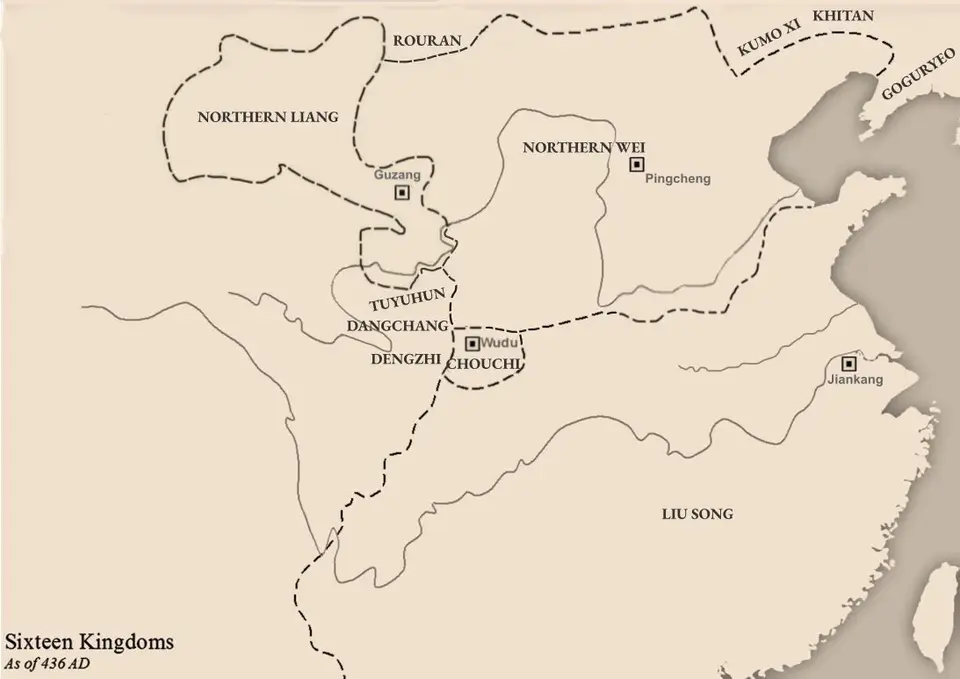
The Northern Liang dynasty (北凉; 397–460 CE) was a regional regime founded in the Hexi Corridor by the Juqu clan of the Lushuihu, a branch of the ancient Xiongnu confederation, during the turbulent Sixteen Kingdoms period. Officially designated "Liang," it was named "Northern Liang" by later historians because its territorial domain lay to the north of the other regional Liang polities. In 397 CE (Later Liang, Longfei 2nd year), Emperor Lu Guang of Later Liang unjustly executed the brothers Juqu Luochou and Juqu Quzhou. In response, their nephew Juqu Mengxun and cousin Juqu Nancheng mobilized their tribal confederates in an oath of vengeance, acclaiming Duan Ye, the Han Chinese administrator of Jiankang, as their supreme leader to inaugurate the Northern Liang state, initially establishing their capital at Jiankang and later moving to Zhangye. In 401 CE, Juqu Mengxun outmaneuvered and executed Duan Ye, assuming the titles of Shepherd of Liangzhou and Duke of Zhangye, thereby cementing the Juqu family's undisputed leadership. In 412 CE (Xuanzhi 1st year), Juqu Mengxun captured Guzang (modern Wuwei, Gansu), the premier metropolis and strategic hub of the Hexi Corridor, moving the capital there and assuming the title King of Hexi (Prince of Hexi). In 420 CE, Mengxun ambushed and slew King Li Xin of Western Liang at Doudujian; in the following year, Northern Liang forces took Dunhuang, completely eradicating Western Liang and unifying the entire Hexi Corridor. Northern Liang extended its domain east to the Yellow River and west across the Pamir Mountains, receiving tribute from the thirty-six kingdoms of the Western Regions. Mengxun maintained an astute diplomatic equilibrium, accepting investiture as King of Hexi from the southern Liu Song court while offering tribute to the rising Northern Wei Empire in the north. He enthusiastically patronized Confucian learning and embraced Mahayana Buddhism, inviting the Central Indian master Dharmaksema (Dharmakṣema) to Guzang to translate the Mahaparinirvana Sutra and sponsoring the excavation of the Tianti Mountain (Tiantishan Grottoes) grottoes (Liangzhou Grottoes), which founded the renowned "Liangzhou Pattern (Liangzhou Model of Buddhist Art)" of early Chinese Buddhist cave art. Following Mengxun's demise in 433 CE, his third son Juqu Mujian ascended the throne, continuing domestic cultural patronage. In 439 CE (Taiyan 5th year), Emperor Taiwu of Northern Wei led a massive cavalry expedition that encircled Guzang; Mujian surrendered, terminating Northern Liang rule in Hexi. Northern Wei forcibly relocated over thirty thousand households of Hexi scholar-gentry, artisans, and Buddhist monks to Pingcheng, deeply enriching northern Chinese culture. Royal brothers Juqu Wuhui and Juqu Anzhou led remnant forces across the deserts to establish an exile regime at Gaochang (Northern Liang of Gaochang) in the Turpan Basin, known to history as "Gaochang Northern Liang." In 460 CE, the Rouran Khaganate stormed Gaochang and slew Juqu Anzhou, ending sixty-three years and five monarchs of Northern Liang dynastic history.
Following the unjust execution of Juqu Luochou and Quzhou by Lu Guang, Juqu Mengxun assembled tribal warriors, joining with Juqu Nancheng to acclaim Duan Ye as leader, founding Northern Liang.
Duan Ye conquered Xijun Commandery, prompting the submission of Jinchang, Dunhuang, and Jiuquan; the capital was moved to Zhangye, extending political authority west toward Gaochang.
Mengxun framed Nancheng to induce Duan Ye to execute him, then mobilized the outraged populace to storm Zhangye and execute Duan Ye, assuming direct dynastic control as Duke of Zhangye.
Juqu Mengxun commanded thirty thousand elite troops against Southern Liang, routing their primary army at Qiongquan and forcing King Tufa Nutan (Tufa Rutan) to evacuate Guzang and flee to Ledu.
Mengxun captured the historic regional metropolis of Guzang, officially establishing his capital there, adopting the title King of Hexi, and implementing classical administrative institutions.
Mengxun executed a feigned western retreat, drawing Western Liang ruler Li Xin into a devastating ambush at Doudujian; Li Xin was slain, his army crushed, and Jiuquan was captured.
Mengxun laid siege to Dunhuang, extinguishing the Western Liang regime and bringing the entire Hexi Corridor under unified rule, while thirty-six Western Regions polities dispatched tributary envoys.
Central Indian master Dharmaksema was venerated as National Preceptor at Guzang, translating the Mahaparinirvana Sutra and inspiring the excavation of the Tianti Mountain cave temples.
Mengxun dispatched diplomatic missions to the southern Liu Song court at Jiankang, receiving imperial appointments as Commander-in-Chief of Four Provinces, General Subduing the West, and King of Hexi.
Juqu Mengxun died of illness; his scholarly third son Juqu Mujian succeeded as King of Hexi, promoting classical education and marrying Princess Wuwei, the sister of Emperor Taiwu of Northern Wei.
Emperor Taiwu personally led an elite cavalry strike force that surrounded Guzang; receiving no aid from the Rouran, Mujian surrendered, extinguishing the Hexi Northern Liang realm.
Juqu Wuhui led ten thousand remnant soldiers and civilians across the arid dunes of Bailongdui, capturing Gaochang in the Turpan Basin to reestablish the regime in exile.
Juqu Wuhui died of illness in Gaochang, and his brother Juqu Anzhou succeeded as King of Hexi, utilizing military support from the Rouran Khaganate to subjugate the Anterior Jushi Kingdom.
The Rouran cavalry launched a surprise invasion of the Turpan Basin, capturing Gaochang and killing Juqu Anzhou, bringing a definitive conclusion to the Northern Liang dynasty.
The royal lineage of Northern Liang traced its heritage to the Lushuihu, a prominent branch of the ancient Xiongnu confederation. Their ancestors had hereditarily held the high office of Left Juqu within the Xiongnu imperial hierarchy, and their descendants consequently adopted the official title "Juqu" as their ancestral tribal surname. During the early Eastern Han dynasty, the Lushuihu were concentrated along the Lushui river valleys near modern Xining, Qinghai. By the Three Kingdoms era, sections of the tribe had migrated southward into northern Sichuan, while other clans established pastoral bases along the northern foothills of the Qilian Mountains near Wuwei and Linsong in Zhangye, gradually transitioning from nomadic grazing to a semi-pastoral, semi-agrarian way of life. In 385 CE, when founding sovereign Lu Guang of Later Liang returned from his expedition to the Western Regions, the chieftains of the Juqu tribe submitted to his banner. Tribal elder Juqu Luochou was appointed Administrator of Xiping and later elevated to General Establishing Loyalty and Master of Writing, while his younger brother Juqu Quzhou was invested as Administrator of Sanhe, firmly embedding the lineage within the military establishment of Later Liang.
In the second month of 397 CE (Later Liang, Longfei 2nd year), Emperor Lu Guang launched a major punitive campaign against Qifu Gangui of Western Qin on account of his repeated rebellions. Lu Guang dispatched his illegitimate eldest son Lu Zuan to seize Jincheng, while ordering his younger brother Lu Yan, Prince of Tianshui, to lead generals Juqu Luochou and Juqu Quzhou in an assault that captured Lintao, Wushi, and Heguan. However, Lu Yan advanced recklessly, fell into an enemy ambuscade, and was slain, forcing the Later Liang forces into disorderly retreat. Rather than acknowledging tactical failure, the elderly and despotic Lu Guang placed the blame squarely upon the escort commanders, summarily executing both Luochou and Quzhou on charges of military failure. At that time, Luochou's nephew Juqu Mengxun was serving as a tribal chieftain under Administrator Duan Ye of Jiankang. When the coffins of the two slain elders were returned to their ancestral burial grounds at Linsong (modern Sunan, Gansu), more than ten thousand kinsmen, neighboring tribesmen, and local residents assembled for the funeral rites. Juqu Mengxun wept aloud before the multitude, denouncing Lu Guang's tyrannical brutality and summoning all present to join an armed rebellion against Later Liang. Within ten days, more than ten thousand warriors rallied to his banner. Mengxun immediately captured Linsong, executed Later Liang Protector Ma Sui and Magistrate Jing Xiang, and withdrew his forces to fortify the rugged Jinshan passes.
Simultaneously, Mengxun's cousin Juqu Nancheng, who held the post of Administrator of Jinchang under Later Liang, raised troops in Jiuquan to join the insurrection. Recognizing that a tribal uprising alone would struggle to win the allegiance of the vast Han Chinese populace of Hexi, Nancheng led his detachment toward Jiankang and urged Administrator Duan Ye to join their cause. Duan Ye, a cultured Han scholar who had previously served as recording clerk to Later Liang grandee Du Jin and drafted public proclamations for Lu Guang, had long been marginalized by imperial favorites Wang Xiang and Fang Jiu. Fearing eventual political destruction, Duan Ye agreed to align with the insurgents. Juqu Mengxun marched from Jinshan to merge his host with Duan Ye and Nancheng. Considering themselves too youthful and lacking in official seniority, the Juqu cousins acclaimed Duan Ye as their supreme coalition leader. Duan Ye assumed the titles of Grand Commander, General-in-Chief, Shepherd of Liangzhou, and Duke of Jiankang, adopting the reign era Shenxi and officially inaugurating the Northern Liang dynasty. Duan Ye appointed Juqu Mengxun as Administrator of Zhangye, Duke of Linchi, and Left Assistant Director of the Department of State Affairs, while appointing Juqu Nancheng as General Supporting the State to oversee military administration. In 398 CE (Shenxi 2nd year), Duan Ye captured Xijun, after which the administrators of Jinchang, Dunhuang, and Jiuquan surrendered in succession; Duan Ye subsequently transferred the dynastic seat to the strategic center of Zhangye, extending territorial influence toward Gaochang in the Western Regions.
Although Duan Ye occupied the throne as sovereign, his temperament was mild and indecisive, lacking both military resolve and strategic foresight. He was profoundly addicted to divination, apocryphal prophecies, and shamanic omens, allowing sycophantic courtiers to abuse administrative power, while practical military command remained concentrated in the hands of the Juqu brothers. Duan Ye harbored deep apprehension toward Mengxun's growing influence, while the ambitious Mengxun chafed under the nominal authority of an ineffective monarch. By 401 CE (Tianxi 3rd year), Mengxun concluded that the moment to assume direct control had arrived, and he proactively petitioned Duan Ye for a reassignment as Administrator of Anxi (modern Dunhuang, Gansu) in order to lull the court into complacency.
Prior to his departure from Zhangye, Mengxun orchestrated an astute conspiracy. In the fifth month, he invited his cousin Juqu Nancheng to accompany him on a pilgrimage to offer ancestral sacrifices at Mount Lanmen. Concurrently, Mengxun dispatched his confidential agent Xu Xian to deliver a secret denunciation to Duan Ye, alleging that Nancheng intended to stage a military coup during the mountain sacrifice. A few days later, Nancheng innocently requested formal leave from Duan Ye to perform the ancestral rites at Mount Lanmen. Terrified by the apparent confirmation of the conspiracy, Duan Ye dispatched concealed guards along the route, who ambushed and arrested Nancheng, summarily executing him. Upon receiving news of Nancheng's demise, Mengxun addressed his troops in tears, passionately condemning Duan Ye for slaughtering a founding pillar of the state and calling upon the army to avenge Nancheng. Deeply loved by soldiers and frontier tribes, Nancheng's death ignited widespread outrage, and neighboring Qiang and Hu communities rushed to join Mengxun's banner, while palace guards inside Zhangye abandoned their posts.
Mengxun led over ten thousand cavalry in a rapid assault that breached the defenses of Zhangye. Duan Ye was captured alive and pleaded bitterly to be spared so that he might return to his native village to live peacefully with his wife, but Mengxun refused all clemency and ordered his execution. Duan Ye had reigned for four years from his initial accession. Following his death, senior military officers such as Liang Zhongyong acclaimed Juqu Mengxun as Envoy with Credentials, Grand Commander, General-in-Chief, Shepherd of Liangzhou, and Duke of Zhangye, adopting the reign era Yong'an. Juqu Mengxun formally took the helm of state, inaugurating direct dynastic rule by the Juqu lineage over Northern Liang.
During his initial years on the throne, Mengxun recognized that Northern Liang was militarily constrained and ringed by hostile neighbors, prompting him to pursue external accommodation coupled with vigorous internal fortification. In the year of his accession, he offered vassalage to Emperor Yao Xing of Later Qin in Chang'an, receiving appointment as Inspector of Hezhou and Marquis of Xihai; concurrently, he dispatched his eldest son Juqu Xianian as a hostage to Southern Liang to purchase diplomatic peace. King Tufa Lilugu of Southern Liang rejected Xianian as too young, demanding instead Mengxun's capable brother Juqu Na. Mengxun complied with bitter reluctance, but harbored deep resentment, accelerating military training and expanding agricultural reclamation.
By 410 CE (Yong'an 10th year), confident in his accumulated strength, Mengxun personally led an army of thirty thousand down the Hexi Corridor against Southern Liang, ravaging Xijun and Xianmei and relocating several thousand captive households. In the following year (411 CE), discovering that Southern Liang's primary army had not completed their fortified encampments at Qiongquan, Mengxun unleashed an immediate cavalry assault that shattered their ranks, pursuing the routed enemy to the gates of their capital at Guzang (modern Wuwei, Gansu). Over ten thousand Han and tribal families defected to Northern Liang; King Tufa Nutan fled southward to establish a new capital at Ledu, while local commander Jiao Lang seized temporary control of Guzang. In the eleventh month of 412 CE (Yong'an 12th year), Mengxun deployed thirty thousand troops to capture Guzang, pardoned Jiao Lang, and formally transferred the dynastic capital from Zhangye to Guzang.
The relocation of the capital to Guzang represented a watershed in Northern Liang's geopolitical prestige. Since the Western Han dynasty, Guzang had served as the paramount political, economic, and intellectual metropolis of the Hexi Corridor, symbolizing legitimate imperial rule in the northwest. Mengxun erected an altar at Guzang, proclaimed himself King of Hexi, inaugurated the Xuanzhi reign era, declared a general amnesty, and restored the full bureaucratic apparatus and ritual palaces of the Han and Wei dynasties. When Tufa Nutan attempted an offensive in 413 CE to reclaim his lost capital, Mengxun ambushed and routed his army, chasing the retreat to the walls of Ledu and compelling Southern Liang to surrender Grand Commandant Ju Yan as a hostage for peace. Following the destruction of Southern Liang by Western Qin in 414 CE, Mengxun immediately declared war, capturing the Hehuang commanderies and securing a vital defensive buffer on his southern flank.
While containing Southern Liang and Western Qin, Mengxun focused his strategic ambition upon Western Liang, ruled by the Li clan from bases in Jiuquan and Dunhuang. Since Li Gao proclaimed himself Duke of Liang at Dunhuang in 400 CE, Western Liang had remained a formidable rival. In 410 CE, Mengxun defeated Western Liang Crown Prince Li Xin at Mamiao; in the autumn of 418 CE, Northern Liang cavalry swept across the frontier to harvest and seize Western Liang's garrison crops, inflicting catastrophic logistical damage. Following Li Gao's death, Li Xin took the throne; he was arrogant, headstrong, and routinely ignored the prudent counsel of his senior ministers.
In the seventh month of 420 CE (Xuanzhi 9th year), Juqu Mengxun executed a masterpiece of strategic deception. He publicly proclaimed an expedition against Haotai, marching his primary army westward. Upon reaching Haotai, however, he withdrew his strike force under cover of night, concealing thirty thousand seasoned veterans within the rugged defiles of Chuanyan near Doudujian. Deceived by reports that Mengxun was far away and that Guzang lay defenseless, Li Xin brushed aside the desperate entreaties of his mother, Empress Dowager Yin, and mobilized his entire army of thirty thousand elite soldiers in an all-out strike against Guzang. When the Western Liang host entered the narrow gorges of Doudujian, Northern Liang horns sounded from the surrounding heights, and Mengxun's concealed cavalry charged down into the congested columns. Trapped in the ravine, Western Liang's army was annihilated, and Li Xin was slain on the battlefield.
Mengxun pressed his advantage immediately westward, capturing the fortress of Jiuquan without resistance. Enforcing strict military discipline, Northern Liang soldiers treated the urban populace with restraint. In the third month of 421 CE (Xuanzhi 10th year), Mengxun's forces encircled Dunhuang, extinguishing the last pockets of resistance and terminating the Western Liang regime. Northern Liang took captive Li Xin's younger sister Li Jing'ai and Empress Dowager Yin, treating both noblewomen with ceremonial honor; Crown Prince Juqu Mujian later wed Li Jing'ai as his principal consort (elevated to queen upon his accession). The conquest of Western Liang placed the four historic commanderies of Hexi—Wuwei, Zhangye, Jiuquan, and Dunhuang—under unified Northern Liang control, extending sovereign influence from the Yellow River to the Pamir Mountains and reopening unimpeded trade across the Silk Road. In 428 CE (Chengxuan 1st year), Mengxun further expanded his southern frontier by capturing Baohan and Xiping from Western Qin, reaching the pinnacle of regional hegemony.
In the fourth month of 433 CE (Yihe 3rd year), dynastic patriarch Juqu Mengxun fell mortally ill. Summoning his third son Juqu Mujian to his bedside, Mengxun designated him as his imperial successor, strictly commanding him to ensure that his daughter, Princess Xingping, was promptly escorted to the Northern Wei court in fulfillment of an agreed matrimonial alliance to safeguard the dynasty. Mengxun passed away the following day at the age of sixty-six; he was honored with the temple name Taizu and the posthumous title King Wuxuan. Juqu Mujian ascended the throne as King of Hexi, adopting the reign era Yonghe. Mujian, whose courtesy name was Maoqian, was an erudite scholar profoundly devoted to literature and statecraft. Upon taking power, he elevated classical education, welcoming eminent Hexi intellectuals such as Kan Yin, Liu Bing, Song Yao, Zhang Zhan, and Zhao Rou into high administrative office, fostering an unprecedented flourishing of scholarship.
In foreign relations, confronted by the rapid military ascendancy of Northern Wei in the north and the traditional imperial prestige of the Liu Song dynasty in the south, Mujian skillfully practiced dual diplomacy. He fulfilled his father's commitment by escorting Princess Xingping to Pingcheng, where Emperor Taiwu created her Right Lady of Bright Deportment, while Northern Wei dispatched General Pacifying the West Li Shun to formally invest Mujian as Commander-in-Chief of Military Affairs in Liang, Sha, and He Provinces and the Western Regions, General of Chariots and Cavalry, Inspector of Liangzhou, and King of Hexi. Concurrently, Mujian dispatched envoys across the southern sea lanes to the Liu Song court at Jiankang, offering formal vassalage to Emperor Wen of Song, who conferred upon him the concurrent titles of General Subduing the West and King of Hexi, accompanied by extensive gifts of classical literature. Domestically wary of Northern Wei's ultimate intentions, Mujian secretly corresponded with the Rouran Khaganate and Western Regions oasis kingdoms, cautioning them against Northern Wei envoys to impede imperial westward encroachment.
In 437 CE, seeking to secure absolute control over the Silk Road conduits to the Western Regions, Emperor Taiwu arranged the marriage of his own sister, Princess Wuwei, to Juqu Mujian. Mujian welcomed the imperial princess with profound reverence, designating her as his Queen, exiling his former queen Li Jing'ai to Jiuquan, and dispatching Chancellor Song Yao to Pingcheng with five hundred fine horses and five hundred catties of gold in thanksgiving. However, marital harmony was short-lived; Mujian engaged in an illicit romance with the widow of his deceased elder brother, Lady Li, causing deep estrangement with Princess Wuwei. Consumed by jealousy, Lady Li administered poison to Princess Wuwei in the third month of 439 CE. Although royal physicians saved the princess, she suffered severe debility. News of the poisoning incensed Emperor Taiwu, who demanded the immediate extradition of Lady Li to Pingcheng for trial. Passionately attached to Lady Li, Mujian secretly sent her to sanctuary in Jiuquan and refused imperial extradition, precipitating an irreversible crisis between the two states.
In the sixth month of 439 CE (Taiyan 5th year), Emperor Taiwu issued an imperial manifesto detailing twelve major crimes committed by Juqu Mujian, personally commanding several tens of thousands of elite imperial cavalry in a massive western invasion. Crossing desert wastes with remarkable speed, Northern Wei forces reached Guzang in the eighth month and established a tight blockade. Emperor Taiwu summoned Mujian to surrender, but Mujian bolted the gates and ordered total defense, counting upon a diversionary southern assault by the Rouran Khaganate. However, the Rouran forces were repulsed along the northern frontier, leaving Guzang completely isolated, with food supplies dwindling and morale collapsing.
In the ninth month, Juqu Mujian's nephew Juqu Wannian concluded that resistance was futile, slipped out through the city walls, and surrendered to the imperial army, opening the outer gates to the Northern Wei vanguard. Realizing that defeat was absolute, Juqu Mujian emerged from the inner fortress with five thousand civil and military officials, bare-chested and leading sacrificial sheep in unconditional capitulation. The conquest yielded over two hundred thousand registered urban inhabitants, vast reserves of bullion and silk, and more than two hundred thousand head of horses and cattle. Emperor Taiwu ordered the forced relocation of over thirty thousand households of prominent scholar-gentry, Buddhist monks, and master artisans to Pingcheng, effectively terminating Northern Liang rule over the Hexi heartland.
Taken to Pingcheng, Mujian received ceremonial respect as an imperial brother-in-law through the intervention of Princess Wuwei, retaining the rank of General Subduing the West and King of Hexi. However, he remained under strict imperial surveillance. In the first month of 447 CE (Taiping Zhenjun 8th year), an informant accused Mujian of maintaining treasonous correspondence with Hexi loyalists and concealing deadly poisons in his residence. Enraged, Emperor Taiwu dispatched Grand Master of Ceremonies Cui Hao to deliver an imperial suicide decree. Mujian wept in farewell with Princess Wuwei, withdrew to an adjoining chamber, and took his own life; Emperor Taiwu accorded him royal burial rites outside the southern suburbs of Pingcheng.
The capitulation of Guzang did not immediately extinguish the Juqu family's presence in the far west. In 439 CE, Emperor Taiwu dispatched General Subduing the South Xi Juan to subjugate Jiuquan. Mujian's younger brother Juqu Wuhui, then serving as Inspector of Shazhou and Administrator of Jiuquan, recognized that his forces were outmatched and withdrew to Gaochang in the Western Regions. Six months later, taking advantage of Northern Wei's military redeployment, Wuhui launched a surprise counterattack that recaptured Jiuquan. Seeking to stabilize the western frontier while preparing campaigns against the south, the Northern Wei court temporarily invested Wuhui as Prince of Jiuquan. However, Wuhui was determined to reclaim the lost ancestral capital at Guzang, provoking Emperor Taiwu to order Xi Juan to encircle Jiuquan in the fourth month of 441 CE. The siege lasted six months until rations were exhausted; over ten thousand inhabitants starved, and the fortress fell.
Juqu Wuhui fought his way out through the imperial cordon, retreating to Dunhuang. Pressured relentlessly by imperial armies, Wuhui dispatched his brother Juqu Anzhou across the sands to secure Shanshan in the eleventh month of 441 CE. In the fourth month of 442 CE, Wuhui led ten thousand loyal troops and civilian refugees in an epic desert crossing through the arid wastes of Bailongdui, arriving in the Turpan Basin. In the ninth month, the Juqu forces seized Gaochang, establishing it as their new capital and inaugurating the Chengping reign era, a polity known to history as "Gaochang Northern Liang." Emperor Wen of Liu Song promptly invested Wuhui as Inspector of Liangzhou and King of Hexi. Following Wuhui's death from illness in the sixth month of 444 CE, his younger brother Juqu Anzhou took the throne.
Juqu Anzhou maintained the survival of his isolated kingdom by allying with the burgeoning Rouran Khaganate on the Mongolian plateau. In 450 CE (Chengping 8th year), supported by Rouran auxiliary cavalry, Anzhou laid siege to Jiaohe and conquered the pro-Wei Anterior Jushi Kingdom, unifying the Turpan Basin. Gaochang Northern Liang maintained classical Chinese commandery administration and instituted extensive agrarian colonies that sustained thousands of Chinese settlers and Lushuihu clansmen. However, as the Rouran Khaganate expanded aggressively into the Western Regions, Gaochang was reduced to a vulnerable vassal state. In 460 CE (Chengping 18th year), Rouran forces turned unexpectedly upon their client, storming Gaochang and executing Juqu Anzhou and the royal lineage. Sixty-three years after Duan Ye initially raised the banner of Liang in 397 CE, the Northern Liang dynasty vanished definitively beneath the sands of Central Asia.
The political structure of Northern Liang was characterized by a synthesis of nomadic military leadership and classical Han-Wei centralized civilian bureaucracy. During the initial decades of the regime, the ruling Lushuihu elite possessed an absolute monopoly over armed force, yet founding monarch Juqu Mengxun clearly understood that a settled agrarian oasis society could not be governed through martial coercion alone. Consequently, Northern Liang implemented a dual system of civil-military co-governance. At the central court, administrative authority was vested in a Department of State Affairs modeled after Han and Jin prototypes, divided into sections overseeing civil appointments, taxation, judicial records, and classical education, staffed primarily by erudite Han scholar-gentry. Concurrently, imperial bodyguard units and tribal contingents were placed under the direct command of Lushuihu tribal chieftains and royal princes, creating a functional balance where Han law governed revenue and civilian life, while tribal commanders led armed expeditions.
To safeguard his elongated desert domain, Mengxun instituted an extensive policy of appointing royal clan members to command strategic frontier commanderies. In critical hubs such as Jiankang, Zhangye, Jiuquan, Dunhuang, and Gaochang, administrative control was uniformly entrusted to trusted Juqu princes and senior kinsmen. Juqu Nancheng served as General Supporting the State managing overall military policy, Juqu Na held command as General Establishing Loyalty over frontier strongholds, Juqu Wuhui administered Jiuquan as Inspector of Shazhou, and Juqu Anzhou governed Ledu and Gaochang. This distribution of power formed an interconnected defensive network radiating east and west from Guzang, enabling regional garrisons to respond rapidly to nomadic raids while preserving supreme administrative loyalty to the central throne.
The recruitment of virtuous talent and the veneration of Confucian scholarship served as the intellectual foundation of Northern Liang's governance. Despite his tribal origins, Juqu Mengxun was deeply enamored of classical culture and actively recruited prominent Han intellectuals. Following the conquest of Western Liang, he incorporated surrendered officials, appointing senior statesman Song Yao as Director of the Bureau of Personnel to manage civil selections. He venerated Dunhuang scholar Liu Bing, appointing him Gentleman of the Secretariat, erecting the Luchen Academy to accommodate hundreds of his students, and providing state stipends; Juqu Mujian later honored Liu Bing as National Preceptor. The renowned classicist Kan Yin was appointed to the Bureau of Civil Evaluation, provided with a staff of thirty scribes to collate and edit over three thousand scrolls of ancient texts. By recruiting scholars like Zhang Zhan, Suo Chang, Yin Xing, Song Qin, and Zhao Rou to teach in the state academy, Northern Liang cemented the unwavering loyalty of the great regional lineages.
Juqu Mengxun's internal governance was distinguished by strict statutory enforcement and relentless suppression of administrative corruption. The central court published detailed administrative codes instructing regional magistrates to actively promote agricultural production, maintain irrigation canals, and prevent local magnates from usurping public lands. Mengxun applied the law without partiality, even against his own close kinsmen. When his paternal uncle Kong Du, Administrator of Linsong, abused his authority to extort the local populace, Mengxun severely reprimanded him and ordered him to commit suicide to uphold judicial impartiality. The court maintained regular grain price stabilization reserves, opening public granaries during droughts to relieve the indigent and severely penalizing officials who concealed crop failures. This combination of agrarian encouragement and strict discipline earned Northern Liang contemporary acclaim for administrative integrity.
Following their westward migration to Gaochang, Juqu Wuhui and Juqu Anzhou preserved intact the civilian bureaucracy of the Chinese commandery system, establishing regular county administrations at Gaochang, Jiaohe, and Tiandi, supported by traditional six-ministry boards. Confronted by the extreme ecological constraints of the hyper-arid Turpan Basin, the exile regime instituted extensive military and civilian agricultural colonies. The administration surveyed arable lands, mobilized more than ten thousand refugee soldiers and civilians to excavate irrigation conduits, and promoted the intensive cultivation of wheat, barley, millet, and grapes under a unified military-agrarian discipline. The surviving official records, census registers, and administrative seals recovered from Turpan tombs provide concrete archaeological evidence of the deep institutional roots established by Chinese statecraft in Central Asian oases.
Northern Liang's military dominance was anchored by its elite cavalry units, supported by the exceptional horse-breeding infrastructure of the Qilian Mountains. The high-altitude valleys of Linsong and Dadoubagu possessed luxuriant natural pastures that had sustained prized warhorses since the Han dynasty. The Juqu clan were seasoned equestrians, and the state established imperial stud farms along the northern slopes of the range, breeding resilient warhorses celebrated for endurance and speed. The army integrated armored cataphracts capable of shock assaults with agile light horsemen skilled in mounted archery, supplemented by well-drilled infantry equipped with heavy shields, spears, and repeating crossbows. Northern Liang commanders specialized in deep operational encirclements, long-range desert maneuvers, and surprise canyon ambuscades, demonstrating remarkable tactical versatility across punishing mountain and desert terrain. An integrated network of beacon towers and fortified earthworks linked the corridor, allowing frontier garrisons to withdraw behind walls and clear the countryside upon enemy approach, before striking back with concentrated cavalry once invaders grew exhausted.
The Battle of Doudujian in 420 CE remains a textbook example of tactical misdirection and ambuscade in medieval Chinese military history. Determined to eliminate Western Liang, Mengxun recognized that the formidable walls of Jiuquan would demand a costly siege. He therefore feigned a major western offensive toward Haotai, creating public fanfare. Once at Haotai, however, he executed a covert night march that positioned his elite strike force within the rocky gorges of Chuanyan near Doudujian. Believing that Guzang was left defenseless, King Li Xin of Western Liang led thirty thousand troops on a reckless eastward assault. As the Western Liang army filed through the narrow ravine, Mengxun's hidden troops attacked from all sides, completely shattering their formation and slaying Li Xin. The annihilation of Western Liang's primary field army enabled Northern Liang to capture Jiuquan and Dunhuang with minimal losses, decisively unifying the entire Hexi Corridor.
Positioned along the northwestern periphery, Northern Liang pursued a pragmatic strategy of regional survival through multi-directional diplomacy. Toward the Eastern Jin and subsequent Liu Song dynasties in the south, Northern Liang rulers maintained consistent ceremonial allegiance, dispatching tributary missions across the southern maritime routes to Jiankang. Emperors of the southern dynasties repeatedly confirmed Mengxun and Mujian as General Subduing the West and King of Hexi. This adherence to southern imperial legitimacy reinforced dynastic loyalty among Hexi scholar-gentry and facilitated the transmission of classical literature from the southern cultural heartland. Simultaneously, Northern Liang maintained formal tributary ties with the ascendant Northern Wei empire, presenting gifts of fine horses and gold while entering into royal matrimonial alliances. Mujian maintained diplomatic channels with the Rouran Khaganate to counterbalance northern pressure, practicing skillful strategic hedging that preserved regional peace for decades.
Following the pacification of Western Liang, Mengxun advanced through the Yumen Pass, compelling the submission of Shanshan and Gaochang and receiving formal tribute from thirty-six Western Regions kingdoms, thereby restoring Hexi's traditional suzerainty over the Tarim Basin. Toward the Tuyuhun Kingdom in Qinghai, Northern Liang maintained a durable political and military alliance, as both polities recognized southern dynastic authority and collaborated to counter Western Qin and secure trans-regional caravan routes. Toward the northern Rouran Khaganate, Northern Liang maintained vigilant frontier defense, but following the fall of Guzang, the exile regime under Juqu Anzhou relied heavily upon Rouran military backing to conquer the Anterior Jushi Kingdom, only to be ultimately betrayed and extinguished by the nomadic empire in 460 CE.
Agriculture in the Hexi Corridor depended entirely upon glacial runoff channeled from the Qilian Mountains through inland river systems. Throughout their six decades of rule, Northern Liang sovereigns prioritized irrigation infrastructure, maintaining and expanding the diversion canals along the Shiyang, Heihe, and Shule rivers. The state enforced explicit agricultural codes directing local magistrates to promote timely planting and maintain canal banks. The administration established a rigorous hierarchy of water-management officials. In dry seasons, permanent water controllers managed distribution, while during summer peak irrigation periods, specialized traveling commissioners were dispatched to patrol trunk canals, resolve communal disputes, and enforce rotational watering schedules. The "Year 10 of Yuanhe Water Allocation Document" excavated at Turpan reveals that administrative rosters meticulously detailed staff assignments and cubic water quotas for specific vineyards and cereal fields, demonstrating an advanced bureaucratic mastery over oasis hydrology.
Occupying the vital geographic bottleneck of the Hexi Corridor, Northern Liang served as the paramount overland commercial artery linking China with Eurasia during an era when the Central Plains were ravaged by continuous warfare. The stability and well-maintained relay stations of the Hexi Corridor attracted merchant caravans from across the continent. Sogdian, Persian, Bactrian, and Roman merchants traveled the northern and southern Silk Road branches, transporting Western frankincense, glassware, silverware, and tapestries to trade for Chinese raw silk, brocades, iron tools, and tea. Guzang, Zhangye, and Dunhuang flourished as bustling cosmopolitan trade hubs. Commercial transactions were governed by sophisticated contractual instruments, loan agreements, and employment covenants, while municipal market directors maintained fair weights, measures, and policing, generating substantial transit revenues for the royal treasury.
While continuous conflict caused the monetary systems of most northern Sixteen Kingdoms polities to collapse into primitive barter economies, Northern Liang stood out for maintaining a standardized bronze currency. Shortly after assuming power in 401 CE, Juqu Mengxun opened official mints at Guzang and Zhangye to cast the bronze coin known as "Liangzao Xinquan" (Coins Newly Minted in Liang). Featuring robust seal-script inscriptions read in cross-fashion, the coins were produced in standardized large and small denominations of refined copper. Archaeological excavations have unearthed these coins in large quantities across Wuwei, Zhangye, Jiuquan, Dunhuang, and the ruins of Gaochang in Xinjiang, proving their sustained circulation as a trusted medium of exchange that facilitated trans-continental trade and preserved commercial efficiency.
Benefiting from the expansive sub-alpine meadows of the Qilian range and the arid grazing grounds of Gaochang, Northern Liang supported vast herds of horses, cattle, sheep, and camels. Livestock represented essential state strategic assets and commercial wealth; when Emperor Taiwu captured Guzang in 439 CE, imperial troops impounded over two hundred thousand head of cattle and horses. In manufacturing, state and private workshops flourished, producing fine scale-armor, cavalry bards, and iron weaponry. Textile production, leather tanning, and winemaking expanded rapidly, with indigenous Turpan grape fermentation blending with traditional Han grain brewing, producing celebrated vintages that supplied the trade routes.
Amid the widespread devastation of the Sixteen Kingdoms era, Northern Liang provided a crucial sanctuary for classical Chinese scholarship and intellectual traditions. As the eminent modern historian Chen Yinke observed: "Although the Juqu rulers were of non-Han ethnicity and unaccustomed to book-learning, they possessed an innate appreciation for Han civilization, actively promoting scholar-officials; consequently, while Hexi fell under tribal dominion, classical learning and culture never collapsed." Juqu Mengxun and Juqu Mujian extended generous patronage to eminent scholar-gentry. The Dunhuang classicist Kan Yin annotated Wang Lang's Commentary on the Book of Changes and authored the celebrated geographic treatise Records of Thirteen Provinces; Mengxun appointed him to high office, granting him thirty scribes to collate more than three thousand scrolls of ancient texts. The scholar Liu Bing authored extensive histories and lexicographical works; Mengxun constructed the Luchen Academy to accommodate his disciples, while Mujian revered him as National Preceptor. Through active book exchanges with the Liu Song court, Northern Liang preserved the continuity of Han-Wei classical learning.
Northern Liang holds an epochal position in the intellectual history of Chinese Buddhism. Dynastic rulers were devout patrons of Mahayana teachings. In 412 CE, following his capture of Guzang, Juqu Mengxun welcomed the renowned Central Indian master Dharmaksema with imperial honors, installing him as National Preceptor and establishing an expansive translation bureau. Over a decade, Dharmaksema translated over six hundred thousand Sanskrit words, including the forty-volume Mahaparinirvana Sutra and the Mahasamnipata Sutra. His translation of the Mahaparinirvana Sutra introduced the revolutionary doctrine that "all sentient beings possess Buddha-nature" and that even the most corrupt (icchantikas) can attain enlightenment. This profound doctrine electrified Chinese intellectual circles, directly spawning the influential Nirvana School and laying the doctrinal foundations for the later indigenous development of Tiantai, Huayan, and Chan Buddhism in the Sui and Tang eras.
Northern Liang was the cradle of large-scale Buddhist cave-temple architecture in China. Fostered by an ascetic monastic tradition that emphasized solitary meditation amid quiet mountain cliffs, Juqu Mengxun sponsored the excavation of the Tianti Mountain grottoes on the sheer precipices southeast of Guzang. Concurrently, cave complexes were initiated at Jinta Temple, Mati Temple, and Wenshu Mountain, while the earliest surviving caves at Mogao in Dunhuang (Caves 268, 272, and 275) were excavated during this period. Pioneering archaeologist Su Bai identified this distinctive aesthetic as the "Liangzhou Pattern," characterized by central-pillar cave architecture, robustly modeled Buddha statues combining Gandharan and Gupta proportions with traditional Han drapery aesthetics, and narrative murals. Following the fall of Northern Liang in 439 CE, three thousand Hexi monks and sculptors were forcibly transported to Pingcheng, where they directly designed and executed the magnificent Yungang Grottoes and influenced the Longmen Grottoes.
Northern Liang served as an artistic crucible where Central Asian and Chinese musical traditions converged. Over successive generations, musical styles from Kucha, India, Kashgar, and Sogdiana merged with Han folk songs and frontier military melodies, coalescing into the celebrated "Liangzhou Music." Utilizing lutes, reed pipes, transverse flutes, and bronze cymbals, this music combined solemn grandeur with melodic richness. Following the conquest of Guzang, Northern Wei court officials incorporated the royal musicians and scores, designating the repertoire "Xiliang Music" and establishing it as one of the formal court music genres. This musical tradition was perpetuated through the Sui and Tang dynasties, leaving an enduring mark on Tang poetry and the celestial musician murals of Dunhuang.
Northern Liang society exhibited remarkable cultural pluralism, embracing Lushuihu, Han, Xianbei, Qiang, Di, Yuezhi, and Gaoche populations. Mengxun pursued integrative social policies, registering tribal nomads on official tax rolls, encouraging intermarriage, and extending legal protections to foreign merchants. Prestigious Han lineages such as the Zhang and Suo of Dunhuang, Fang of Qinghe, Pei of Hedong, and Yang of Hongnong served in the same imperial administration alongside Xianbei and Gaoche tribal elites. Decades of peace fostered widespread economic interdependence and cultural assimilation, as nomads adopted settled farming and Han youths learned mounted archery, establishing the social foundations for multi-ethnic cohesion during the Sui and Tang dynasties.
| Temple Name | Posthumous Title | Personal Name | Reign Period | Reign Eras | Historical Significance and Major Achievements |
|---|---|---|---|---|---|
| None | None | Duan Ye | 397–401 CE | Shenxi, Tianxi | Initial ruler, acclaimed by the Juqu brothers; cultivated but indecisive, overthrown and executed by Mengxun |
| Taizu | King Wuxuan | Juqu Mengxun | 401–433 CE | Yong'an, Xuanzhi, Chengxuan, Yihe | Founding patriarch; seized power, moved capital to Guzang, crushed Western Liang to unify Hexi, sponsored Dharmaksema |
| None | King Ai | Juqu Mujian | 433–439 CE | Yonghe, Yuanhe, Taiyuan, Chenghe, Jianping | Third son of Mengxun; elevated Confucian education, married Northern Wei princess, surrendered Guzang to Emperor Taiwu |
| None | None | Juqu Wuhui | 439–444 CE | Chengping | Younger brother of Mujian; led remnants across desert to found Gaochang Northern Liang, recognized by Liu Song court |
| None | None | Juqu Anzhou | 444–460 CE | Chengping | Younger brother of Wuhui; captured Jiaohe and conquered Anterior Jushi with Rouran aid, slain in Rouran invasion |
Standard dynastic histories offer nuanced appraisals of Juqu Mengxun's exceptional tactical acumen and ruthless political pragmatism. In the Book of Jin (Jin Shu), the appraisal observes: "Mengxun was shrewd, unconventional, and endowed with immense strategic cunning; he possessed the talent to employ both scholar-officials and the common people, which enabled him to establish preeminent hegemony across the western frontier." While acknowledging his ability to unify Hexi and patronize cultural institutions, classical historians uniformly condemned his treachery in orchestrating the demise of his sworn allies and sovereign Duan Ye.
In the Book of Wei (Wei Shu), the chronicle notes that the Juqu leaders exploited the volatile collapse of Later Liang, Southern Liang, and Western Qin to consolidate their regional realm, skillfully navigating the balance of power between the northern and southern empires.
Modern historians and archaeologists accord Northern Liang a pivotal status in the preservation and transformation of medieval Chinese civilization. Professor Chen Yinke highlighted that Northern Liang's consistent patronage of classical learning provided an indispensable sanctuary for Han-Wei literary culture during the chaos of the Sixteen Kingdoms, preserving institutional traditions that later nourished the Sui and Tang imperial systems.
In art history, the pioneering studies of Professor Su Bai established the foundational role of the "Liangzhou Pattern." The cave temples of Tianti Mountain, Mati Temple, and early Dunhuang fused Gandharan and Gupta sculptural traditions with Chinese aesthetic sensibilities, pioneering the sinicization of Buddhist cave art. When thousands of Liangzhou artisans were relocated to Pingcheng after 439 CE, they directly shaped the monumental Yungang and Longmen Grottoes, establishing Northern Liang as the true fountainhead of classical Chinese Buddhist art.
Founding Monarch of Northern Liang (reigned 397–401)
Duan Ye (段业) (c. 350 – June 401), a native of Jingzhao Commandery (modern Xi'an, Shaanxi Province), was the founding sovereign of Northern Liang during the turbulent Sixteen Kingdoms period, reigning from 397 to 401. Emerging from a family of central plain literati, Duan Ye was renowned for his literary refinement and erudition. Joining the western expedition commanded by Former Qin general Lu Guang in 383 as an army secretary under Du Jin, he subsequently served the Later Liang regime as Administrator of Jiankang and Master of Writing. In 397, amid the rapid political decay and tyrannical cruelty of Later Liang, Lushuihu tribal chieftains Juqu Nancheng and Juqu Mengxun rebelled to avenge clan elders, marching upon Jiankang and proclaiming Duan Ye their sovereign leader. Supported by regional Han gentry, Duan Ye established an altar, took solemn oaths, and founded the Northern Liang state under the reign era Shenxi. His forces captured Xijun through hydraulic siege tactics and received the surrender of Jinchang and Dunhuang, controlling much of the Hexi Corridor. Assuming the royal title King of Liang in 399 under the era Tianxi, he repulsed a massive Later Liang invasion by implementing scorched-earth defenses with Southern Liang reinforcements. However, indecisive, suspicious, and lacking independent military backing, Duan Ye executed key general Ma Quan and fell victim to Juqu Mengxun's fratricidal trap, wrongly executing loyal founder Juqu Nancheng. In 401, Juqu Mengxun marched upon Zhangye; betrayed by inner guards, Duan Ye was captured and executed, transferring sovereign control of Northern Liang to the Juqu lineage.
Second Ruler and Actual Founding Sovereign of Northern Liang
Juqu Mengxun (沮渠蒙逊, 368–433), of the Lushuihu branch of the Xiongnu people, was a native of Lincong (south of modern Zhangye, Gansu Province). He was the second ruler and the genuine founding architect of the Northern Liang dynasty, reigning for thirty-three years from 401 to 433. His family hereditarily held the position of Left Juqu under the Xiongnu royal house, adopting the title as their clan name. From his youth, Mengxun was well-read in classical histories, skilled in astrology and divination, and calculating in political strategy. In 397, after his uncles were wrongfully executed by Lu Guang of Later Liang, Mengxun rallied tribal chieftains in rebellion, elevating Duan Ye as a figurehead while serving as Administrator of Zhangye. In 401, Mengxun engineered the elimination of Duan Ye and seized supreme power, styling himself Governor of Liangzhou and Duke of Zhangye. Throughout his thirty-three-year reign, Juqu Mengxun displayed masterful diplomatic flexibility and military skill. He paid nominal homage to Later Qin, Eastern Jin, Liu Song, and Northern Wei, balancing rival superpowers to ensure Northern Liang's survival. Domestically, he promoted sericulture, expanded irrigation, and patronized scholars such as Liu Bing and Kan Yin to collate over three thousand scrolls of ancient texts. Furthermore, he sponsored the Indian master Dharmaksema to translate the Mahaparinirvana Sutra and excavated the Tiantishan Grottoes, pioneering Buddhist rock-cut art in China. Through decisive military campaigns, he moved his capital to Guzang as King of Hexi in 412, crushed Western Liang at Liaochuan in 420, and conquered Dunhuang in 421, completely unifying the Hexi Corridor. He passed away in 433 at the age of sixty-six, receiving the temple name Taizu and the posthumous title King Wuxuan.
 Northern Liang Dynasty (北凉)
Final Monarch of Northern Liang (Gaochang Northern Liang)
Juqu Anzhou (沮渠安周) was the final monarch of the Northern Liang dynasty (Gaochang Northern Liang), of Lushui Hu descent, the youngest son of dynastic founder King Wuxuan Juqu Mengxun, and younger brother of Juqu Mujian and Juqu Wuhui. Following the conquest of Northern Liang's capital of Guzang by Emperor Taiwu of Northern Wei in 439, Juqu Anzhou accompanied his brother Juqu Wuhui westward across the desert into the Western Regions, capturing Shanshan and Gaochang to establish the Gaochang Northern Liang state in the Turpan Basin. In the twenty-first year of the Yuanjia era of Southern Song (444), upon the death of Juqu Wuhui, Juqu Anzhou succeeded to the throne, establishing the era name Chengping. Throughout his sixteen-year reign, he recognized the Southern Song dynasty as the legitimate sovereign of China, receiving investiture from Emperor Wen of Song as King of Hexi, Commander-in-Chief of Liang, Qin, Ning, and Yi Provinces, and Governor of Liangzhou. He implemented Chinese administrative institutions, promoted oasis irrigation, and extensively patronized Mahayana Buddhism; the celebrated Chinese epigraphic monument Stele of Juqu Anzhou's Temple Construction was erected during his reign. In 460, the Rouran Khaganate stormed Gaochang, killing Juqu Anzhou in battle and terminating Northern Liang's six-decade rule.
 Era not stated
Historical figure
Song Yao (宋繇, 361–439), courtesy name Tiye (体业), was a native of Dunhuang Commandery (present-day Dunhuang, Gansu Province), hailing from the prominent Dunhuang Song lineage of the Hexi region. He was a foundational statesman and regent of the Western Liang state during the Sixteen Kingdoms period, an eminent Confucian scholar, and a distinguished official who served across four regimes: Later Liang, Northern Liang, Western Liang, and Northern Wei. He was ennobled as Duke of Qingshui and posthumously honored with the name Gong. Song Yao was the posthumous son of Song Liao, a General of Dragon Cavalry in Former Liang who perished during internal political strife. Orphaned in infancy, Song Yao was raised by his aunt and earned widespread renown for his filial piety and diligent scholarship. In his youth, he studied in Jiuquan, mastering classical Confucian canons and dynastic histories. Under Emperor Lü Guang of Later Liang, he was recommended as an Cultivated Talent (Xiucai) and appointed Gentleman (Langzhong). When Duan Ye established Northern Liang, Song Yao served as Regular Mounted Attendant. Discerning Duan Ye's indecisiveness and military ineptitude, Song Yao journeyed west to Dunhuang to join his maternal half-brother Li Gao. When Duan Ye dispatched Suo Si to replace Li Gao as Governor of Dunhuang, Song Yao forcefully urged Li Gao to execute Suo Si and declare independence, thereby precipitating the founding of the Western Liang state. Following its establishment, Li Gao appointed Song Yao as Administrator (Changshi), entrusting him with central military and civil affairs, during which Song led forces to pacify cities west of Yumen Pass. On his deathbed, Li Gao designated Song Yao as prime regent to assist his heir, Li Xin. Despite Song Yao's repeated counsel urging moderation and virtue, Li Xin pursued aggressive militarism, ultimately leading to the destruction of Western Liang by Juqu Mengxun of Northern Liang. After capturing Jiuquan, Juqu Mengxun was deeply impressed by Song Yao's incorruptibility and erudition, appointing him Director of a Bureau in the Ministry of Personnel to oversee civil appointments. In 439, when Emperor Taiwu of Northern Wei conquered Northern Liang, Song Yao was received with profound veneration at Pingcheng due to his venerable stature, receiving the noble title Duke of Qingshui. He passed away that same year in Pingcheng at the age of seventy-nine. Amid the turbulent warfare of the Sixteen Kingdoms, Song Yao remained devoted to Confucian governance, treating scholars with humility and preserving ancient canonical texts, thereby making a monumental contribution to the continuity of Chinese classical culture in the Hexi corridor.
 Northern Liang Dynasty (北凉)
Historical figure
Juqu Mujian (沮渠牧犍, ?–447), also recorded as Juqu Maoqian (沮渠茂虔), was a Lushui Hu aristocrat and the final sovereign of the Northern Liang dynasty (reigned 433–439) during the Sixteen Kingdoms period. He was the third son of Juqu Mengxun, posthumously honored as King Wuxuan. Intelligent, intellectually curious, refined, and modest, Juqu Mujian actively promoted classical Confucianism, patronized Buddhist institutions, and attracted prominent scholars to his court, transforming the Hexi Corridor into a thriving haven for Han literary preservation and Sino-Western cultural exchange amid northern political instability. In 433, as Juqu Mengxun lay dying, northern Liang ministers and clan nobles agreed that heir-apparent Juqu Puti was too frail to navigate a chaotic world, elevating Juqu Mujian from Administrator of Dunhuang to heir-apparent. Upon Mengxun's death, Mujian assumed the royal mantle as King of Hexi, adopting the reign title Yonghe. Conscious of the perilous position of a buffer state between major powers, he maintained pragmatic tributary ties with both the Northern Wei and the Southern Dynasties Song. He escorted his sister Princess Xingping to join the palace of Emperor Taiwu of Northern Wei (Tuoba Tao), later marrying Tuoba Tao's sister Princess Wuwei and receiving titles as General of Chariots and Cavalry and King of Hexi. Simultaneously, he paid homage to Emperor Wen of Song, receiving appointments as General Pacifying the West and Governor of Liangzhou. Mujian actively promoted cultural exchange, sending the sophisticated astronomical work Jiayin Yuanli and classical texts to Jiankang while requesting southern treatises in return. However, palace scandals disrupted his regime. Mujian engaged in an illicit liaison with his widowed sister-in-law Lady Li, who conspired with Mujian's sister to poison Princess Wuwei. Emperor Taiwu dispatched rapid imperial couriers with antidotes to save his sister's life and demanded the extradition of Lady Li, which Mujian obstinately refused, sending her with treasures to Jiuquan. In 439, Emperor Taiwu led a massive expedition that surrounded the Northern Liang capital of Guzang. Following the defection of key royal nephews, Juqu Mujian surrendered. Emperor Taiwu treated him with initial magnanimity in Pingcheng as an imperial brother-in-law, maintaining his princely title. In 447, amid revelations of concealed royal treasury treasures, witchcraft, poison plots, and clandestine communication with former subjects, Emperor Taiwu dispatched Situ Cui Hao to deliver imperial orders for Mujian to commit suicide, granting him the posthumous title King Ai.